Many of our ancestors from the Iron Age were outstanding farmers, and if they were told that somewhere in the 21st century, we would have wind farms and farmed wind power, they would think of us playing the fool. Luckily, today we don’t have to worry about being banished forever, or even worse, killed for thinking outside the box. This latest historic discovery was certainly thinking outside the box and might change the pursuit of harvesting wind power forever, making renewable energy much more attainable.
This study changed how we perceive wind power
“A recent discovery by engineers of Oxford Brookes University’s School of Engineering, Computing, and Mathematics could change the design of offshore wind farms forever.” – Forbes.
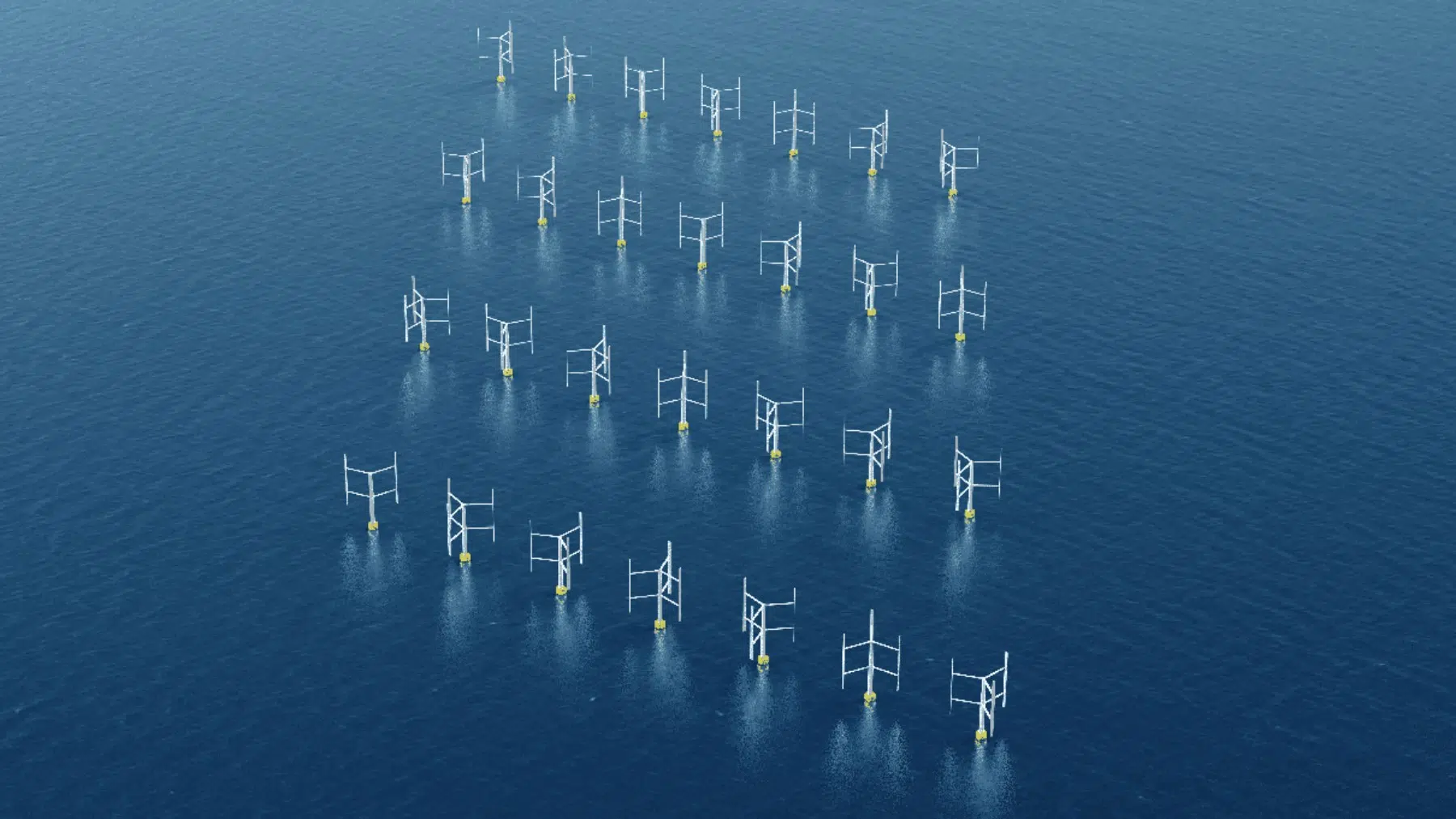
Oxford Brookes University recently published new research announcing their discovery of the benefits of Vertical Axis Wind Turbines (VAWTs) in comparison to Horizontal Axis Wind Turbines (HAWTs). The research team comprised individuals from the School of Engineering, Computing, and Mathematics (ECM) and was led by Professor Iakovos Tzanakis. The study utilized more than 11,500 hours of computer simulation, researching whether wind farms can perform more efficiently by substituting the traditional HAWT propeller type for compact VAWTs.
Their results determined that VAWTs were much more adequate in large-scale, offshore wind farms than HAWTs. VAWTs have an axis that spins vertically to the ground. When set in pairs in a grid formation, they enhance each other’s performance by up to 15%.
Vertical versus horizontal axis wind turbines
Naturally, all discoveries have benefits and downfalls. The most significant benefit of VAWTs is drawing wind from all directions without needing a yaw system. For those who don’t know, according to Wikipedia:
“The yaw system of wind turbines is the component responsible for the orientation of the wind turbine rotor towards the wind.”
According to Professor Tzanakis, their study proved that vertical-axis wind farm turbines can be designed to be much closer together, increasing their efficiency and ultimately lowering electricity costs. He believes that VAWTs can help accelerate the green transition of our energy systems in the long run, producing more clean and sustainable energy from renewable sources.
The biggest downfall of VAWTs is that they have much lower aerodynamic efficiency than HAWTs.
“In other words, the front row will convert about half the kinetic energy of the wind into electricity, whereas for the back row, that number is down to 25-30%. Each turbine costs more than £2 million/MW. As an engineer, it naturally occurred to me that there must be a more cost-effective way.” – Joachim Toftegaard Hansen, lead author of the report and Bachelor of Engineering graduate.
The verdict on the future of VAWTs as a renewable energy source
Not all experts agree with the research’s findings. Aerodynamics expert, Professor Jens Nørkær Sørensen, questions the scientific design basis of the Oxford Brookes research effort, the design set-up, and the results on which the conclusions were based.
“My objections concentrate on three main points. The first is about the use of a two-dimensional shape for the CFD flow model. Wind flow in a wind-farm array should, in my view, always be studied from a three-dimensional perspective because the mixing of fresh high-energy wind from the upper, outer layers with ‘depleted-energy’ wind flow inside the wind-farm boundaries is of key importance to continuously regenerate energy for generation in downstream turbine rows.” – Sørensen
This latest historic discovery might have been innovative, but we cannot deny nor confirm whether it will change the pursuit of harvesting wind power. More in-depth research and field studies will have to be conducted to prove that VAWTs are indeed more beneficial than HAWTs. Should VAWTs become a proven cost-effective substitute, it would certainly help make renewable energy more attainable. We guess only time will tell.
Read the whole thing?
Get the week's signal, not the noise
Our sharpest reporting on energy, climate and nature — free, once a week.