

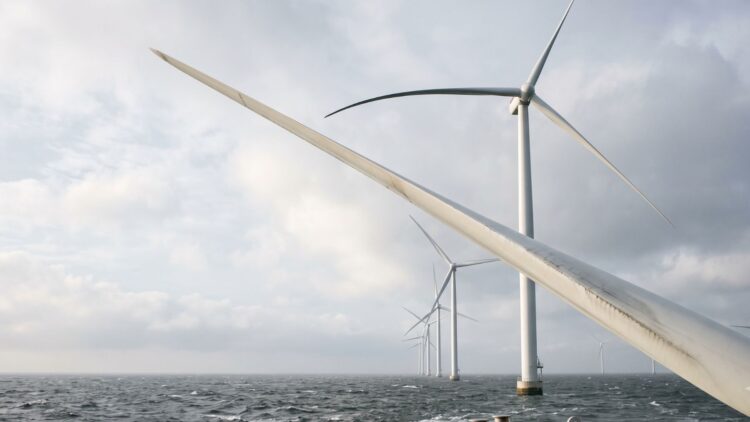
Wind turbines have become one of the great symbols of a clean future, tall, white and turning slowly on the horizon.
We were told they were clean, quiet and almost maintenance free, the kind of machine you build once and then mostly forget.
But hundreds of feet up, in a place where almost no one ever looks, a problem was spreading.
And when the answer to it finally arrived, it turned out to be stranger than the problem itself.
The promise that hid a problem
The picture is reassuring.
A turbine sits in a field or out at sea, spinning gently, making clean power and asking almost nothing in return.
The reality is far rougher, a relentless beating from ferocious winds, salt spray that eats at metal, and brutal swings between heat and cold.
Their sheer size makes them extraordinarily hard to check.
A modern blade can now run 100 to 150 meters long, longer than a passenger jet’s wing, hanging high in the air.
Inspecting every meter of that surface, across thousands of turbines, is a task of almost absurd scale.
And when something does go wrong, the bill is enormous, from lost power and downtime to, in the worst cases, a catastrophic collapse.
The comforting idea that a turbine is a build it and forget it machine was always a little bit of a myth.
The blind spot no one wanted to talk about
The hardest part to inspect is also the most important.
Tiny cracks tend to begin on the blades, invisible to the eye and hidden just beneath the surface.
Left alone they grow, and experts warn that much of this damage goes unnoticed until it becomes catastrophic.
For years, the only way to find those cracks was to send a human being up there.
That meant ropes, platforms and cranes, slow and genuinely dangerous work that usually forced operators to shut the turbine down for days at a time.
Out at sea, in the wind and the spray, it was harder and riskier still.
So the most critical checks of all were often the ones most likely to be put off.
The blind spot was never really about the technology, it was the plain problem of how on earth you reach the thing.
Then something started climbing into the sky
In January 2026, a Danish team pulled off something that had never been done before.
The startup Quali Drone, working with the energy company RWE and several partners, sent an autonomous drone to inspect an offshore wind turbine while it was still spinning.
No one climbed anything, and the turbine was never shut down.
Using artificial intelligence, thermal imaging and computer vision, the drone read the blade as it turned and picked out damage on the surface and hidden fractures beneath it.
Built in a laboratory at the Technical University of Denmark, its AI learns from every new inspection and gets sharper each time.
These systems can spot the microcracks and erosion that no human eye would reliably catch.
It can shrink a job that once took days down to hours, and it was the first time anyone had managed this offshore, on a working turbine at the Rodsand 2 wind farm.
The thing keeping watch over the machine, it turned out, was another machine.
Why this matters most far out at sea
The timing is no accident.
Wind farms are growing larger and pushing further out into the ocean, where access is hardest and the stakes are highest.
A single turbine failure at sea can swallow millions in lost power and repairs.
A small flaw caught early is a quick repair, while the same crack found too late can cost a fortune.
Autonomous drones can work in remote, punishing places and in rough weather, catching small flaws long before they become disasters.
They turn maintenance from a frantic reaction into steady prediction.
Operators that once gambled on a turbine holding together between rare inspections can now keep an almost constant eye on every blade.
The machines now watching the machines
What began as a single test is fast becoming an industry.
One company, SkySpecs, says it has now inspected and analyzed more than 33,000 wind turbine blades with fully automated drones.
At one offshore wind farm, its drones checked 25 turbines in a single day, work that used to take a rope team a full day for just one.
Rivals like Aerones and Perceptual Robotics are racing in, and this kind of inspection was already worth over 400 million dollars in 2025, on track to more than double within a decade.
The Danish flight itself grew out of a multi year research project backed by universities and major energy firms betting this is the future.
Most of these systems still slow or stop the giant blades to get a clean look, which is exactly why the Danish test on a spinning turbine points to where all of this is heading.
As the machines that power our world grow ever larger, we are slowly handing their care to other machines, robots watching over robots, hundreds of feet above the waves.
The future of wind may not be settled by slogans at all, but by tireless drones climbing into the sky again and again to keep the giants turning.