
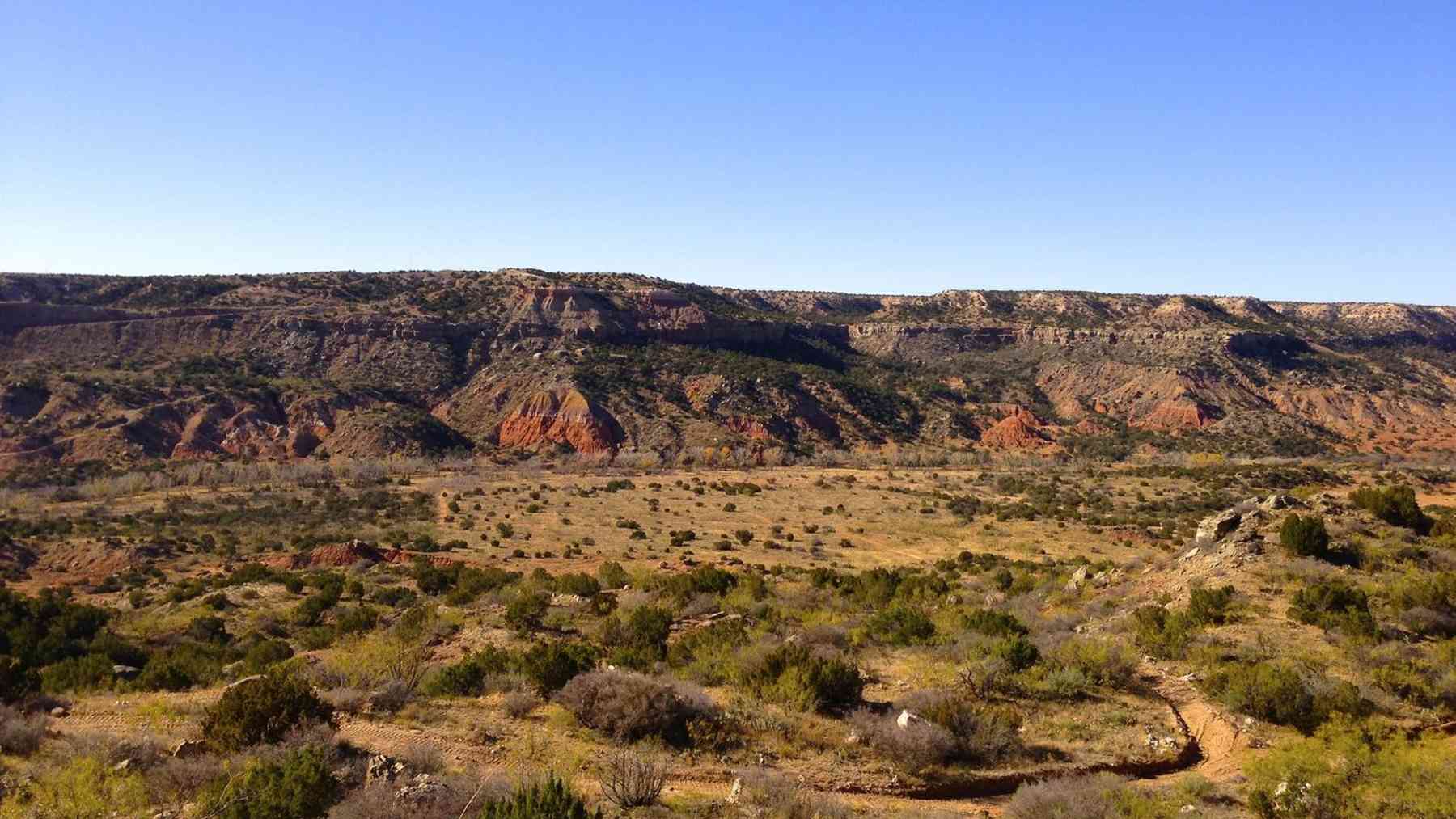
Short grass, mesquite, and then the ground simply stops and drops away in red bands.
The canyon below is the second largest in the country and most of it is a state park.
The land at the top edge is not. It is private, and it has been since the late 1940s.
Every summer thousands of people sit in an amphitheater down there and look up at this ridge.
Nothing they see has ever been protected.
As of this year, it now is.
What actually leaves the deed
Land ownership is a bundle of separate rights, and the right to subdivide and build is only one of them.
A conservation easement pulls that one right out of the bundle and extinguishes it permanently.
Everything else stays with the family. They keep the title, keep running cattle, and can sell the place tomorrow.
What no future owner can do is cut it into parcels and put houses along the rim.
The restriction is recorded against the land rather than against the person, so it travels through every sale and every inheritance.
In exchange the owner is paid for the value given up, and a land trust takes on a permanent duty to monitor it.
What one family decided about a skyline
A couple bought the ranch in the late 1940s, and their descendants have held it through every cycle since.
Three generations is long enough that selling would have been ordinary rather than shocking.
The daughter of the original owners is 98 years old and describes the outcome as meaning everything to her.
That framing matters because the alternative was not abstract. Rim frontage above a famous canyon is exactly the ground a developer wants.
An easement is also a working ranch decision rather than a retirement from ranching.
Grazing continues, fences continue, and the cattle operation that has run for three generations goes on running.
The family gave up a sale option and kept the business.
The acreage and the money behind it
The first easement closed on 1,725 acres, and a second of 1,323 acres was expected to follow before the end of the year.
Together they come to 3,048 acres, which is a little under 5 square miles along the rim.
The land is a mix of tallgrass and shortgrass prairie, mesquite grassland, shrubland, a playa lake and canyonland.
None of that is spectacular on its own. Together it is the habitat the park boundary happens to cut through.
That mix is why the funding came from two directions at once, one agricultural and one focused on buffering a state park.
The federal program pays for keeping working land working. The state side pays to keep development off the boundary of public land.
Neither would have covered it alone, which is the usual pattern and the slow part.
What the view is actually worth
The amphitheater below has staged the same outdoor musical for close to 60 years, with the canyon wall standing behind the stage as its backdrop.
A ridge line of houses behind that wall would not damage the park, and it would change the thing people come to see.
Viewshed is a soft word for a hard asset here, because a park’s value depends on what is visible from inside it as much as on what it owns.
The habitat argument is separate and stands on its own. The ground supports grassland birds including a species listed as a conservation priority.
Grassland is the least protected major habitat in North America and the easiest to convert, which is what makes private acreage the decisive part.
Public land alone cannot hold a landscape, and the trust account is direct about that.
Land can also be reused rather than built on, as when a French marsh cemetery took 5,000 panels instead of new ground.
What this does not settle
Permanence is a strong word and here it is literally true, which also means the monitoring burden never ends.
Somebody has to walk that fence line in fifty years and check that nothing has been built.
An easement is cheaper than buying land outright and it leaves a working ranch working, which matters because an empty preserve still has to be paid for.
It also depends on a land trust surviving as long as the land does, and that is an institutional bet rather than a legal one.
Development pressure moves around rather than disappearing, and the sector coverage is clear that the next ridge is unprotected.
And a structure can move when the ground matters more, which is what crews did with a frame house on a Gettysburg lot.
Here nothing moves at all, and that is exactly the point.


