
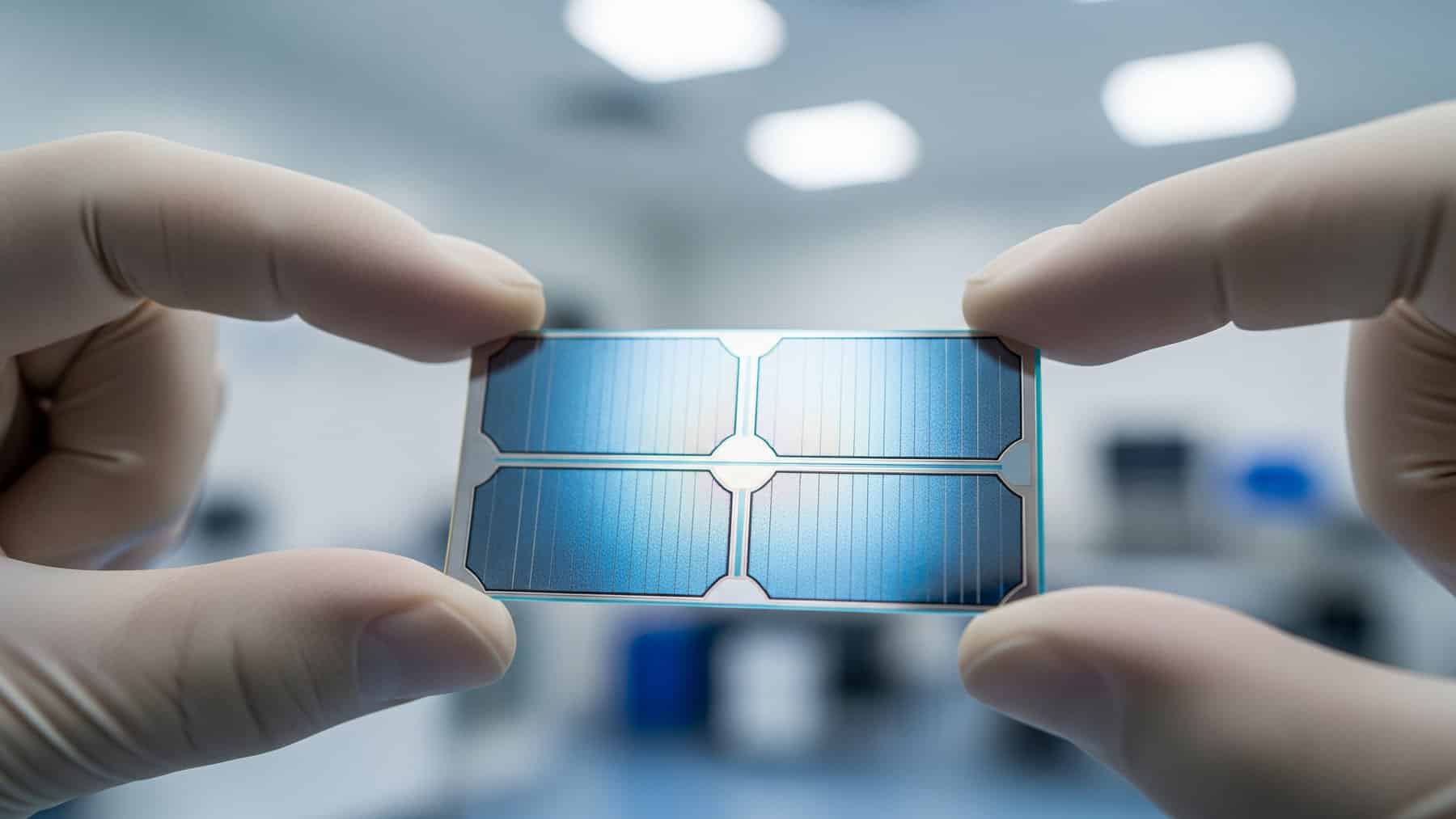
There is a number stamped into nearly every solar panel sitting on an American rooftop right now, and almost nobody thinks to question it.
It is the efficiency rating, the share of sunlight the panel actually converts to electricity, and for years it barely moved.
Something just happened in a laboratory that changes everything, and the physics behind it is stranger than most people expect.
The number every panel buyer sees but almost nobody understands
Walk into a solar showroom today and the panels lining the wall will advertise efficiencies somewhere between 20 and 23 percent.
That means for every 100 watts of sunlight hitting the glass, roughly 77 to 80 watts escape as heat, reflection or wasted energy the cell simply cannot use.
That is not a manufacturing flaw.
It is physics, baked into silicon itself by a rule called the Shockley-Queisser limit.
The limit says a single layer of silicon can only ever convert so much light before the rest becomes irretrievable.
For decades, engineers treated that ceiling as almost permanent.
Then researchers started stacking two materials on top of each other, and the ceiling cracked.
Why silicon alone was always fighting with one hand tied
Sunlight arrives in a range of wavelengths, from deep infrared to near ultraviolet.
A silicon cell is tuned to one band in the middle, and the energy in every photon outside that band is wasted.
Think of it like a radio that can only receive one station while dozens of others are broadcasting at full strength.
The tandem idea is simple in principle and fiendishly hard in practice.
Engineers stack a second material, a crystalline compound called perovskite, on top of silicon.
Perovskite is tuned to the wavelengths silicon misses, so together the two layers catch far more of the spectrum.
The theoretical ceiling for this two layer structure sits at 43 percent, a number that once looked almost unreachable.
Then one laboratory started closing that gap at a pace that stunned the industry.
A race where the record kept breaking before the ink dried
In November 2023, Chinese manufacturer LONGi hit 33.9 percent efficiency on a tandem cell, already past the old single silicon wall.
The team lifted that mark to 34.6 percent by June 2024, then kept pushing.
Each new number made it into the most watched efficiency table in the photovoltaics world, compiled by an international team led by Professor Martin Green at the University of New South Wales.
The 34.85 percent record, validated by NREL in April 2025, surpassed the Shockley-Queisser limit for a single junction silicon cell.
That alone was a landmark.
LONGi announced a power conversion efficiency of 35.5 percent for a two terminal crystalline silicon perovskite tandem solar cell on July 14, 2026, independently certified by the European Solar Test Installation, part of the European Commission’s Joint Research Centre in Italy.
The gap to that 43 percent theoretical ceiling is closing fast.
What 35.5 percent actually means for solar cell efficiency records and US rooftops
The cell that just broke the record is a laboratory device, not a product you can order today.
LONGi did not disclose the active area or detailed electrical characteristics, and the reported figure refers to a certified laboratory device rather than a commercial module.
But that gap between lab and rooftop is exactly how every efficiency leap in solar history has started.
One company, Oxford PV, pioneered the path from laboratory to market: in September 2024 it shipped the first commercial perovskite tandem panels, rated at 24.5 percent, to an undisclosed US company for a utility scale project.
That was the first commercial deployment of the technology worldwide.
Engineers track these solar milestones closely because each percentage point carries a real dollar value, and the lab to market pipeline is already moving.
The honest catch, and why the next few years matter more than today
Perovskite has one well known complication the industry is still working to solve.
Perovskite films contain lead, and regulatory barriers in the EU and some US states may slow residential adoption where hazardous materials rules are strict.
Durability outdoors over 25 years is also still being proven for tandem cells, while silicon’s track record is rock solid.
Any homeowner or developer weighing an early tandem product should ask hard questions about warranties and recycling commitments before signing.
The clean energy sector has enough friction already without adding uncertainty about the panels themselves.
Still, the direction of travel is clear.
The theoretical limit for crystalline silicon perovskite tandem cells stands at 43 percent, far above what single junction silicon can ever reach.
Every fraction of a percent the laboratory closes toward that ceiling will eventually land on a real roof, turning sunlight that once escaped as heat into electricity that actually works.
The panel you buy in ten years may look nearly identical to your neighbor’s today, but the number on the label will represent a different world entirely.


