
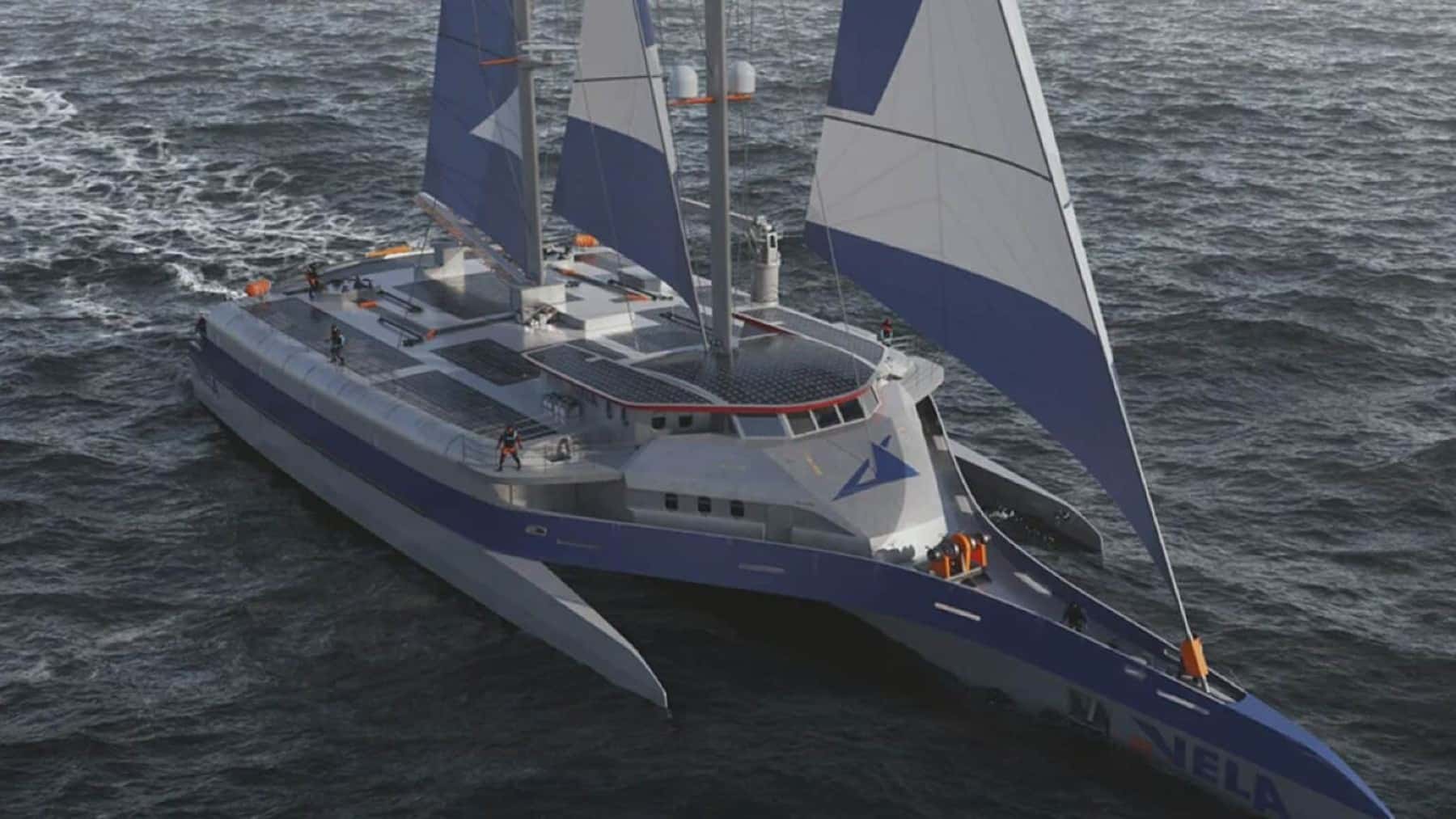
While we often talk about Ancient Egyptians, we rarely get a chance to marvel at what some Ancient Egyptians pioneered all those years ago. Japan may very well be sailing away in a futuristic ship, but this ship revisits the past and a 5,000-year-old energy source. Echoing Ancient Egyptian nostalgia, a highly sophisticated ship powered by the wind will transport medicine across the Atlantic. In doing so, the transition towards sustainable shipping is clear, and it is all thanks to Japan’s leading pharmaceutical company, Takeda, and its partnership with the French startup, Vela.
Understanding ancient winds in a modernised setting
Being set on transporting medical products by relying solely on wind power leads to the idea of zero carbon emissions. In aligning with this sustainable fuel solution, the original maritime fuel is being brought back to the 22nd century. The Ancient Egyptians can be thanked for this fuel source, as they were the first of civilisation to make use of the wind for transportation. Ancient Egyptians built riverboats with reed hulls and square sails that used northbound wind when sailing the Nile. Thanks to these sailboats, the Egyptians established their place in terms of trade and agriculture.
In today’s modern world, Japan is drawing inspiration from Ancient Egypt’s transportation methods and is introducing a ship much like those that the older Egyptians can be credited for. However, unlike sailboats from the past, a modernised trimaran has been created after being constructed with lightweight and aerodynamic materials that have advanced sail-rigging systems.
An entirely new type of cargo ship to transport medication
Yes, the boat, which is modernised and fast, drifts away from the fuel choice of many other shipping vessels. Fossil fuels are no longer relied upon. However, in keeping up with modern times, the trimaran is a three-hulled vessel meant to be efficient and fast. Moving away from the idea that cargo ships ought to be larger and slower, this is one fast ship that relies on the wind and will take about 15 days to cross the Atlantic.
Being a pharmaceutical company, the transportation of medicine was of core focus, so the CoolSafe refrigeration system was used to ensure that medication remains at a certain temperature during long commutes. This was key, especially when transporting medication that requires stricter climate control. Able to beat most traditional cargo routes, racing technology was revisited to maximise sail designs and to ensure efficient routing. The idea is to dock at secondary ports to ensure that waiting time is reduced and that congested terminals are not an issue.
Takeda’s zero emissions ambition is made clear with this shipping solution
Takeda’s Head of Global Distribution and Logistics, Xavier Baville, states that reactivating sailing cargo ship lines between Europe and the U.S. was exciting for all of Takeda’s team members. It is clear that Takeda is showcasing its net-zero ambitions by seeking to eliminate greenhouse gas. By relying on wind, this company is proving that the future of cargo vessels need not be set in stone.
It has yet to be seen if such a wind-powered cargo ship can become a scalable solution. Vela, however, remains confident that this wind-powered cargo ship will be best for transporting high-value cargo, including pharmaceuticals and electronics. With the rising fuel prices, perhaps it is best to rely on fuel resurrected from 3500 BCE, since this fuel may become a necessity in the near future.
Ancient Egyptians set the foundation for sustainability today
Boats that relied on the wind were created by the Ancient Egyptians more or less in 3000 BCE, and such riverboats with reed hulls and square sails allowed for travel towards the south. With sophisticated modernised engineering techniques and maritime principles, sailing the Atlantic using wind as a fuel source has been made a possibility by Japan’s Takeda and French startup, Vela. The foundation set by the Ancient Egyptians is still creating waves to date. Egypt’s pyramids are also making headlines for a first-of-its-kind form of energy in the pyramids.
Disclaimer: Our coverage of events affecting companies is purely informative and descriptive. Under no circumstances does it seek to promote an opinion or create a trend, nor can it be taken as investment advice or a recommendation of any kind.


