
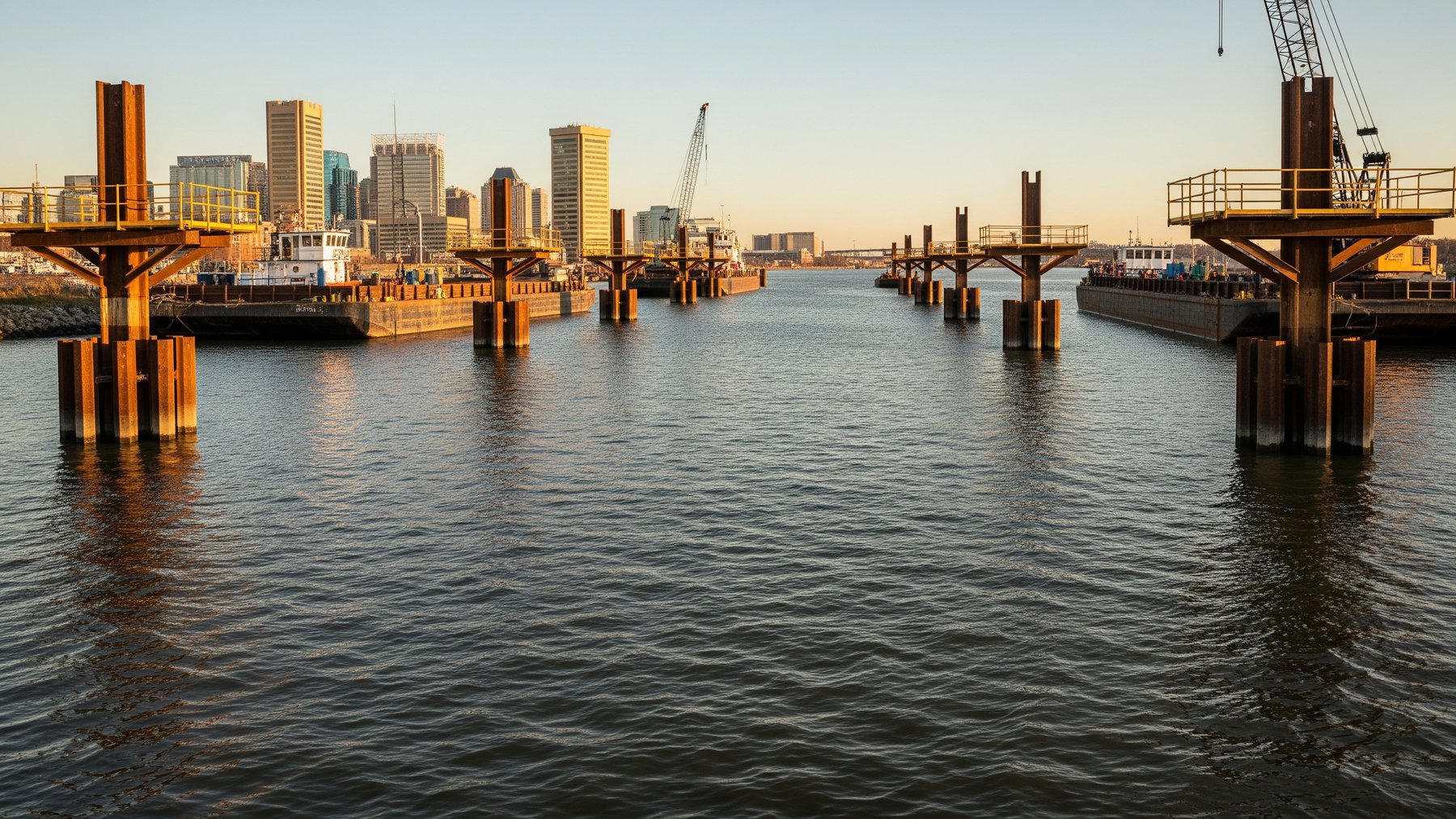
Foundation work is underway in Baltimore’s Patapsco River on the replacement for the Francis Scott Key Bridge, a new cable-stayed structure that will stretch 11,015 feet end to end and become Maryland’s first highway bridge of its type.
The Maryland Transportation Authority has set a target opening date of late 2030, with an estimated construction cost now pegged at between $4.3 billion and $5.2 billion, up from earlier projections.
A collapse that changed Baltimore overnight
The original Key Bridge, a 1.6-mile steel span, collapsed on March 26, 2024, after a container ship struck one of its piers.
The collapse killed six construction workers who were filling potholes when the structure fell.
Baltimore’s port was closed for months after the collapse, and increased traffic congestion has remained a problem for drivers across the region.
The original bridge, built between 1972 and 1977, carried Interstate 695 across the mouth of Baltimore’s harbor and allowed drivers to bypass the city entirely.
The MDTA has acknowledged the financial strain the loss placed on businesses and commuters across the state.
What the new cable-stayed design looks like
Unveiled by Governor Moore on February 4, 2025, the replacement is Maryland’s first cable-stayed highway bridge, eclipsing the original steel truss design in both scale and safety.
Stretching 11,015 feet, the structure features a 1,665-foot main span with 144 cables distributing weight evenly, flanked by marine and land approach spans.
Two towers each standing more than 600 feet tall will support the main span, founded on 45 steel piles more than 200 feet long and 8 feet in diameter, with 20-foot thick footings.
The bridge will carry four 12-foot travel lanes and 10-foot outside shoulders, with a minimum vertical clearance of 230 feet over the 800-foot federally authorized Fort McHenry Navigation Channel.
That clearance exceeds what the original bridge offered, a deliberate design choice to reduce the risk of a repeat ship strike.
How fast engineers are moving on design
Kiewit Infrastructure Co. won the contract in August 2024 and received notice to proceed on September 16, 2024.
In March 2025, Kiewit conducted the first of two phases of wind tunnel testing on the proposed design to evaluate aerodynamic behavior under high wind conditions.
In late November 2025, Kiewit submitted plans to MDTA for review at a 70 percent level of design completion.
MDTA chief engineer Jim Harkness noted that reaching the 70 percent milestone on a structure more than two miles long in only 14 months is a pace that “can take five to seven years on average.”
On August 14, 2025, crews began procurement of material for a temporary work trestle, a road built on pilings that lets equipment and concrete reach foundation sites over open water.
The cost picture and what drives it higher
In November 2025, MDTA said the updated estimated cost would run between $4.3 billion and $5.2 billion, more than initially projected.
The wide range reflects how much is still being finalized in a project of this complexity.
Cable-stayed bridges are concrete intensive structures, and material costs on major civil projects have been volatile across the industry in recent years.
Labor availability and long lead procurement items continue to disrupt large projects, requiring proactive planning by contractors and owners alike.
Foundation piling and specialized cable assemblies for a span this size must be ordered far in advance, locking in prices before conditions change.
MDTA officials say they expect a clearer cost estimate as design work nears completion in the coming months.
What the bridge means for Baltimore and the wider region
The United States is in the middle of the largest bridge construction and rehabilitation cycle in a generation, with the Federal Highway Administration classifying tens of thousands of bridges as structurally deficient in recent reporting cycles.
Baltimore’s project stands apart because it is not a routine repair but a full replacement of a critical interstate link after a sudden, catastrophic loss.
As of early 2026, demolition of the original structure is complete and foundation work is advancing, moving to restore the I-695 beltway bypass for travelers who currently use Baltimore’s tunnels or city streets.
Every day the bridge is absent, tens of thousands of drivers and freight trucks take longer, costlier routes around the harbor.
The Port of Baltimore, one of the busiest on the East Coast for vehicle imports, also depends on clear channel access that the new higher clearance will help protect.
Kiewit and MDTA hit a major design milestone in roughly a year, a timeline engineers say could inform how future emergency replacements are procured on other structurally critical US bridges.
The design is not yet finalized and cost pressures remain real, but the foundation work now advancing in the Patapsco River marks a firm commitment: Baltimore’s harbor will have its bridge back before the decade is out.


