
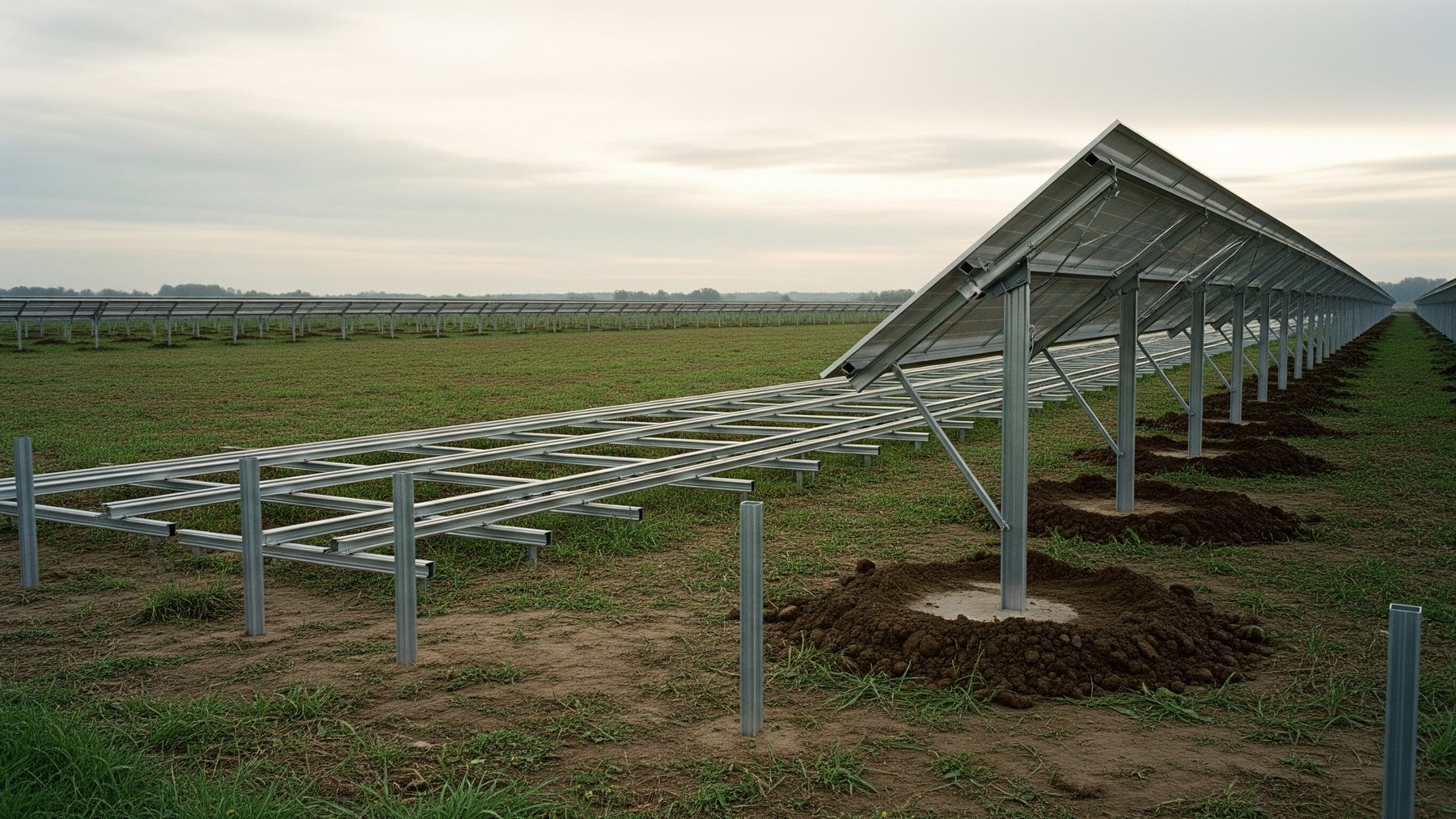
Major construction is underway on the Cider Solar Farm in Genesee County, New York, a 500 MW photovoltaic project that will become the state’s largest solar farm when it enters service.
Developer Greenbacker Renewable Energy Company announced the start of full construction activities in May 2025, with completion targeted for late 2026 and commercial operations expected by year end.
What the project is and where it sits
The 500 MW photovoltaic project spans approximately 2,500 acres near the towns of Elba and Oakfield in Genesee County.
Genesee County sits roughly 35 miles west of Rochester in western New York, a largely agricultural region known for its flat, open fields.
With a capacity of 674 MWdc and 500 MWac, Cider will be the largest solar project in New York State.
Cider was the first renewable energy project of its kind to receive a siting permit from the state’s Office of Renewable Energy Siting and Transmission under Section 94-c rules.
Section 94-c is New York’s fast track permitting law for renewable energy projects larger than 25 MW, passed in 2020 to speed up approvals.
Greenbacker assumed long term ownership and operational control after acquiring the project from Hecate Energy LLC, a US renewable power and energy storage developer.
How it will be built and what goes into it
Cider’s initial construction phase focuses on civil and mechanical activities like placement of steel piling and racking for the solar modules.
The plant will include 955,724 Canadian Solar modules mounted on Array Technologies trackers, with 134 Sungrow inverters.
Array Technologies trackers are single axis systems that rotate panels throughout the day to follow the sun, squeezing more electricity from the same number of panels.
The financing package comprises a $418 million tax equity bridge loan, a $373 million construction to term loan, and $79 million in letters of credit.
Together those instruments make up the nearly $950 million total that Greenbacker secured to acquire and build the farm.
“Our union is pleased to provide local, highly skilled labor supporting Cider’s construction,” said Carpenter’s Local 276 Business Manager Chris Austin.
Power output and what it means for New York households
Once it enters commercial operation, Cider is expected to supply about one million megawatt hours of renewable electricity per year.
That output is enough to power approximately 120,000 households, roughly every home in Genesee County and several neighboring counties combined.
The project is also expected to deliver more than $100 million in revenue for Genesee County communities through property taxes, host agreements, and tax benefits.
New York has set a goal of 70 percent renewable electricity by 2030, and utility scale solar farms in the Northeast are a central part of meeting that target.
The project was named the 2024 North American Solar Deal of the Year by Proximo Infra, an award that honors innovative financing including one of the market’s earliest tax credit transfer bridge loans.
Agrivoltaics plan and land use
Cider will not be a fence to fence wall of panels.
An agrivoltaic integration plan is in development, and Hecate intends to set aside roughly 300 acres for dual use agricultural purposes including sheep grazing.
The project has potential to host over 1,000 acres of rotational grazing over its operational lifetime.
Agrivoltaics means running farming operations beneath or between solar panels on the same land, a practice gaining ground across the US as a way to ease land use tensions.
Similar dual use approaches have shown ecological benefits at other solar sites, though the science of best stocking densities and crop mixes for different soil types is still early.
Keeping 300 or more acres in active agricultural use may also help the project maintain goodwill with neighboring farmers and local officials in a region where farmland protection carries real political weight.
Timeline, costs and what to watch
Early site work began in late 2024, major construction started in May 2025, and completion is expected in late 2026 with commercial operations by year end.
That schedule leaves roughly 18 months of active construction remaining as of mid-2025, a tight window for a project of this scale.
Supply chain pressures and grid interconnection queues remain live risks for large solar projects across the country, and Greenbacker has not published a detailed contingency schedule.
The $950 million price tag makes Cider one of the costlier solar projects under active construction in the Northeast, though the per watt figure is broadly in line with utility scale builds that include significant land acquisition and transmission work.
Greenbacker is an investment manager as well as a power producer, meaning long term ownership is baked into its business model rather than a quick sell after commissioning.
Dan de Boer, Greenbacker’s interim CEO, said the project “represents an important milestone in New York’s clean energy transition that will power the state forward for years to come.”
Whether the farm comes in on budget and on schedule will be the clearest test of that ambition, and the industry will be watching Genesee County closely as 2026 approaches.


