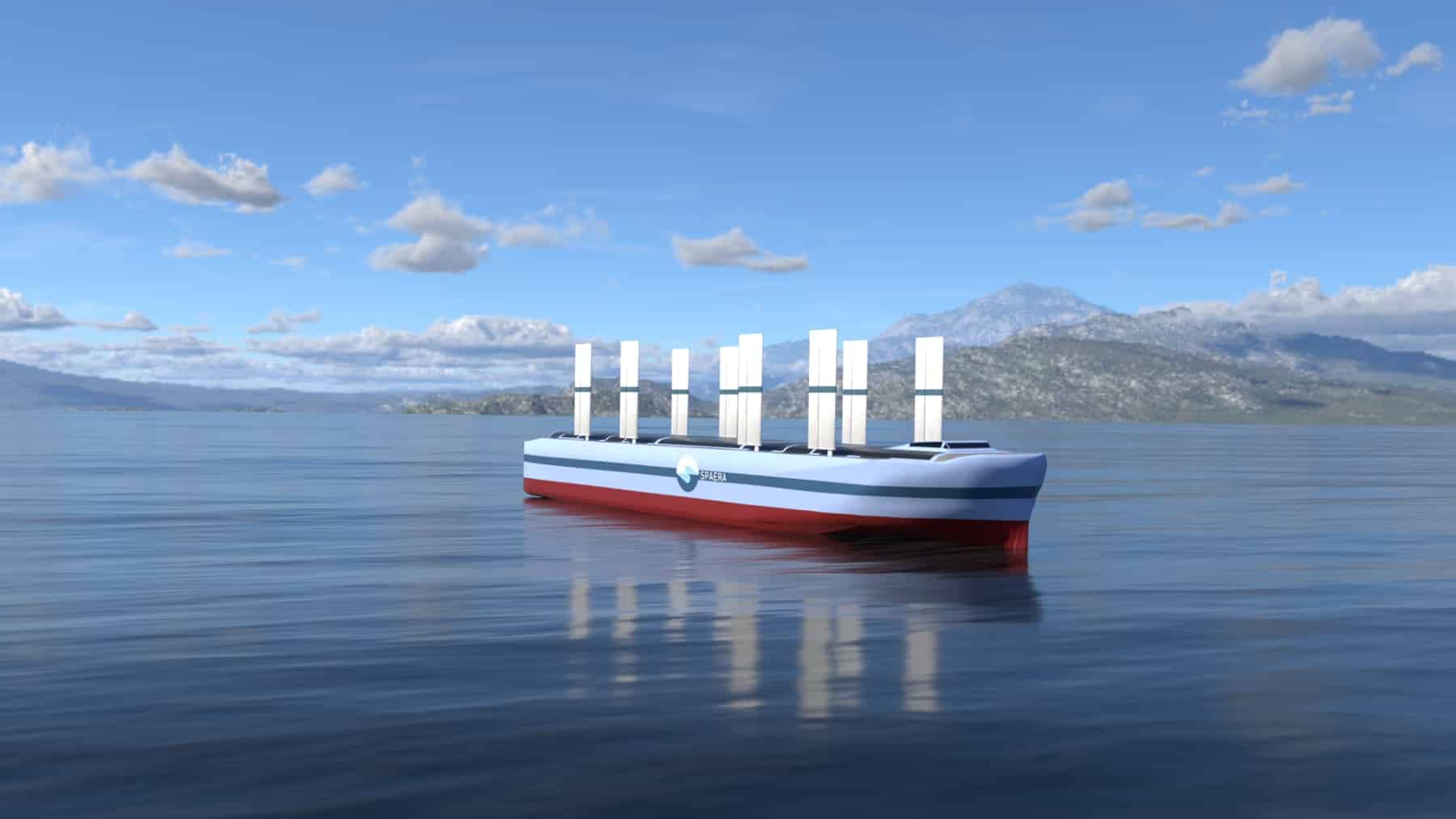
Project Lovelock is a groundbreaking prototype vessel created by UK maritime technology company Spaera, which can achieve zero emissions by offering new wind propulsion technology for cargo ships. The London-based company unites carbon-free fuels with highly efficient aerodynamics, green methanol fuel cells, and renewable energy sources to develop commercially viable replacements for fossil-fuelled ships. Their vision is ambitious and aims at matching the conventional operation costs in the traditional vessels without affecting the environment at all.
Revolutionary wind propulsion technology transforms maritime logistics
Spaera’s Wind Propulsion Technology is a total re-conceptualisation of sail-driven cargo transport that uses optimised aerodynamics that are completely unaffected by the weather conditions. Under effective conditions, the system can also cover up to 100% of the necessary propulsive power, and the automatic operation can reduce the burden on the crew and the costs of maintenance greatly.
The company’s aerodynamic force allows its ships to turn adverse weather conditions into opportunities, not problems, making a fundamental shift in the way ships deal with environmental forces. The conventional methods of shipping consider storms as a shipping delay, yet the Spaera technology transforms the tough weather into propulsive chances by the use of advanced sail design and controlling technological systems.
Key Wind Power Advantages:
- The most powerful wind propulsion technology available today
- Full Propulsive Power capability under certain conditions
- Automatic working limits crew requirements
- Adverse weather means operational advantage.
Green methanol fuel cells eliminate emissions completely
Spaera applies fuel cell technology to extract the hydrogen from green methanol and significantly minimize harmful emissions to near zero, in comparison to traditional marine engines. Any remaining emissions are scrubbed or stored, or recycled to provide a completely neutral system that enjoys cost parity with heavy fuel oil.
Hydrodynamic efficiency improvements maximize renewable energy impact
The Company’s vessel efficiency philosophy offers higher percentages of forward speed during wind-propelled motion and lower on-board power generation. Aerodynamics is one of the two areas of influence, the other being hydrodynamics, and together they can account for more than 20% of efficiency improvements; both are important players in overall performance optimization.
Evolution of shipping has historically focused on bigger vessels featuring greater capacity and lower energy efficiency, to battle against higher fuel prices. Rather than simply growing larger in capacity for cargo, Spaera provides a solution for vessels of all sizes to compete effectively by maximizing vessel efficiency.
“We want to have a cost of operation that is equivalent or inferior to fossil fuels at current prices, and possess a significant incremental cost advantage when the full impact of emissions is taken into consideration.”
The benefits of efficiency are:
- Hydrodynamic benefits: 20%+ productivity benefits.
- Aerodynamic optimization leads to greatly reduced drag.
- Operational costs that are directly related to vessel efficiency
- All vessel scales are effective competitive controls.
Solar and battery systems provide auxiliary power
Solar panels and battery packs work as energy buffers between different renewable sources and maximize the performance of individual components while providing the availability of auxiliary power. When ships are idle at port, deck-mounted solar panels generate enough energy for all ships’ auxiliary systems without having to connect to any external power connections.
The Project Lovelock by Spaera is an example of a paradigm shift in terms of maritime transportation, and it shows that eco-friendly operations and commercial profitability could be in harmony. The power of free wind, green methanol fuel cells, and vessel optimization is coming together to build a sustainable future for the shipping of cargo around the world. This is innovative, because it shows that zero emissions is one of the possible ways ahead for the maritime industry without compromising on operational efficiency or profitability.
Disclaimer: Our coverage of events affecting companies is purely informative and descriptive. Under no circumstances does it seek to promote an opinion or create a trend, nor can it be taken as investment advice or a recommendation of any kind.