
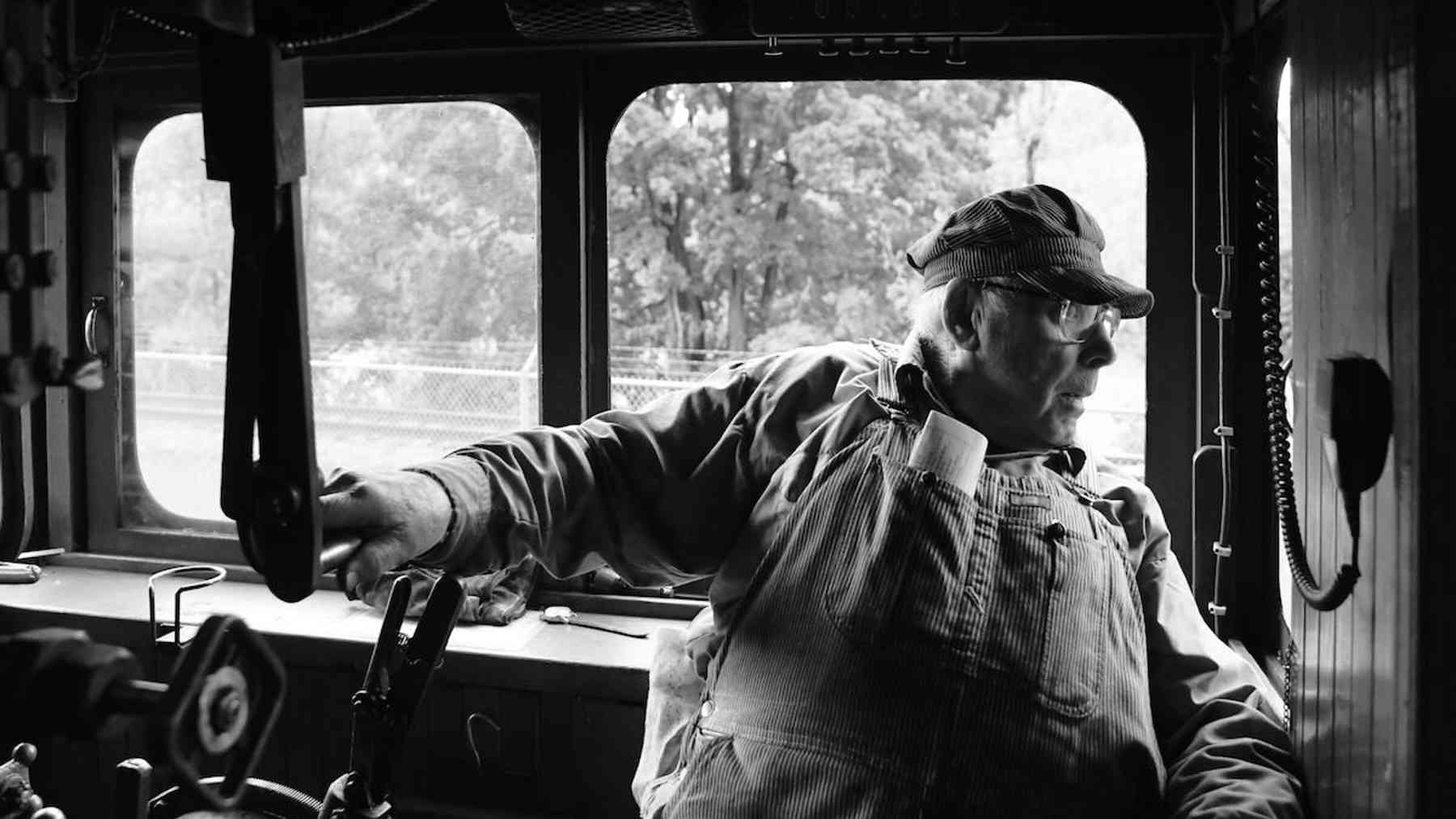
Just before seven on a Sunday evening in late August, a man climbed down from a steam locomotive cab in Phillipsburg, New Jersey, for the last time.
He was 89 years old.
He had been running steam for exactly 60 years, on heritage railroads across the northeast. Almost all of it was volunteer work.
That day he ran four trips along the old Pennsylvania Railroad line beside the Delaware River, just under 70 miles in all.
His federal engineer’s license expired that evening. He chose not to renew it. How does a single form with a date on it close a 60 year career?
The single piece of paper that governs a cab
Running a steam locomotive in the United States is not a romantic exception to modern bureaucracy. Anyone at the throttle must hold a current locomotive engineer certificate issued under federal rules, and that certificate carries an expiry date the way a pilot’s medical does. When Don Young decided he would not sit for the renewal, he was not quitting so much as letting a clock run out.
The mechanism that ended his career was not age, not infirmity, not a safety board. It was a form with a date on it. That is the quiet machinery behind heritage railroading that most passengers on the platform never see.
Federal oversight reaches into every cab on every excursion line in the country, volunteer run or otherwise. The engineer who waves from the window has passed a knowledge examination and a skills evaluation, and has to be recertified at intervals no longer than 36 months. So the number that really marks Young’s career is not the years or the age. It is the count of renewals he sat for and cleared, one after another.
What the locomotive and the man had in common
The engine Young drove on that last day was No. 142, a Chinese built 2-8-2 Mikado from the Tangshan works, delivered new to a Connecticut tourist line before passing to a historical society that now runs excursion trains out of Phillipsburg. The train carries paying passengers south along the river to Riegelsville, where a Roebling suspension bridge crosses to the Pennsylvania bank.
The locomotive itself runs on its own federal clock. Federal rules require a full boiler inspection after every 1,472 service days or 15 years, whichever comes first, and that requirement pulled No. 142 out of service for years. A boiler under pressure is one of the most consequential pieces of equipment a heritage railroad owns, because the failure mode is severe and the warning signs hide inside metal that looks sound from the outside.
Young worked the overhaul as well as the running, volunteering in the railroad’s shop while the engine was apart. No. 142 came back, and he ran it on many Sundays until that last one. Both had cleared their reviews.
Sixty years, several railroads, one kind of machine
Young’s first day running steam came in 1965 as a volunteer on Pennsylvania’s Wanamaker, Kempton & Southern, where he went on to run three small locomotives over the following decades. Later came a long volunteer tenure at Steamtown in Scranton, where he fired and ran the locomotives that operation has steamed this century, before he joined the Delaware River outfit.
No. 142 itself rolled out of the Tangshan Locomotive and Rolling Stock Works in 1989, which makes the machine about half a century younger than the man at its throttle. On his last day, Young put in a full shift as a volunteer steam engineer exactly 60 years after his first.
When he climbed down after putting No. 142 away in the shop a few minutes before 7 p.m., he was looking ahead to riding the rails as a passenger, with no more early alarms. After 60 years, that was enough.
The rules that make the cab possible
What kept Young in the seat for six decades was not nostalgia alone. He joined the Delaware River operation in 2009 and fired and ran No. 142 until the locomotive went down for its required inspection in 2017. He stayed through the maintenance years, not just the running ones, and that willingness is what heritage operations depend on. Trains magazine noted that Young called his years with the railroad “a wonderful experience.”
The rules governing who climbs into a cab echo across every professional transport context. Harbor pilots boarding moving ships face their own version of the same logic, and a new global standard for pilot boarding ladders was adopted because the moment of transfer is where outdated rules cost people most. In both worlds, the paperwork sets the terms. The boarding is what matters.
At 89, Young decided not to renew. The decision was entirely his. No regulator pulled him from the cab; the rule set a date, and he let it arrive.
What gets passed on and what stays in the cab
Heritage railroads run on knowledge that cannot be downloaded. The feel of a throttle opening on a grade, the sound a boiler makes when pressure climbs too fast, the way a firebox needs nursing on a cold morning: none of that lives in a manual. It lives in the people who have done it long enough to forget they know it.
Young grew up in Baltimore chasing steam trains on his bicycle when they were still working machines. He served in Navy submarines, took a degree in metallurgical engineering and spent his working life in the steel industry, and he kept finding his way back to the cab.
The arc from boyhood enthusiasm to federal licensee spans 60 years of Sundays. Heritage operations depend entirely on the chain holding, and when a licensee steps down, the knowledge they carry does not automatically transfer to the next person who wants to try. Someone has to take the exams, log the hours and sit for the renewal. The locomotive will be there next spring, warm and ready, but whether the cab has someone who knows what to do with it is a question every small railroad answers one person at a time.


