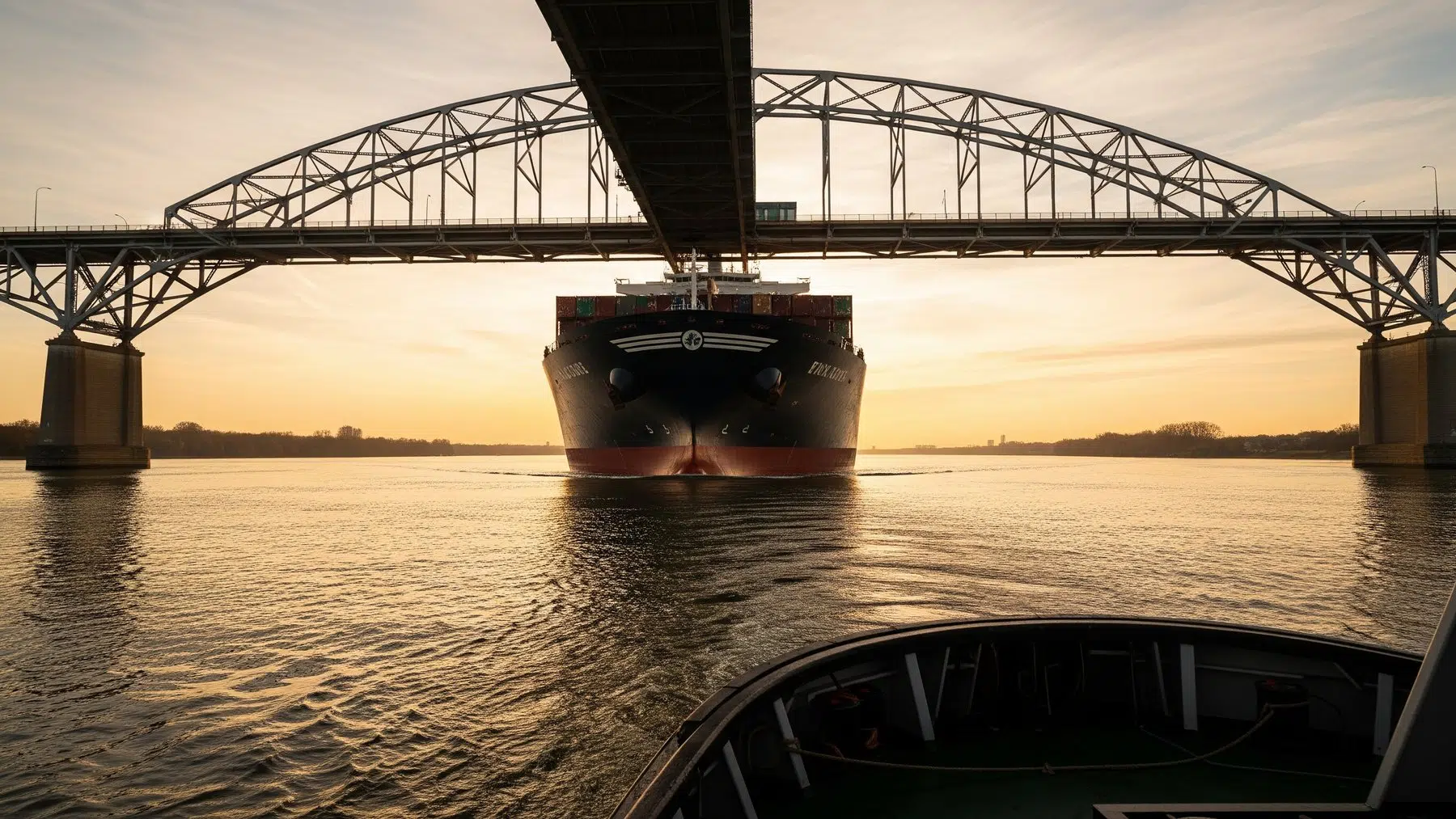
Picture a vessel as long as three football fields sliding beneath a steel cantilever bridge with less space above its hull than the height of a refrigerator. That is not a near-miss. On the Columbia River in the Pacific Northwest, that is Tuesday morning. What most people never think about is how that gap is not fixed, it is alive, changing by the hour, shaped by forces that have nothing to do with the ship or the bridge, and everything to do with the river itself.
The bridge that was built for a different world
The Lewis and Clark Bridge at Longview, Washington, opened in 1930. At the time, it made perfect sense: the ships using the Columbia River were modest, and the clearance beneath the cantilever span felt generous enough.
When the bridge was completed, Congress had stipulated a channel width of a thousand feet and a vertical clearance of 195 feet at mid-span to accommodate tall-masted clipper ships. Nearly a century later vessel size has grown far faster than either specification anticipated.
Ships have roughly doubled in size since the modern shipping channel was first put into use, pushing further every decade. Their length, beam and draft have all grown, which means they carry dramatically more momentum than the bridge was ever designed to withstand.
The river is not a road, it moves
Here is the part that surprises people. The gap between the bottom of a bridge and the top of a ship is not a single fixed number printed on a chart. It shifts every single day.
When a river rises after heavy rain or snowmelt in the Cascades, the water lifts toward the bridge deck, shrinking the clearance from above. When temperatures drop at night, the river falls back, buying a few extra inches.
The Columbia carries salmon, migrating birds and seasonal floodwaters, all pulsing through it like a slow breath that raises and lowers the surface continuously. Pilots discovered that NOAA river level data for Longview can be off by up to one full foot, which on a ship that stands nearly as tall as the bridge is not a small error.
A ship that grows taller in the sun
The river is not the only thing that moves. The ship itself changes shape. Steel expands when it heats up in afternoon sun and contracts when temperatures fall overnight, meaning a vessel that cleared the bridge on a cold morning can sit fractionally taller by midday.
Then there is the cargo. As a loaded ship burns through its fuel on a long ocean crossing, it grows lighter, riding higher in the water. A vessel that descended the Columbia fully laden sits lower on the way in and rides higher, closer to the bridge, on the way out.
Pilots later discovered that several ships on the Columbia had actually been taller than reported, setting off an urgent push for better real-time measurement technology. The bridge had been clearing these vessels, barely, without anyone fully knowing it.
13.2 inches of air, and the science behind every inch
This is where the wonder lands. In 2022, a 1,041-foot cruise ship called the Celebrity Eclipse came within 4.1 feet of the bottom of the bridge as it headed to sea after repairs in Portland. Once pilots factored in inaccuracy in the river level data and bridge sag, that margin could have been as little as 13.2 inches.
Less than fourteen inches of air between a moving steel skyscraper and a 96-year-old cantilever bridge. The solution engineers are now pursuing is an air gap sensor, a device mounted under the bridge that measures the exact live distance between the bridge deck and the water surface in real time, feeding pilots a number they can actually trust.
Right now, pilots must calculate clearance margins with imprecise tools, threading a steel skyscraper under a steel cantilever span using memory, experience, tide tables and a river that has its own opinion about the matter.
The pilots who memorize a living river
Becoming a Columbia River pilot requires years of deep-water experience before even beginning additional years of training, tests and certifications on the river itself. The Columbia River Pilots guide ships from Astoria to ports along the river, and those who earn that license know every turn and every current.
That river system is also a heavy transport corridor unlike any highway, a living channel where salmon runs alter seasonal water levels, where osprey nest on the bridge’s own steel framework, and where Pacific tides push their influence approximately 145 miles inland to Bonneville Dam, adding yet another variable to the clearance equation.
The Columbia’s role as a working industrial waterway also means that bridge engineering along critical freight routes is under closer scrutiny than ever, as communities weigh the cost of aging infrastructure against the vessels that now dwarf everything it was built to accommodate.
Moving the federal navigation channel toward the center of the river could buy pilots about 8 feet of additional clearance because of the bridge’s cantilever arch shape, a meaningful gain when ships now surpass 1,000 feet long and push nearly 200 feet tall.
No single sensor or channel shift removes every risk from a 96-year-old bridge on a tidal river carrying the largest vessels in American history. But understanding the physics, the living river, the expanding steel, the shifting tide, is the first step toward the few extra feet that make all the difference.
Read the whole thing?
Get the week's signal, not the noise
Our sharpest reporting on energy, climate and nature — free, once a week.