Every summer road trip, they’re up there.
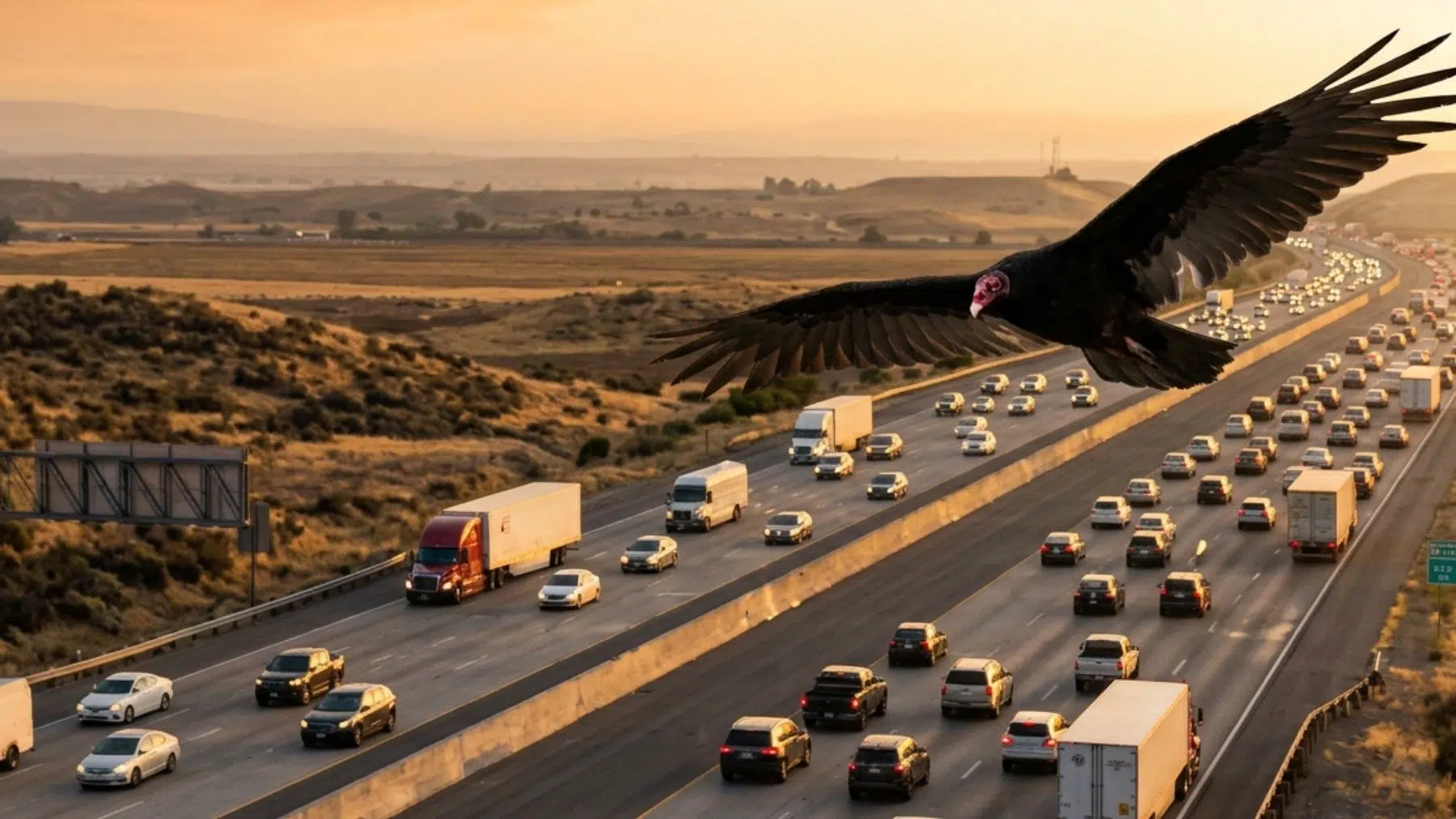
Big, dark, barely flapping, riding a thermal above the highway median while the cars below barrel past at 75 miles an hour.
Most people glance up, maybe shudder a little, and drive on.
But that bird overhead is not just a roadside curiosity.
It is running one of the largest free public services in the country, and almost nobody has put a dollar sign on it until now.
The bird everyone ignores
The turkey vulture is easy to dismiss.
Its bald red head looks almost prehistoric.
It circles things that are already dead.
It is not a hawk, not an eagle, not the kind of bird that ends up on a national symbol or a wildlife refuge brochure.
Yet roughly 13 million turkey vultures range across North and South America, making them one of the most abundant large birds on the continent.
They show up in farm fields, suburban edges, interstate corridors and national parks, doing it without being fed, managed, subsidized or thanked.
On a hot August afternoon, a single bird can spend six hours aloft without a single wingbeat, covering dozens of miles of roadside in a long, unhurried arc.
In winter they gather in communal roosts, sometimes hundreds strong, perched in bare trees above small towns that have no idea what service is resting overhead.
The highway never sends them a check.
What happens the moment something dies on the road
A deer clips a bumper at dusk and drops in the grass along the shoulder.
By morning, a turkey vulture has found it.
What happens inside that bird is extraordinary.
The turkey vulture’s stomach acid is so corrosive it can dissolve bone and neutralize dangerous pathogens that would sicken almost any other animal.
Its digestive system destroys microbes including anthrax, tuberculosis and rabies, making it nature’s frontline in disease prevention.
The carcass that could have drawn flies, rats and spreading bacteria for days is gone by noon.
No truck, no fuel, no landfill, no invoice.
In a single county on a single summer weekend, dozens of deer, raccoons and opossums may fall along roadsides, and the vultures work through them all before a sanitation crew ever gets the call.
The diseases that never spread
The math gets serious when you scale this across a continent.
Every deer, every possum, every steer that dies in an open field is a potential disease node.
Cattle ranchers have documented significantly higher disease rates in herds when turkey vulture populations decline.
Intact vulture populations provide a free, natural disease barrier for farmers across the entire American interior.
A study in Spain found that replacing the carcass disposal service provided by vultures there with vehicle transport would result in an additional $50 million of payments to insurance companies each year.
That is one country, one study, one slice of the real number.
The scale of the benefit grows considerably when extended across the full range of scavenging birds in the Americas.
Greenhouse gas emissions from decomposing carcasses also drop substantially when vultures are present, an environmental dividend that researchers are only beginning to measure.
Even local water quality benefits, because carcasses left near streams can leach bacteria into drinking sources that communities downstream never trace back to a single dead animal on a county road.
The $700 million bird on the highway
Here is the figure that stops economists mid-sentence.
The global population of turkey vultures renders clean-up services valued at $700 million per year across their range in North and South America.
That is not a grant, not a government program, not a corporate contract.
It is the estimated replacement cost of what these birds do every single day, for free, simply by being alive and hungry.
A report by BirdLife International found that vultures in three southern African countries, Botswana, Zambia and Zimbabwe, provide ecosystem services totaling $1.8 billion per year, a figure that sparked a global conversation about what scavengers are actually worth; the peer-reviewed study underlying that report, however, put the same three-country total at just over $250 million per year, and researchers note that the full valuation methodology is still being debated.
The US has never fully priced what it would cost to replace the bird circling above Interstate 40.
By every available estimate, the answer runs into hundreds of millions of dollars a year, just for roadkill removal alone.
What it means to lose the service
The risk is real, and Asia already lived it.
When vulture populations collapsed across the Indian subcontinent, feral dog populations exploded to fill the scavenging gap and rabies cases in humans surged.
Researchers estimated the broader economic toll, measured as mortality damages from a sustained rise in all-cause death rates in districts that had once been vulture-rich, at roughly $69 billion per year during the worst years of the collapse, from 2000 to 2005.
For those who care about sea otters or beavers rewriting the ledger on what wildlife is worth, the turkey vulture makes the same case, just directly above your car.
Turkey vultures are not currently endangered, but they face real threats that could tip the balance.
Lead poisoning from spent ammunition in carcasses is among the most pressing dangers they face today.
Switching to non-lead ammunition costs hunters very little and would remove the single largest preventable threat to a bird worth hundreds of millions of dollars a year to every community it serves.
The good news is that the bird is still up there, still working, still free.
The next time one tilts a wing above the highway, it is worth knowing exactly what that wide, patient circle in the sky is saving you.
Read the whole thing?
Get the week's signal, not the noise
Our sharpest reporting on energy, climate and nature — free, once a week.