A neighbor in Plymouth, Massachusetts felt his house shake just before two in the afternoon.
He later described the rumble as something like a mini earthquake.
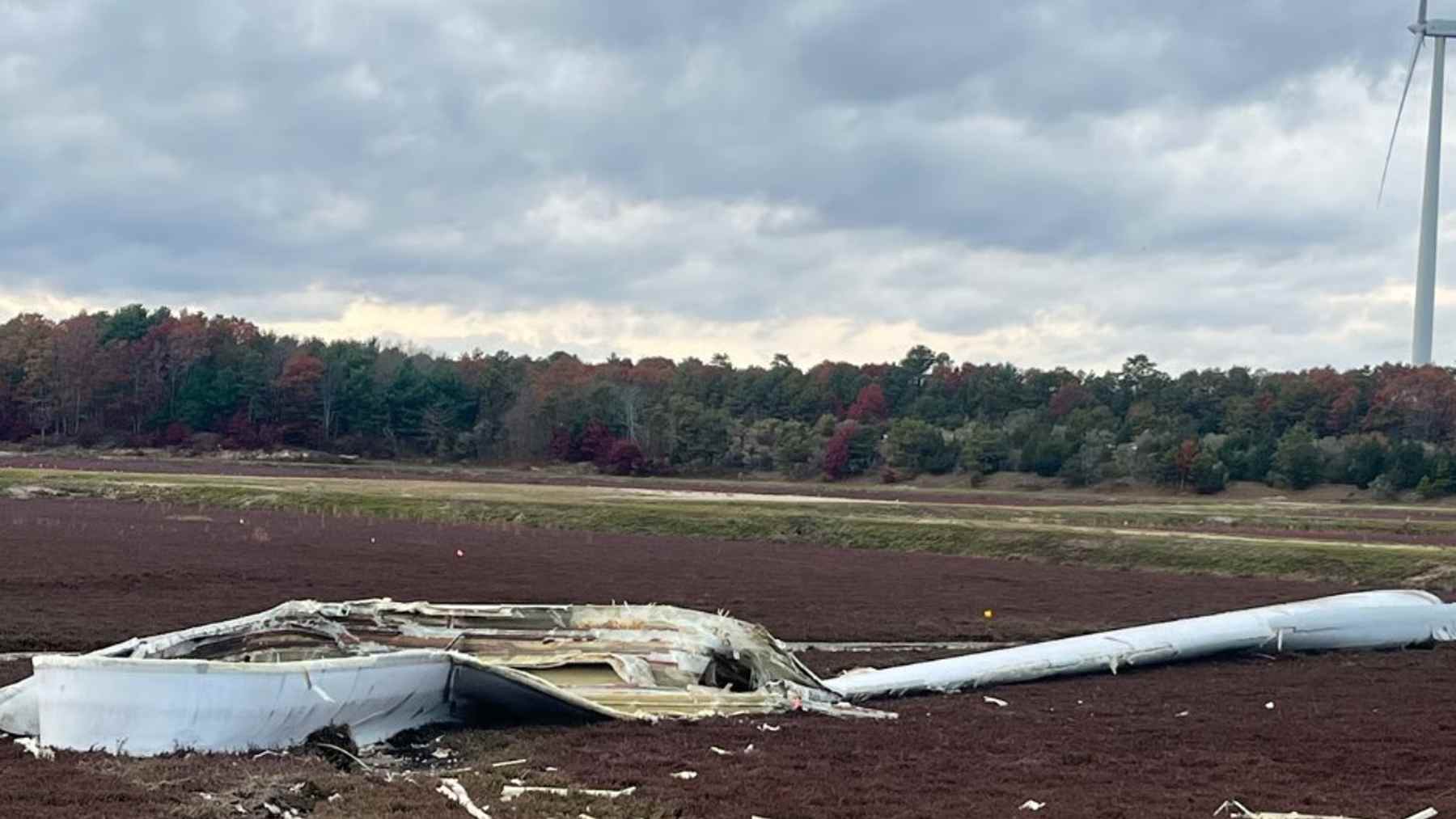
Across the bog, one of the three blades on a turbine standing three hundred feet tall was simply gone.
No one was hurt.
But residents said they had been told the machines would need no upkeep for twenty five years.
This blade had been turning for far fewer than that, so what actually gives inside a blade long before anyone expects it to?
What actually fails inside a blade
Wind turbine blades are not solid. They are hollow fiberglass shells, a pressure side and a suction side, joined along glued seams that run the length of the blade. Those seams, rather than the fiberglass itself, are among the hardest parts of the structure to inspect, because they sit inside the shell and carry flexing loads with every rotation.
What officials have confirmed at the Plymouth site is narrow. Firefighters located the detached blade, roughly 75 to 100 feet long, several hundred feet from the base of the tower, resting in open cranberry bog.
Television footage shot from a helicopter showed the hub area at the top of the tower appearing charred. No cause has been published yet.
In the wider industry, one documented route to this kind of separation is a bond line that opens slightly, admits moisture, and works wider under years of cyclic load until the shell lets go. Whether that is what happened here is exactly the question the review is meant to answer, and the charring visible at the hub leaves other explanations open.
A working bog turned into a debris field
The turbine sits among working cranberry bogs on the southern edge of Plymouth, near the Bourne town line, a stretch of coastal farmland most drivers only glimpse from Route 25 on the way to the Cape Cod bridges.
Fire officials said the call came in at about 1:52 p.m. from a neighbor who noticed that one of the three blades on the turbine was suddenly missing. Firefighters canvassed the area and found no further hazards.
The site is remote, and officials said no homes or occupied buildings stood in the immediate vicinity of the fall. The fire chief put it simply: “Thankfully, no one was hurt, and the turbine automatically shut itself down as designed.”
According to the maintenance company, the machine entered a fail safe mode and stopped immediately after the blade detached, which is the one part of this story that behaved as engineered. The three remaining turbines at the site were shut down as a precaution while the review got under way.
The hardest number is nine years
The four turbine project came online in August 2016, and each machine can produce 2 megawatts of electricity, 8 megawatts across the site. That puts the blade’s working life at roughly nine years before it separated, well short of the twenty year service lives that utility scale turbines are generally designed around.
Residents remembered a different figure from the time the machines arrived. One neighbor told reporters that residents were told the turbines would not need maintenance for twenty five years after installation.
That recollection has been questioned by industry commentators, who point out that commercial turbines are normally serviced on a schedule of inspections every six to twelve months. So a maintenance free guarantee would be unusual.
Either way, the gap between what the neighborhood believed and what landed in the bog is what makes this blade worth a second look. The fire department notified the state environmental agency and the town’s inspectional services department, which are reviewing the incident.
Why bond lines keep being a weak point
Blade failures of this kind are rare, and each one tends to send engineers back to the same few square feet of adhesive. A seam that runs the length of a blade cannot be fully seen from the ground, cannot be seen at all from outside the shell, and has to hold through millions of load cycles in salt air.
That problem does not get smaller as machines grow. Newer turbines rely on longer blades to boost energy yield, and most still bond two molded shells together using the same basic technique, which means a longer seam carrying higher loads.
Other designs take different approaches to the same forces, including rotors engineered to fold upward rather than ride out the worst of the wind.
None of that explains why this particular blade let go on a November afternoon rather than during a storm, which is why the root cause work matters more than the speculation around it.
What happens next for the bog and the blade
The owner’s spokesperson said an exhaustive root cause analysis had begun with the equipment manufacturer and the service provider. The site was cordoned off, and the company said work to remove the fallen blade would begin once the area was determined to be safe.
The fire department said the owner was looking at removal methods with minimal environmental risk and was expected to submit a removal plan to the town. Until then the debris stays where it fell, documented and fenced off, in the middle of a working farm.
For a neighborhood that has lived beside these machines for nearly a decade, the reassuring detail is the shutdown that worked and the empty ground the blade found. The uncomfortable one is that a turbine’s least visible part, the glued seam running down the inside of a blade, can decide how long a promise of decades of clean power actually holds.
Read the whole thing?
Get the week's signal, not the noise
Our sharpest reporting on energy, climate and nature — free, once a week.