Decades of astronomical work. Hundreds of researchers across dozens of institutions. Nearly three thousand stellar explosions, each one a brief but brilliant beacon scattered across the observable universe. Scientists spent years gathering this data, refining it, and stitching it into the most detailed portrait of cosmic expansion ever assembled — and what they found doesn’t quite fit the picture they expected.
Something about the invisible force driving the universe apart may not be behaving the way the standard model of cosmology says it should.
The largest supernova dataset ever assembled
At the center of this work is a single, staggering number: 2,884. That’s how many Type Ia supernovae an international team, led by researchers at the University of Queensland’s School of Mathematics and Physics, compiled into one unified dataset — the largest collection of its kind ever assembled.
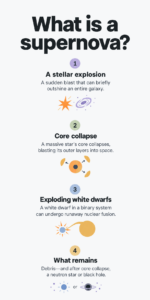
Type Ia supernovae are what astronomers call “standard candles.” These stellar explosions release energy in a predictable way, allowing scientists to measure distances across the universe with remarkable precision. String enough of them together across cosmic time and you get a map of how the universe’s expansion has shifted over billions of years.
PhD candidate Ryan Camilleri described the project as establishing a new international standard for supernova cosmology. “We’ve rebuilt three decades of astronomical observations into a single, consistent framework,” he said. That framework now represents the most detailed picture of cosmic expansion history ever constructed.
Rebuilding 30 years of data from scratch
Creating that framework wasn’t simply a matter of gathering old data and layering new observations on top. The team had to reanalyze historical measurements using updated methods — methods that reflect how much scientists have learned about supernova behavior since those original readings were taken.
Different telescopes, different eras, different calibration standards all had to be reconciled. Researchers accounted for cosmic dust, host galaxy masses, and gravitational lensing — the subtle bending of light as it travels from a distant explosion toward Earth — since each factor can distort distance measurements if left unaddressed. The 2024 findings from the Dark Energy Survey (DES) were incorporated as a key component, anchoring the more recent end of the dataset.
A constant that may not be constant
The standard model of cosmology treats dark energy as a cosmological constant — a fixed, unchanging property woven into the fabric of the universe. That assumption has held for decades. The new supernova compilation suggests it may need revisiting.
When the team cross-referenced their supernova data with relic light from the Big Bang and large-scale maps of galaxy distribution, they found a deviation from what the standard model predicts. The data suggests dark energy may evolve as the universe ages rather than remaining static. Professor Tamara Davis noted that while this deviation points in a slightly different direction than the hints seen in the 2024 DES results, it still challenges the core assumption of constancy. The direction may differ; the challenge does not.
Two independent experiments, one unsettling pattern
What makes these findings harder to dismiss is that a completely separate line of research has arrived at a similar place. The Dark Energy Spectroscopic Instrument (DESI) surveyed relic sound waves from the early universe — a technique called baryon acoustic oscillations — and also found hints that dark energy may vary over time.
These two methods share nothing technically. Supernovae measure distances through brightness; baryon acoustic oscillations measure distances through ancient sound patterns frozen into cosmic structure. Different instruments, different teams, different data entirely. Yet both point away from the standard model. The deviations aren’t identical, but hints from two unrelated techniques carry real weight — not proof of anything yet, though certainly reasons to look harder.
What comes next — and why it matters beyond cosmology
The team’s next step involves the Dark Energy Bedrock All-Sky Supernova program (DEBASS), which targets supernovae closer to Earth than those captured by DES. Nearby explosions fill gaps in the expansion history and allow for sharper tests of whether dark energy’s behavior truly shifts over cosmic time.
More data means more precision. Researchers believe that understanding dark energy could offer clues to reconciling general relativity with quantum mechanics — two theories that each work extraordinarily well in their own domains but have never been successfully unified. That’s a long horizon. With the largest supernova dataset ever built now in hand, and two independent experiments nudging in the same direction, the next few years of observation could prove decisive. Watch for what DEBASS and continued DESI surveys reveal — the picture of dark energy is still being developed, and the next data points may change it significantly.
You can learn more about this exciting discovery here: The University of Queensland. “Nearly 3,000 exploding stars challenge our understanding of the Universe.” ScienceDaily. ScienceDaily, 22 October 2026. <www.sciencedaily.com
Read the whole thing?
Get the week's signal, not the noise
Our sharpest reporting on energy, climate and nature — free, once a week.