
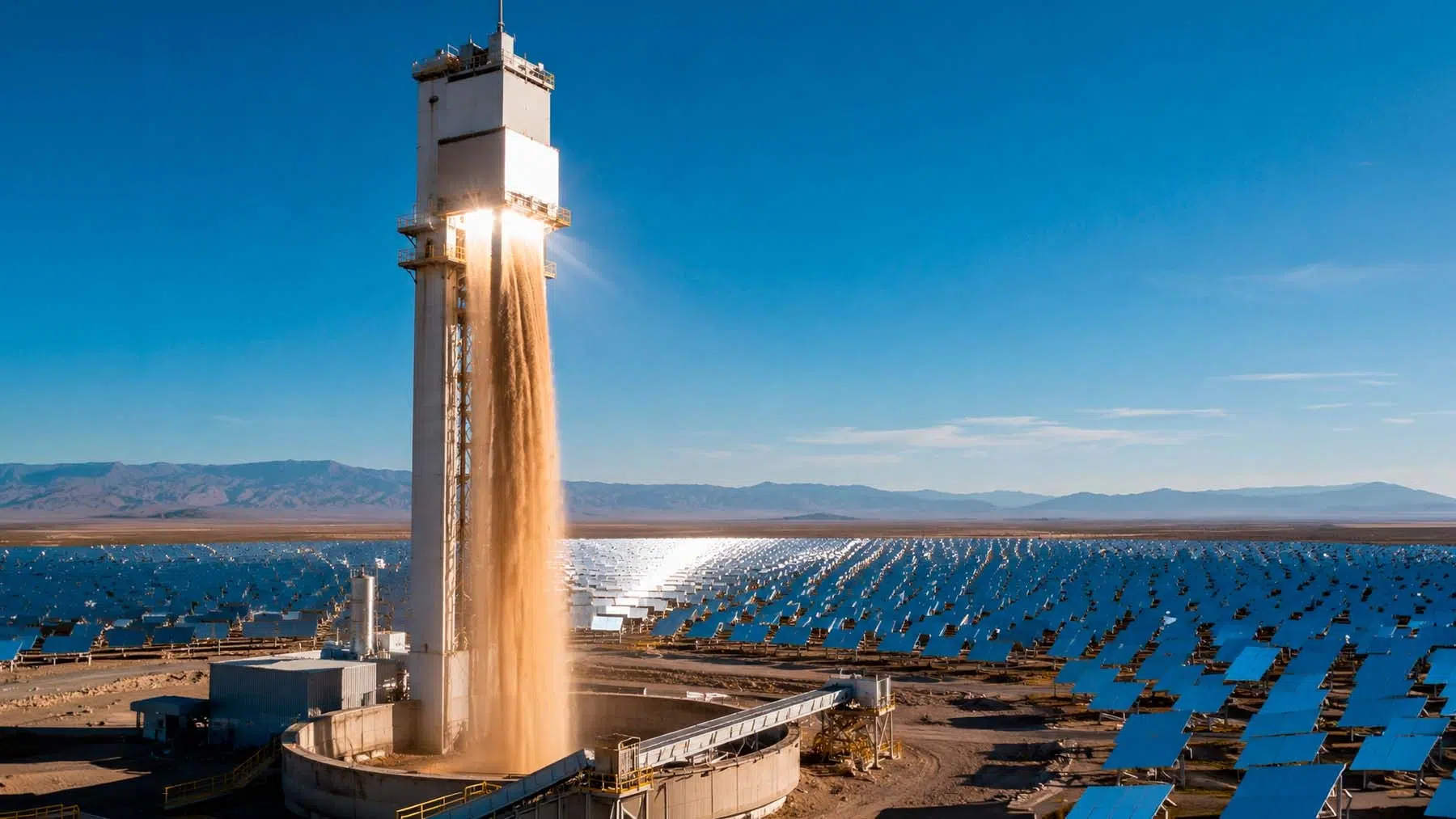
The desert sky above New Mexico holds a great deal of heat. The challenge, however, has always been how to store that heat after dark.
A vertical tower with hundreds of mirrors has just begun to reflect sunlight onto a single point. This tower does not store heat in liquid inside a sealed tube.
Instead, it stores the heat in falling sand.
Each particle absorbs incredible amounts of heat while tumbling through the light beam.
Once the particle reaches its peak temperature, it can be stored in insulated containers for many hours.
How have engineers kept the curtain of particles in the tower from simply floating away?
Capturing intense solar energy in freefall
Most Concentrated Solar Power (CSP) facilities currently employ some type of synthetic oil or molten salt to carry heat. Synthetic oils begin to degrade once heated to high temperatures.
Meanwhile, molten salts can freeze within the pipes used to circulate them. In contrast, the particles are made up entirely of chemically inert ceramic material.
The CSP plant shown here utilizes numerous heliostat mirrors. These mirrors focus intense beams of sunlight towards a central area located at the top of the tower.
At the top of the tower, a special hopper releases millions of dark ceramic grains every second.
Once the curtain begins to fall, each particle falls directly under the concentrated light rays.
Since no tubing exists, direct sunlight heats the particles without barrier heat loss.
When the hot grains reach the bottom of the tower, they fall into an insulated container.
There, they remain until needed.
Elevating storage capacity for next-generation power cycles
Renewable energy must continue to generate electric power even when the sun is not shining. The falling sand concept serves as a giant thermal battery.
This falling particle research is funded by the Department of Energy to improve clean power systems.
Hot particles can maintain their heat for more than 6 hours.
Testing at Sandia National Laboratories proves ceramic grains retain extreme heat across long periods.
To generate electricity when needed, hot grains are released into a pressurized heat exchanger. Pressurized CO2 flows through the heat exchanger and collects thermal energy.
Although this closed-loop system produces electricity long after sunset, utilizing solid particles decreases total operating cost. It also eliminates operational risks related to pipe corrosion and leakage due to chemicals.
However, delivering consistent heat necessitates precise control of the particle stream.
The architecture of the advanced particle receiver
The receiver situated high atop the tower is constructed to maximize thermal capture. Featuring an internal cavity, it incorporates a unique angled construction to reduce heat loss.
Inside this cavity, metal channels temporarily catch falling grains before releasing them once again.
This temporary containment strategy reduces the velocity of the grain stream and enhances curtain consistency.
As a result, the grains experience increased exposure to intense light, thus achieving higher desired temperatures.
Engineering stability inside the thermal cavity
Sensors integrated into the receiver continuously monitor particle mass flow rates across all aspects of the curtain width. Automated systems alter grain curtain density simultaneously based on current real-time solar radiation levels.
After being cooled via the heat exchanger, an insulated bucket elevator transports grains back up. They return to the top of the tower for the next cycle.
Continuous operation facilitates reliable and efficient production of electricity via simple sand. The particle tower represents a significant advancement toward developing viable, long-duration energy storage technologies.
Swapping liquids for inexpensive, readily available sand slashes the costs of delivering clean energy to millions.
As grid demands grow, expanding these storage alternatives will be essential to ensuring long-term reliability.
These alternatives are vital to securing a stable energy future.
Advanced solar towers represent a major breakthrough for long-duration energy storage.
This operational shift directly parallels how automated thermal flows are managed downstream.
Read the whole thing?
Get the week's signal, not the noise
Our sharpest reporting on energy, climate and nature — free, once a week.


