A heavy chain moves down a concrete channel in the Central Valley, tearing rooted weed off the bed.
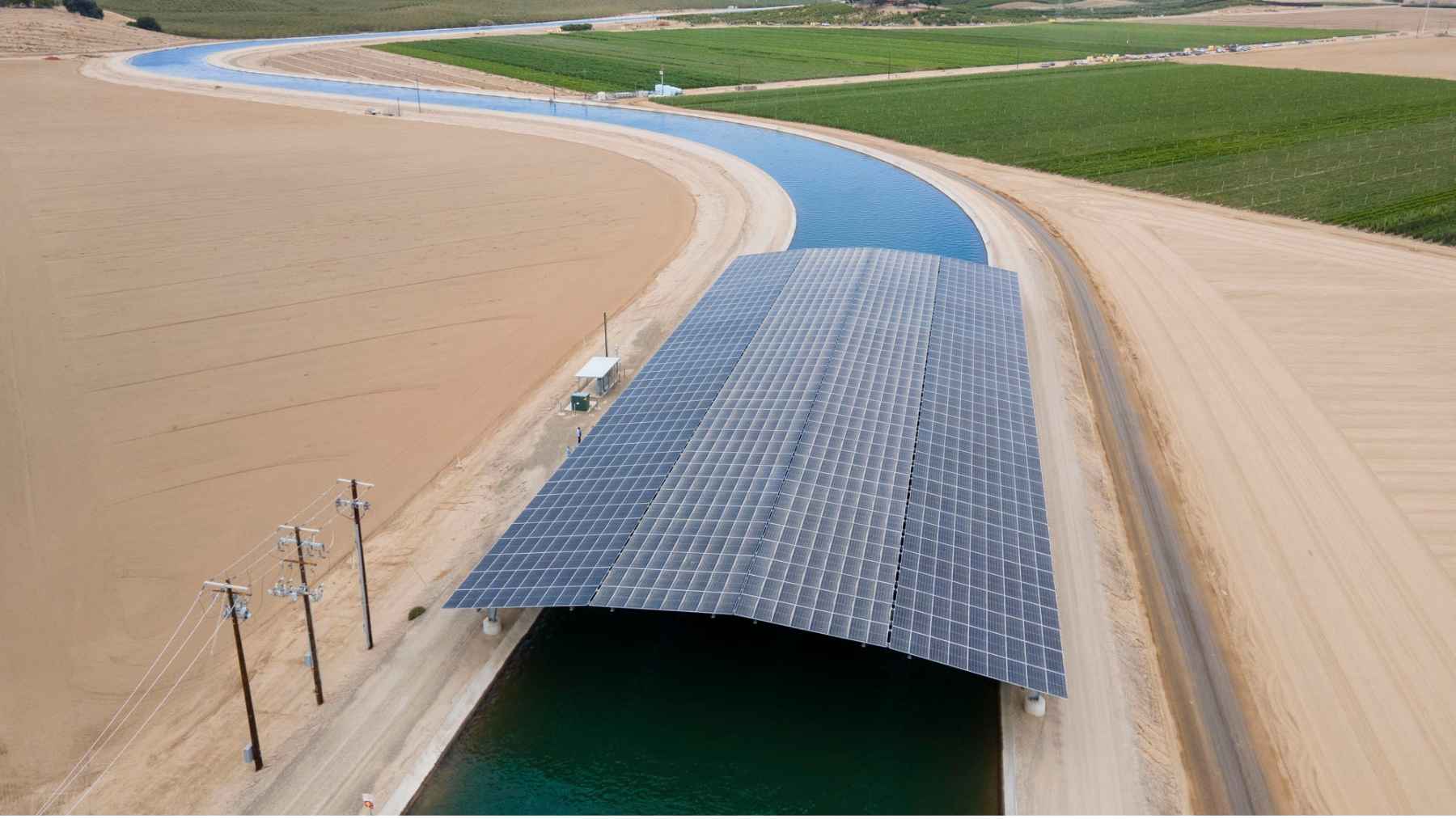
Above it, steel trusses carry rows of panels across the water, high enough that the chain never touches them.
That clearance is not an aesthetic choice. It is the first thing the structure had to satisfy.
The pilot was launched in 2022, and state officials gathered at the two sites at the end of April, 2026, to mark the build complete.
What everyone quotes from it are two percentages.
Which leaves the question under the trusses. Why build this high at all?
Why 1 anchor chain sets the height
Because a working canal is a machine that needs servicing.
Weed does not wash out of an irrigation channel. It roots in the bed, and the district clears it by dragging a heavy anchor chain along the bottom, which means equipment has to reach the water from the bank and swing over it.
Put a low roof over that and the cleaning stops. The canal silts, the weed thickens, flow drops, and the water utility has traded its day job for a power plant.
So the canopy had to clear the service equipment first and collect sunlight second, which sets the span, the column positions and most of the cost.
It also explains why the versions in India and Arizona do not simply transfer. Those sit low over the channel and leave little room for a cleaning rig.
115 feet, 20 feet and 1 retractable span
The sites were picked to be awkward on purpose.
The district runs about 250 miles of canals and has been in operation for 139 years, and the pilot sits on two of its stretches near the towns of Hickman and Keyes.
One channel is roughly 115 feet across and carries a wide span canopy with nothing standing in the water. Another is about 20 feet across and carries slanting panels.
A third stretch got something different again, an accordion style retractable array that can be rolled back off the water.
Three forms over three widths is not indecision. It is the only way a pilot answers which form belongs where.
The whole thing is quoted at 1.7 megawatts by the district, and at 1.6 by other records, which is small for a plant and large for an experiment.
70 percent, 85 percent and 1 rake
Now the two numbers, with the label they actually carry.
The university team reports up to 70 percent less evaporation under the shaded reaches and 85 percent less weed growth, and both are presented as early results rather than as findings.
The instruments behind them are modest. A prototype device measures evaporation at the site directly, and algae is checked with a long handled rake.
No published account ties those two percentages to a specific sensor record, a sample size or a time window, which is the ordinary condition of a pilot that has not reported yet.
The money is firmer. A 20 million dollar state grant paid for the research and the infrastructure, with the district adding staff time.
A grant that size buys a demonstration. It does not buy a conclusion.
What 1 pending report decides
Here is the part that reorders the story.
The district is not the one deciding what happens next, in the way that a canal model or a solar orchard turns into a settled case.
The state water agency says it is waiting for the final report before committing to further projects, and the broadcaster account puts that report later this year.
The big statewide figures are estimates and are labeled as such. Covering all 4,000 miles of open canal is projected to power about two million homes and to conserve water on a similar scale, and the university release calls that a study rather than a result.
Nobody has published the energy this pilot has actually generated since it went live.
The headline is a percentage. The decision waits on a document.
Where 48 miles of canal says no
The useful question is not whether this works. It is where it ports.
A district to the west runs 48 miles of canal built in the nineteen thirties, and its own spokesperson says a project like this one would not fit, because the maintenance crews there have little room to work alongside the water.
That is the real finding hiding behind the percentages. Canal solar is not a technology question, it is a question about the shape of somebody else’s maintenance yard.
Wide channels with bank access and modern service equipment are candidates. Narrow old ditches with crews working off the edge are not.
Shade over irrigation canals costs no farmland and displaces no field.
Somebody still has to clean the ditch.
Read the whole thing?
Get the week's signal, not the noise
Our sharpest reporting on energy, climate and nature — free, once a week.