Stand on any American port dock and watch a container ship move in, and you already think you understand what you are seeing.
A steel box, full of other steel boxes, pushed by an engine.
That picture is almost entirely wrong, and the ship that proves it most dramatically is the biggest cargo vessel ever put to work on the ocean.
It crosses the Pacific right now, carrying a fraction of everything that stocks American shelves, and most people have never heard its name.
A vessel so large it barely seems real
Picture four American football fields laid end to end.
Now stack 22 layers of steel boxes on top of that length, each adding another 8.5 feet of height above the waterline.
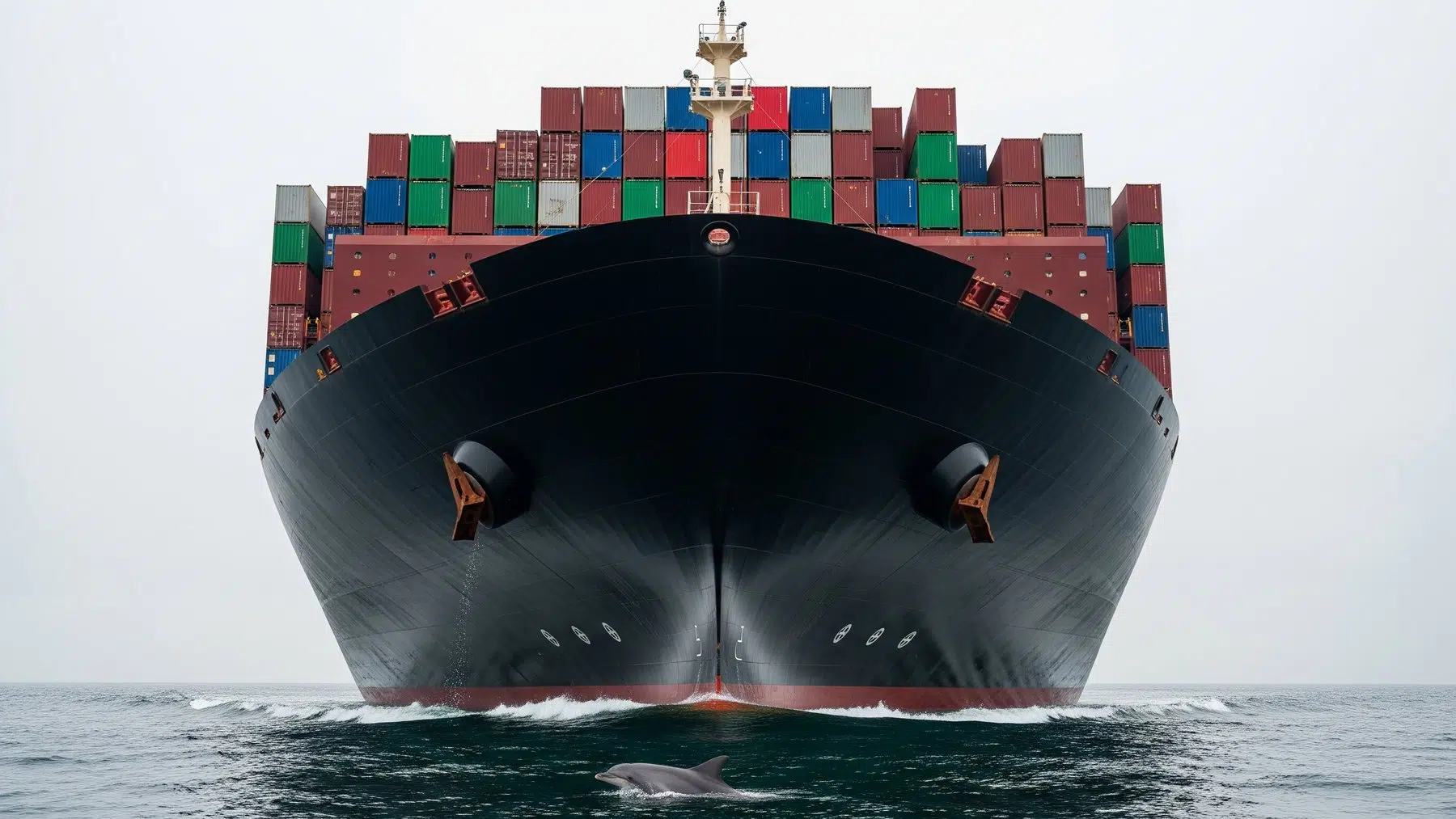
That is roughly what the MSC Irina looks like from the water.
The MSC Irina is the world’s largest container ship, with a capacity of 24,346 TEUs, measuring 399.9 meters in length and 61.3 meters in width.
A TEU is one standard 20-foot steel shipping container, the kind stacked along every American interstate near a port.
If those 24,346 containers were loaded onto a single freight train, that train would stretch more than 140 kilometers.
The ship entered service in 2023 and immediately broke every record the maritime industry had.
What it takes to move something this heavy
The real engineering puzzle is not building something this large.
It is moving it without burning the planet’s entire fuel supply in the process.
At that scale, water friction against the hull becomes a monstrous enemy.
Every extra square foot of steel dragging through seawater costs fuel, costs money, and releases carbon.
The engineers who designed the MSC Irina knew they had to solve friction in a completely new way.
Their answer came not from the engine room but from a principle most people only experience in a bathtub.
They decided to slide the ship across the ocean on a blanket of air.
The ocean floor the ship carries with it
Below the waterline, the MSC Irina’s hull is doing something no passing ship watcher ever sees.
A dedicated system pumps millions of tiny air bubbles out through the flat underside of the hull.
Those bubbles form a thin, slippery layer between the steel and the seawater, cutting the drag that would otherwise slow the ship and guzzle fuel.
The ship pairs this with wide diameter propellers and energy saving ducts, and together these technologies cut CO2 emissions by 3 to 4 percent.
Three to four percent sounds modest until you do the math on a vessel burning fuel across 12,000 ocean miles.
That margin equals thousands of tons of CO2 kept out of the atmosphere each year, from a single ship.
The bubbles also create a zone of aerated, churned water directly under the hull, a frothing world in constant motion that no engineer designed as a habitat.
Yet something is living in it.
The creature the engineers never planned for
Massive container vessels like the MSC Irina produce an enormous bow wave, a rolling wall of pressure pushing outward for hundreds of feet in every direction.
Dolphins and porpoises have learned to read these pressure waves as a free ride, surfing the bow without burning a calorie, sometimes for miles.
Researchers tracking cetacean behavior in major shipping lanes have documented this association for decades, but the sheer scale of the MSC Irina changes the equation.
The air lubrication systems on the hull, paired with wide diameter propellers, oxygenate the slipstream in a way smaller ships simply cannot match, drawing baitfish in surprisingly large numbers.
Where baitfish gather, dolphins follow.
A vessel meant only to carry container loads of goods across the Pacific has become, in its own accidental way, a moving hunting ground for marine mammals working the edges of its wake.
The 730-foot sand carrier that crosses European waters disrupts a seabed city with every pass; the MSC Irina, crossing open ocean, creates one instead.
It is one of the stranger partnerships the sea has produced: 24,346 boxes of human commerce and a pod of dolphins sharing the same moving sliver of water.
Why the biggest ship alive is also one of the cleanest
There is a counterintuitive truth buried in the physics of very large vessels.
Bigger ships are, per container, far more fuel efficient than smaller ones.
Moving one box from Shanghai to Los Angeles on the MSC Irina burns dramatically less fuel than moving that same box on a ship half the size.
The air lubrication system, the oversized propellers, and the hull shape all push that efficiency further still.
The result is a vessel that carries more of the world’s goods while leaving a smaller carbon mark per unit than almost any ship before it.
The ocean does not care about cargo manifests or trade routes.
It responds to pressure waves and bubbles and churning wakes, and the creatures living in those waters adapt to each one.
The largest container ship ever built turns out to be a moving lesson in what engineering at its most ambitious can accidentally give back to the sea.
Read the whole thing?
Get the week's signal, not the noise
Our sharpest reporting on energy, climate and nature — free, once a week.