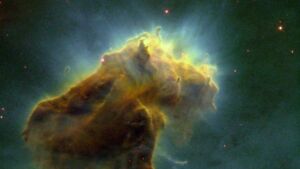
The Eagle Nebula’s Pillars of Creation have captivated astronomers and casual stargazers alike for decades — towering columns of gas and dust stretching light-years into space, 6,500 light-years away, where new stars are quietly being born.
Now, scientists have given that iconic scene a second dimension: sound. As a sonification line sweeps left to right across a combined Hubble and Chandra image of the nebula, stars and dust translate into pitch — rising, falling, shifting — turning one of astronomy’s most celebrated sights into something you can hear for the first time.
One of astronomy’s most famous images — reimagined for your ears
The Eagle Nebula, catalogued as M16, has been a cultural touchstone since Hubble first revealed its towering pillars in sharp detail. Scientists and the public keep returning to that image — it’s the kind of picture that makes space feel both vast and strangely personal.
Sonification translates visual data into audio by mapping properties like brightness and position to characteristics like volume and pitch. It’s not a random artistic choice. The mapping follows actual data, so what you hear reflects what the image genuinely shows.
In NASA’s sonification video, a vertical scan line moves steadily from left to right across the image. Your vertical position within the frame determines pitch — higher in the frame, higher in tone. Bright stars and dense dust structures each register as distinct sounds when the line passes over them, each with its own texture.
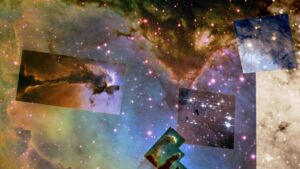
The source image is unusually rich, combining visible-light data from Hubble with X-ray data from the Chandra X-ray Observatory. That pairing captures both the cool, dark gas columns and the energetic young stars embedded within them — giving the sonification two very different kinds of cosmic material to work with.
What the Pillars of Creation actually are
The pillars themselves are towering columns of cold gas and dust, each stretching several light-years in length. They sit roughly 6,500 light-years away in the constellation Serpens — the Serpent — well beyond our immediate cosmic neighborhood, yet close enough for Hubble to resolve in striking detail.
Deep inside those dark structures, bright young stars are actively forming. The pillars are essentially stellar nurseries: dense enough to collapse under gravity and ignite new suns, while still opaque enough to shield that process from view in ordinary visible light.
The pillars are also under pressure. Energetic ultraviolet radiation and powerful stellar winds from M16’s cluster of massive stars are sculpting and eroding the columns from the outside. According to NASA, the cosmic pillars are ultimately destined for destruction — slowly worn away by the very stars that share their neighborhood.
A stellar nursery that echoes our own origins
What makes M16 scientifically significant goes beyond its visual appeal. The turbulent star-forming environment within the nebula is thought to resemble the conditions that gave birth to our own Sun, billions of years ago — which is precisely why astronomers keep coming back to it.
Understanding how stars and solar systems form in environments like this one could tell us something fundamental about how our own corner of the universe came to be. The combined Hubble and Chandra dataset adds another layer to that picture. Chandra’s X-ray vision picks up energetic signatures of young stars invisible to Hubble alone, and together the two observatories reveal the interplay between those hot, newly ignited stars and the surrounding gas they’re actively reshaping.
Why turning space into sound matters
The most immediate reason to sonify an image like this is accessibility. For people who are blind or visually impaired, a stunning photograph of a nebula is simply out of reach. Sonification changes that — opening astronomical data to a broader audience without diluting its scientific content.
Sound also offers something to sighted listeners. Patterns and gradients that blend together in a static image can become distinct and separable when rendered as audio. Your ears catch shifts that your eyes might skim past.
NASA has applied sonification to several iconic images, making this project part of a broader initiative rather than a one-off experiment. Different sound textures help listeners distinguish between types of cosmic material — stars register differently from dust, giving the audio a layered quality that mirrors the image’s complexity. It’s a richer experience than it might sound on paper.
There’s something worth sitting with here. A stellar nursery 6,500 light-years away, in an environment that may mirror the birth of our own Sun, now has a sound. The universe has always been full of information. We’re only just learning how many ways there are to receive it.
Read the whole thing?
Get the week's signal, not the noise
Our sharpest reporting on energy, climate and nature — free, once a week.