The machete goes in low, and the whole plant comes down in a single push.
It is not a tree, and it does not splinter.
It folds over wet and heavy, the way a soaked stack of newspaper folds.
The bunch is cut away and carried off to the packing shed.
What is left lies there in the row, bleeding sap into the mud.
On most farms it stays exactly where it fell until it rots back down.
One bunch, and the plant is finished
A banana plant is a strange piece of agriculture.
It grows for most of a year, pushes up a single flower spike, and fills out one bunch of fruit.
Then it is done, permanently.
It will never fruit again, so the grower cuts it down and lets a sucker at the base take over the spot.
That cycle runs on every commercial banana farm on the planet.
Cavendish alone accounts for roughly 50 million tons of fruit a year, with about 20 million tons of it crossing a border.
Every one of those bunches came off a plant that was then cut to the ground.
And the stem left behind outweighs the fruit itself.
What is actually standing in that row
The thing growers call a trunk is not a trunk.
It is a pseudostem, a tight roll of overlapping leaf sheaths sitting on an underground corm.
Slice one across and the cut face looks like the end of a cabbage rather than like wood.
Most of that mass is simply water.
Running the full height of every sheath, though, are long bundles of cellulose.
Weavers in Okinawa have pulled those bundles out by hand for centuries to make a stiff summer cloth called bashofu.
Workshops in Nepal and India spin a coarser grade into rugs and upholstery yarn.
Nobody ever scaled any of it, and the reason is almost entirely mechanical.
Why the pile just sat there for a century
Start with weight, because weight decides everything downstream.
A fresh pseudostem is more than 90 percent water, which makes it costly to move and quick to spoil.
Truck it anywhere and you are paying freight on water.
Then comes the extraction itself.
The traditional route is retting, leaving stems submerged for days until bacteria loosen the fiber, which is slow and smells the way that sounds.
Chemical degumming works faster and hands you a wastewater problem instead.
Scraping by hand gives beautiful fiber at a labor cost no factory absorbs.
The raw material was never the obstacle, and the processing line always was.
The number that came off the tensile rig
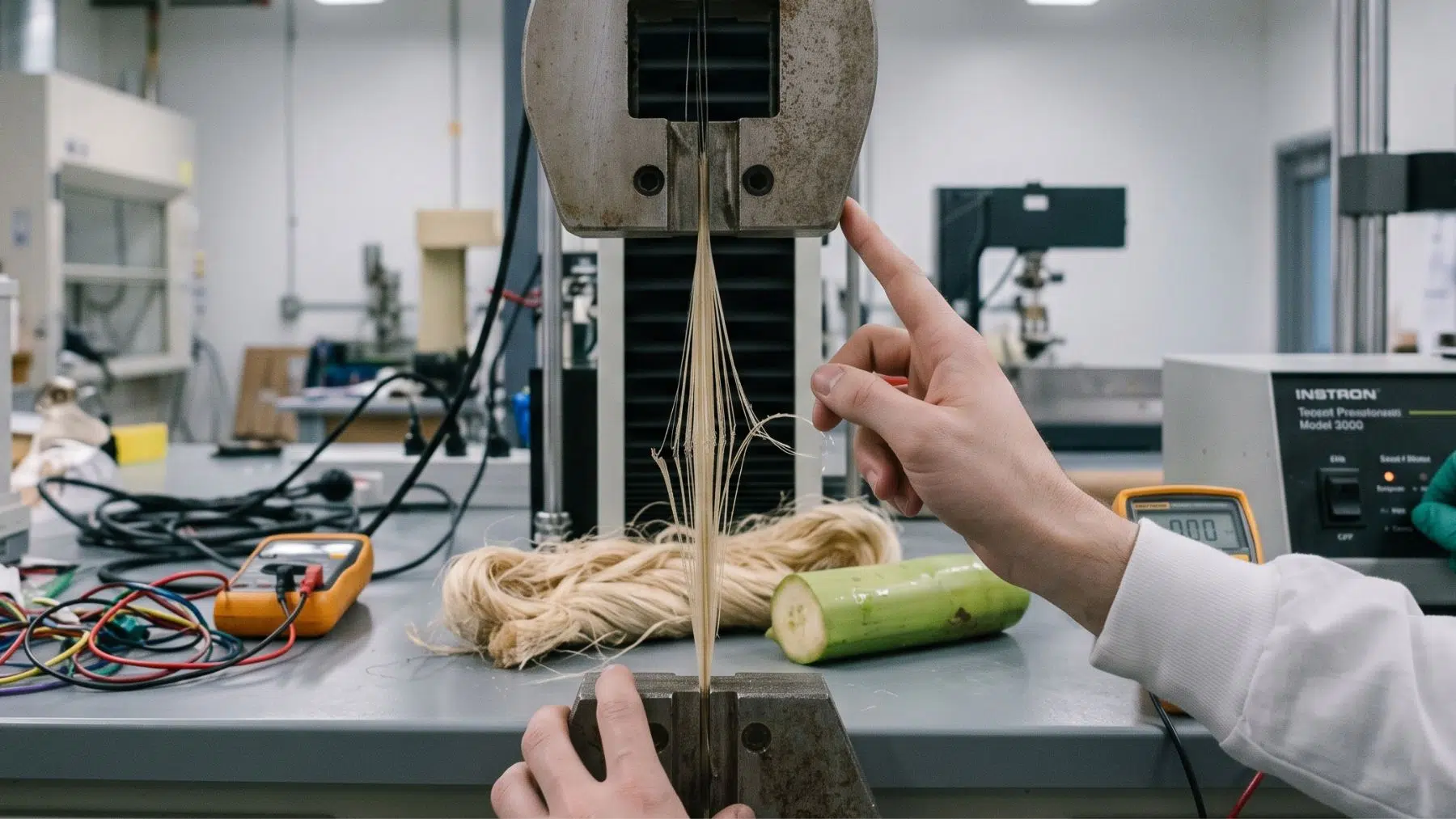
Then a group of Brazilian researchers clamped the fiber into a testing machine and pulled until it broke.
Banana pseudostem fiber came in around 570 megapascals, according to the measurements.
The reported figure for jute is 249, and for sisal it is 350.
That puts a discarded farm residue well past two of the most heavily traded natural fibers in the world.
The structural reason turned up in the same work.
The banana fiber measured close to 67 percent crystallinity, against 43 for jute and 46 for sisal.
More of its cellulose sits in ordered alignment, and ordered cellulose is what carries load.
The material rotting in the row was the strongest thing on the farm.
What is running now, and what is still arithmetic
Some of this has already left the laboratory.
A Swiss company called QWSTION launched a technical canvas named Bananatex in 2018, woven from abaca grown in Catanduanes in the Philippines and spun in Taiwan, and it has since shown up in H&M sneakers, in bags and in furniture covers.
One honest catch sits inside that success.
Abaca is a separate species raised specifically for fiber, not the leftover stem of a fruit farm.
The waste stream version is younger, and the clearest case is a Brazilian project called Banana Textil, run by a SENAI textile institute in Santa Catarina with industry partners, which reached the finals of the BRICS Solutions Awards, as the federation announced.
A small factory on Kosrae in Micronesia has been turning local trunks into paper and wallets for years.
The remaining limit is arithmetic, and it is unforgiving.
One yield study measured usable fiber at 2.66 percent of green weight, so a full ton of wet stem returns roughly 53 pounds of fiber.
Washing that fiber takes water, and the wastewater has to go somewhere, the way tradeoffs trail a solar site or an offshore project long after the engineering is settled.
None of that makes the idea weak.
It makes it a logistics problem rather than a materials one.
And logistics problems are the kind that eventually get solved.
Read the whole thing?
Get the week's signal, not the noise
Our sharpest reporting on energy, climate and nature — free, once a week.