Some stars only ever go supernova once. When that explosive finale occurs, the star is gone for good with no second chance.
However, one particular object in the galaxy NGC 4559 has attracted attention.
There was a large star that showed spectacular flares roughly every 113 days. Then the star would return to normal.
This went on with incredible consistency. Instead of going supernova at the end of its life, it survived.
It must be something else causing these flares.
The eruptions kept returning on schedule
AT 2016blu is not a regular star. It belongs to a rare type of star called luminous blue variables.
However, AT 2016blu has taken it even further.
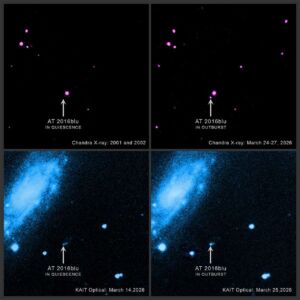
Between 2012 and 2026, there have been 27 or more eruptions. These occur roughly every 113 days.
This suggests something is happening periodically in this star.
Yet the star refused to follow the usual script
Another issue with the brightening periods is that each time it erupts, it gets incredibly bright. This makes it look like a Supernova.
Whilst this can indicate that a giant star is reaching the end of its life, AT 2016blu defied this and survived multiple times.
Therefore, AT 2016blu has earned the nickname of “supernova impostor.”
Whilst the flares are real. They do not actually result in destruction.
So, what is causing this to look like it is exploding?
An answer may not be visible at all
Observations from NASA’s Chandra X-ray Observatory suggest AT 2016blu has a hidden companion.
AT 2016blu is not moving through space on its own. There is an unseen companion orbiting the giant star.
As a result, the two come very close together on a repeating cycle.
The companion is thought to be a neutron star or stellar mass black hole. They are both dense remnants of giant stars.
Whilst they cannot be seen using normal telescopes, they were noticed in March 2026 when Chandra observed them shining brightly in X-rays during an outburst, with the results later appearing on arXiv.
Everything changed when the two moved closer together
As the two objects come closer together, some of the material ejected by the giant star will also get caught by the companion.
The gas will get extremely hot as it falls down to the neutron star or black hole. That process causes high energy X-rays.
The gas surrounding the objects will absorb that energy and emit bright visible light.
To us, the result looks like an outburst from the star, but it isn’t actually going supernova multiple times. It is the hidden companion that is being fed multiple times.
The mystery may extend beyond a single star
AT 2016blu is a rare type of object. The system consists of a giant star that is a luminous blue variable and a dense companion.
Together, they suggest that this companion can cause the multiple eruptions we observe.
It is also bright enough in X-rays that it is considered a potential ultra-luminous X-ray source.
Objects in this category are quite poorly understood. Many of them show dramatic changes in brightness.
This may mean that hidden interactions could be causing this.
A system that was once just known for its strange outbursts might help give us an insight into this wider category of cosmic mysteries.
A hidden companion may be pulling more strings than expected
Large stars often can become unstable just before reaching the end of their lives. Others can eject large amounts of material.
Often, it is unclear what the cause is. This star shows that sometimes a hidden companion can be involved in a much bigger way.
Whilst the star looked like it wanted to mimic a supernova, it might be showing us what happens when a dense object feeds off of its giant companion multiple times.
Looks like a hidden object has been controlling things!
Read the whole thing?
Get the week's signal, not the noise
Our sharpest reporting on energy, climate and nature — free, once a week.