Planets are usually born alongside their stars.
When a star dies, the planets left around it either die too or are assumed to be survivors of the original system.
Yet a Hubble record from 1999 that looks at a dead star called HS 0209+0832 holds a chemical clue that does not quite fit that picture.
Could a planet actually form after this star had died?
A cold case that has been sitting in the archive
In 1999, NASA’s Hubble Space Telescope observed a star called HS 0209+0832.
This star is classified as a white dwarf.
A white dwarf is the leftover core of a low-mass star that has burned through its nuclear fuel and lost its outer envelope of gas and dust.
HS 0209+0832 is a young and hot white dwarf, relatively speaking.
It has been cooling for only about 5 million years, and the temperature at its surface is about 35,800 kelvin.
In its atmosphere lies a puzzle.
The 1999 spectrum showed mostly hydrogen, as is expected, but about 1% was seen to be helium.
This may not sound like a lot, but at the temperature it is at, the helium should have sunk away a long time ago.
This brings researchers to the conclusion that something must be feeding this star.
The spectrum also showed numerous lines that no one seemed to be able to identify.
A clue in its variable light could solve this puzzle
A new look at these archives was in order, and Jamie Williams, from the University of Warwick, led a paper in Nature Astronomy.
What was found was most unexpected.
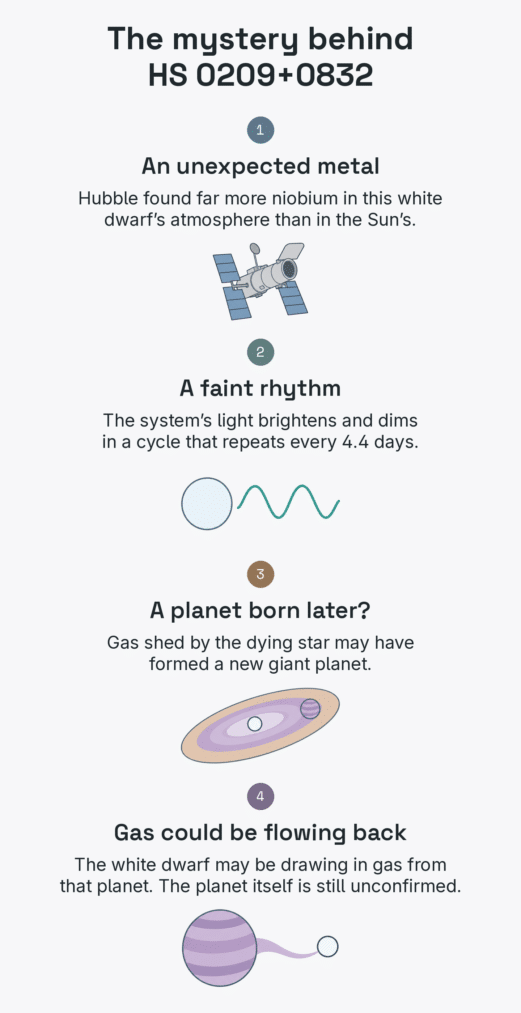
Most of the mystery lines matched those of copper and niobium.
Niobium is more than a thousand times more abundant in this white dwarf HS 0209+0832 than in our Sun.
It is unusual for a star to have such high levels.
Upon further investigation, niobium was not found in the 33 other white dwarf stars that the team examined.
So what is giving the white dwarf so much niobium?
Something interesting gave the team a clue.
One of NASA’s satellites saw the star’s light vary by about 0.12% every 4.4 days.
One possible theory touches on something never seen before.
The evidence could, in fact, lead to the theory of a second-generation planet orbiting this white-hot dwarf, something scientists have never seen before.
A giant planet formed after the death of HS 0209+0832
A second-generation planet is one that is formed after a star dies.
This is not the norm for planets, which are usually formed during the birth of stars.
But the evidence of niobium, which is only formed in a dying star, gives pretty good proof.
Furthermore, the team thinks that the light variability of HS 0209+0832 leads to the same conclusion.
Another giant planet could be in orbit, around 3.7 million miles away.
Theoretical astrophysicist Nicholas Stone, from the University of Wisconsin–Madison, explains a key point.
HS 0209+0832 was once an ordinary star. As it died, it threw off its outer layers, rich in niobium.
This is not unusual for dying stars, which throw away all kinds of material, sometimes not even their own.
Some of HS 0209+0832’s cast-off material could have formed into a giant planet that now orbits the white dwarf left behind.
This theory would explain the light variability and the high levels of niobium still around the white dwarf.
The star’s own debris, shaped into a planet, is being returned to the star.
For now, there is no formal conclusion that this is the case. It has been inferred from the star’s chemistry and faint light variability. No one has seen the planet yet. But as this system is further studied, the truth will likely come out. Hubble tells us more about the past than ever before, with further mysteries like this one being unravelled.
Read the whole thing?
Get the week's signal, not the noise
Our sharpest reporting on energy, climate and nature — free, once a week.