The outer continental shelf is mostly a desert of sand.
Flat and shifting, and almost entirely without anything hard to hold onto.
A mussel needs a wall the way a climbing plant does, and out there no wall exists.
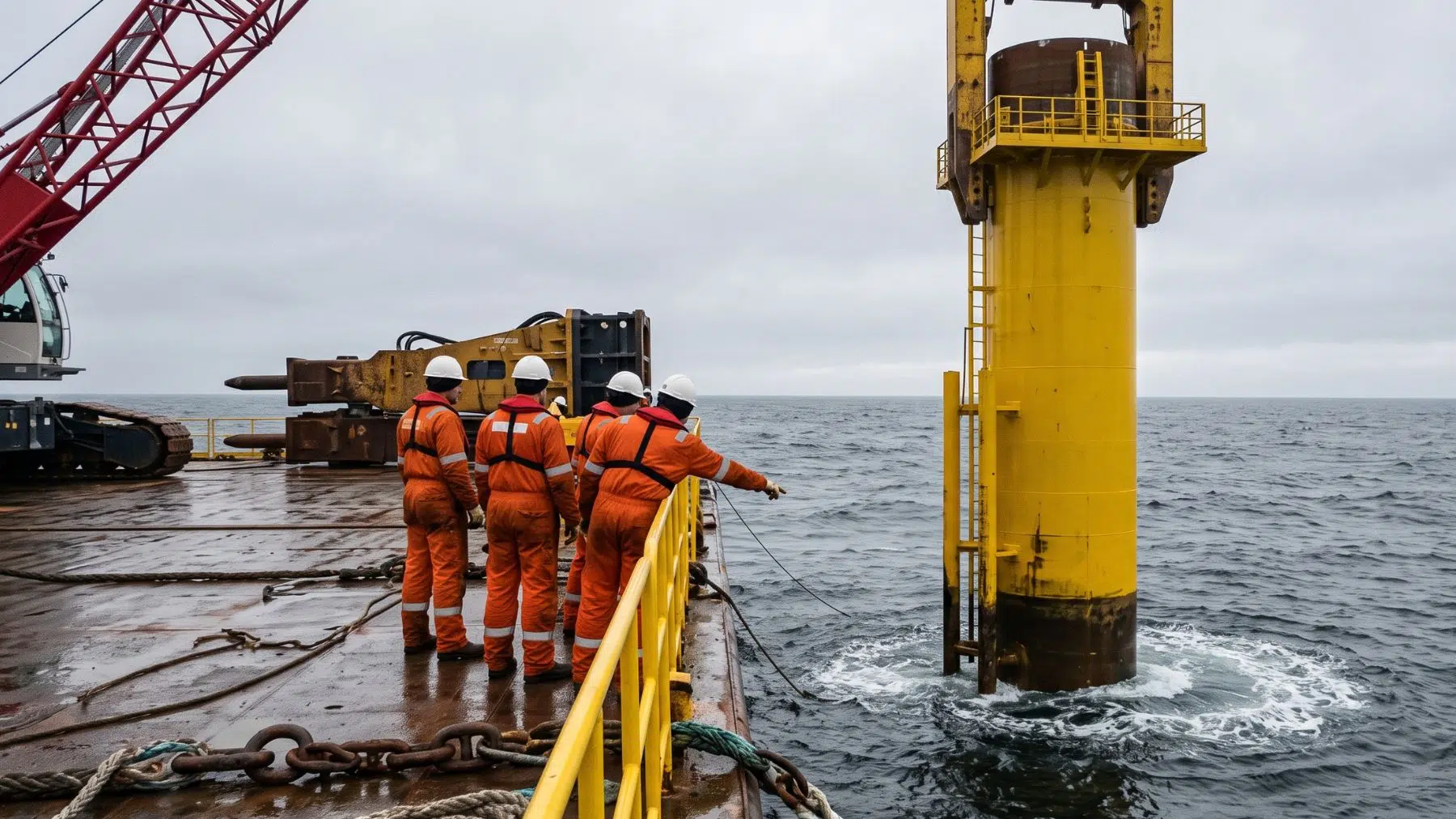
Then a crane arrives and drives a steel cylinder the size of a grain silo into the seabed.
It does that fifty four times.
Nobody set out to build a reef, but that is what happens next.
What the divers counted off Taiwan
The clearest picture comes from the other side of the world. Off Miaoli County on Taiwan’s west coast, 69 foundations went into a flat sandy seabed between 2016 and 2021, and fish biologists have been diving on them ever since.
The tally is not subtle.
Divers logged 11,552 individual fish across 97 species, and pole and line surveys added another 40, bringing the total to 137. Of those, 86 were reef fish, and every single one was recorded within about 165 feet of a foundation. Not one turned up in the open sand between the towers.
The comparison that matters came later. By 2025, species richness, diversity and trophic structure around those steel legs were statistically indistinguishable from purpose built artificial reefs that had been sitting on the same coast for roughly fifteen years. The turbine legs had not become reef like. They had become reefs.
Why hard structure is the whole story
Mussels, barnacles, sponges and anemones are filter feeders. They do not swim after food, they sit still in a current and strain it, which means they need something upright to sit on.
Sand is useless for that. It moves.
This is why a sunken ship becomes a fishing mark within a season, and why crews know exactly where every wreck on the shelf lies. Introduce vertical relief into a flat seabed and the colonization is not gradual, it is close to immediate, because the demand has been sitting there unmet the whole time.
Everything else follows from the crust. Encrusting life feeds small fish, small fish draw larger ones, and within a few seasons a bare pile carries a full food chain that had nowhere to stand before.
What actually went into the water off New York
The Long Island array sits 15 to 30 miles south of the shore in water between about 75 and 135 feet deep. Fifty four monopile turbine foundations were installed through the summer and early fall of last year, all of them now in place, for a project rated at 810 megawatts.
The path there was not smooth. A federal stop work order halted construction in April of last year and was lifted the following month.
The rock matters more than the schedule does. An initial filter layer of rock went down at each position before the pile, and a second armor layer of smaller rock was placed afterward to hold the foundation steady. Each of those rings is hard bottom in its own right, sitting on sand that had none.
More is coming. Roughly 94 miles of export cable and over 100 miles of cable between the turbines are being laid into this year, and cable protection adds its own strips of hard surface.
The American evidence is already in
Nobody has to wait for Taiwan to be confirmed. At a Rhode Island site, mussels spread roughly 160 feet out from a turbine base within three years, and Jonah crabs gathered around the legs in numbers worth studying.
That work now runs off lobster boats, with traps sampled twice a month.
“The turbines can create a kind of mini ecosystem,” said Emmanuel Oyewole, the doctoral student running the crab sampling. “They provide food and habitat, which can draw marine life into the area and potentially change how species use the surrounding environment.” The Taiwan paper describes the same pattern at a much later stage.
In the North Sea, tagged harbor seals were tracked moving through wind farms turbine by turbine, working the legs the way someone works down a buffet, because the structures had already concentrated the fish.
An accident, not a plan
None of this was designed. The rock is there to stop the seabed scouring away from the pile, and the mussels are an uninvited consequence of putting steel where there was sand.
That cuts both ways, and it is worth saying plainly.
A reef in the wrong place concentrates fish where boats cannot legally work, changes what a stretch of seabed does, and can favor species that were not there before. Off Long Island the species already looking for structure are black sea bass, tautog and cod, so the arriving crowd is likely local rather than exotic, but that is an expectation, not a measurement.
First power is expected late this year and full operation by the end of next, and the installation log is public. By then the steel will have had two full years down there, which on the evidence from the Taiwan surveys is plenty of time.
Read the whole thing?
Get the week's signal, not the noise
Our sharpest reporting on energy, climate and nature — free, once a week.