TOI-561 b should not exist the way it does. The planet is drenched in molten rock, whips around its host star every 10.5 hours, and endures radiation intense enough to have scoured away any atmosphere billions of years ago. And yet, something appears to be shielding it.
To find out what, an international team of astronomers trained the James Webb Space Telescope on TOI-561 b for 37 continuous hours — long enough to watch the planet complete nearly four full orbits. What the data revealed has left researchers rethinking what a lava world can actually hold on to.
A planet that defied the odds
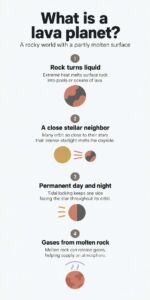
TOI-561 b is no ordinary rocky world. It orbits its host star every 10.5 hours — so close that tidal forces have locked one face permanently toward the star. At that distance, radiation bombardment should have stripped away any atmosphere long ago, leaving behind a bare, scorched rock.
Earlier temperature readings already hinted that something unusual was going on. The planet’s dayside ran significantly cooler than models predicted for an exposed rocky surface at that proximity. That gap prompted an international research team — including Dr. Anjali Piette of the University of Birmingham — to look harder, and they published their findings in The Astronomical Journal.
What JWST’s phase-curve technique revealed
The team used a method called a phase curve. By tracking how the planet’s brightness and heat output changed across its full orbit, researchers could map both the permanently lit dayside and the perpetually dark nightside — the first time the nightside had been examined directly.
The 37-hour observation window covered nearly four complete orbits, letting the team build a detailed thermal portrait rather than catching a single snapshot. The nightside wasn’t warm enough to account for all the heat the dayside appeared to be shedding, which ruled out heat redistribution as the sole explanation. The data pointed instead toward reflection: TOI-561 b bounces back roughly 75% of the starlight that reaches it — comparable to Venus.
Silicate clouds acting as a natural sunscreen
To understand what could produce such high reflectivity, the team ran computer climate models and compared the results against JWST’s measurements. The simulations suggest that clouds rich in silicate minerals — including silicon dioxide (SiO₂) and magnesium silicate (MgSiO₃) — may form over the dayside, intercepting incoming radiation before it reaches the surface. Heat redistribution from dayside to nightside adds another moderating layer on top of that.
The effect works like a planetary sunscreen, bouncing energy back into space and keeping surface temperatures lower than they’d otherwise be. The atmosphere’s actual chemical makeup remains unknown. A thick carbon dioxide layer or one dominated by sulfur dioxide — resembling conditions on Jupiter’s volcanic moon Io — are both possibilities.
Could a global lava ocean be keeping the atmosphere alive?
TOI-561 b’s surface is almost certainly covered by a global ocean of molten rock, and that ocean may not be a passive feature. It could function like a planet-wide volcanic system, continuously outgassing new material and replenishing the atmosphere faster than radiation strips it away — helping explain how any atmosphere survived billions of years of intense irradiation.
Dr. Piette put it plainly: “Our discovery challenges current theories. We would expect a heavily irradiated rocky planet like TOI-561 b to have lost its atmosphere billions of years ago. Instead, the evidence suggests it still has a significant atmosphere today. This raises major questions such as whether the planet started with an unusually large supply of gases or if the ocean of molten rock covering its surface acts as a planet-wide volcano that is constantly feeding its atmosphere.”
What comes next for TOI-561 b
The team isn’t finished with this planet. Planned follow-up observations with JWST at longer wavelengths could reveal the chemical fingerprints of the atmosphere — the key to distinguishing a Venus-like composition from an Io-like one. That distinction matters well beyond TOI-561 b itself.
Professor Lisa Dang, who led the project at the University of Waterloo, framed the next step directly: “The next big question we will seek to answer is whether TOI-561 b’s atmosphere resembles Venus or an extreme version of Io. Observing the planet at longer wavelengths with JWST could give us insights and help explain how a planet this hot has held on to an atmosphere for billions of years.”
That answer could reshape how scientists think about atmospheric survival on rocky worlds — and what conditions might allow a planet, against all odds, to hold on to what it has.
Read the whole thing?
Get the week's signal, not the noise
Our sharpest reporting on energy, climate and nature — free, once a week.