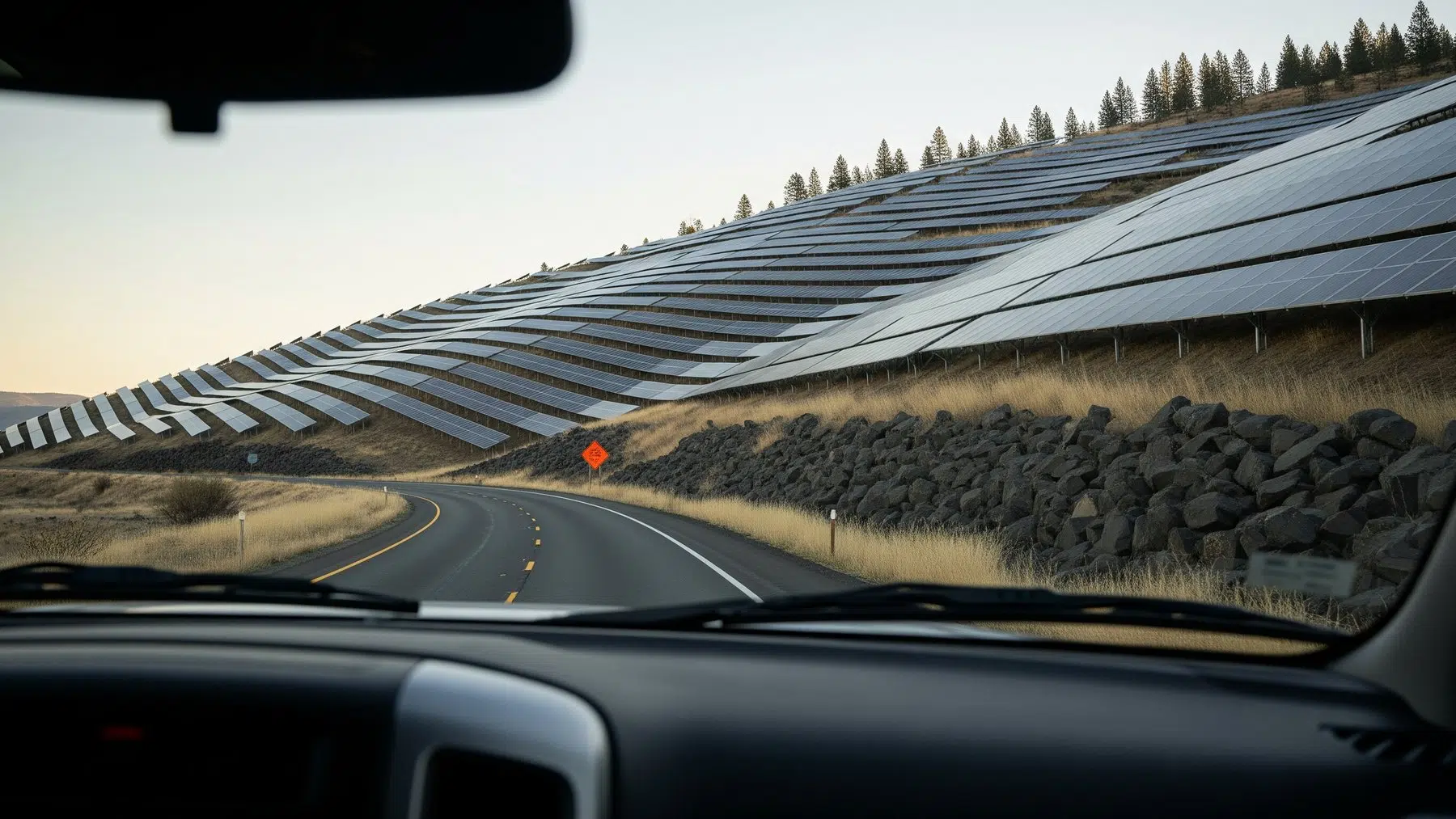
Just after dawn on Interstate 84 near Pendleton, Oregon, a driver drops into a long dip in the road.
For a heartbeat, the whole hillside ahead flares blinding white.
It is not the sun itself, but a mirror the size of a small neighborhood.
The flash is fierce enough that drivers began to complain.
And the source is a brand new solar farm.
So how does a field of dark panels turn into a roadside mirror?
The sign no one expected to need
The fix ended up being almost comically low tech. After the morning complaints piled up, the state highway agency did not move the panels or dim the sun. It simply bolted a metal warning sign to the roadside, alerting drivers to solar glare ahead.
So the giant mirror got a caution sign.
The sign was not free, but it was cheap next to the alternatives. Highway crews spent about 6,260 dollars on it, a rounding error beside the array it warns about. Moving 20,000 panels or regrading a hillside would have cost a fortune, so officials said a plain sign was the quickest way to keep traffic moving safely.
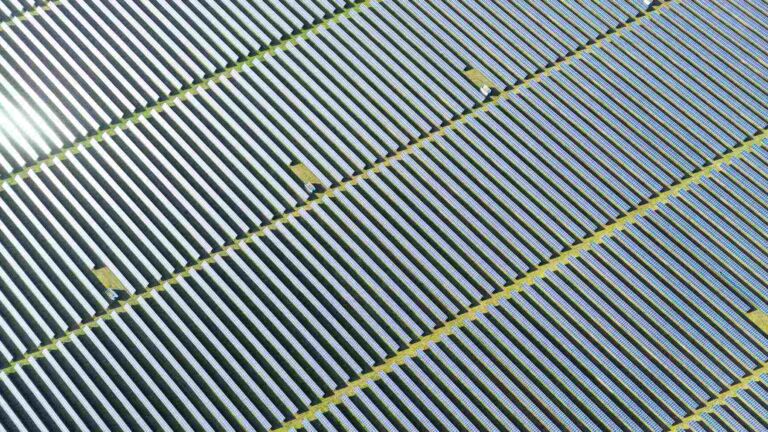
Because the array itself is enormous. Spread across the slope sit 20,000 solar panels rated at 6 MW, a 12 million dollar project built to feed the local grid. Nobody planning it expected it to double as a mirror aimed at the freeway.
How a solar panel becomes a mirror
A solar panel is built to swallow light, not bounce it, yet its smooth glass face still reflects. At a steep angle the glass looks dark and drinks the sun. At a low, grazing angle it turns shiny, the same way a calm lake blazes at sunset.
So dawn is the worst moment of all.
Sunrise is exactly that grazing angle. As the sun climbs low over the horizon, its light skims across the tilted panels and glances off toward the valley. A whole field of glass then throws one broad sheet of light.
And the road sits right in its path. The dip in the interstate lines up under the hillside, so the reflected beam pours straight down onto the morning traffic.
One hillside, 20,000 panels
The site has a fitting name, Airport Hill, a bluff just outside Pendleton. The array covers close to 58 acres there, roughly 45 football fields of dark glass laid across the slope that faces the road.
It was built for good reasons. The 6 MW of panels feed clean power into the regional grid, and a bare, sunny hillside is exactly the kind of spot developers look for. The land was cheap, open and steeply angled toward the light, and utility crews wanted the power close to town, right beside the lines already running past the hill.
But that same angle was the trouble. Tilted to grab the sun, the panels also caught it low and flung it at the cars below.
A problem hiding in the geometry
The strange part is that this was all predictable. Glare from a solar farm is not random, it follows from three known things, the tilt of the panels, the track of the sun, and the height of anything watching from below.
Modelers can map it before a single panel goes up, the same hidden math that shapes an offshore wind farm’s layout. Reporters who followed the Pendleton array found a site that ticked every box for power, and one nobody had checked hard enough for glare.
So most solar farms never blind a road at all. A slightly different tilt, a low screen of trees, or a panel coating can send the stray light somewhere harmless. Plenty of arrays near highways get exactly that treatment before anyone on the road ever notices.
What a warning sign really says
One roadside sign is a small thing, but it carries a real lesson. Solar is going up fast across the country, on hillsides, deserts and rooftops, and where it lands now matters as much as how much power it makes. The country adds gigawatts of it every year, faster than the rules for where to put it can keep up.
Glare is one of the easy problems to solve, once someone looks for it. A tweak in angle or a strip of screening fixes it, the same way a fox settles back in around some solar panels once the site is planned with it in mind.
And the farm itself is doing its real job, feeding clean power to the grid every day. The sign is just a reminder that a good idea still has to be pointed in the right direction.
For now, drivers dropping into that dip at dawn at least know the flash is coming.
Read the whole thing?
Get the week's signal, not the noise
Our sharpest reporting on energy, climate and nature — free, once a week.