Stand at the foot of a wind turbine in western Poland and the loudest thing is not the blades.
It is a low hum, rising from the ground.
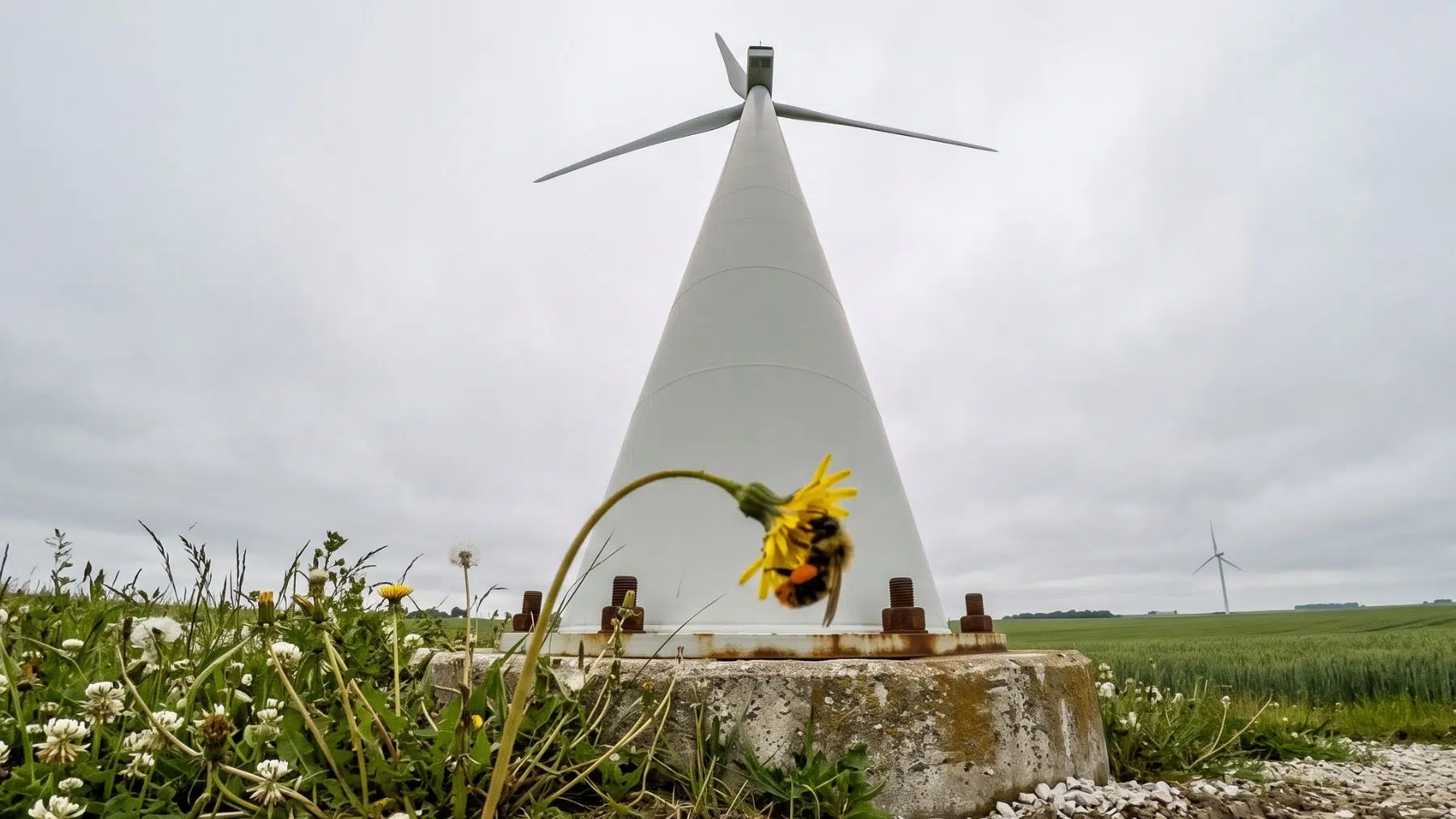
The tower climbs up to 394 feet, bolted to a concrete slab in a field farmed edge to edge.
Around that slab runs a thin ring of dirt the plow never touches.
So what moved into it?
The gravel ring beat the farm around it
When a research team finally counted, the bare little pads were not dead ground at all. Wild bees reached their highest numbers right there on the turbine bases, as rich and varied as the natural grassland kept nearby for comparison, and on several measures a step above it.
The sprayed crop fields all around told the opposite story. They held far fewer bees, a thin scatter against the busy ring at the tower’s foot, and that gap was the whole finding.
Flies, by contrast, did not follow the bees. They turned up in much the same numbers on the pads and on the grassland, so the strong pull toward the bases was a bee story, not a general insect one. Butterflies leaned the other way and favored the open meadow instead.
A patch of ground that escaped the plow
None of this was planned. Every turbine needs a cleared service pad so a maintenance truck can reach the tower, and in this part of Poland that pad is one of the only spots for miles that never meets a sprayer.
So the farmers work their wheat and rapeseed right up to the concrete, then stop. On the untended ring, weedy flowering plants move in on their own, season after season, with nobody to seed or tend them.
So the plow just steers around it.
And nobody ever decides the pad should become habitat. It simply fills with bloom across a whole wind farm, dozens of towers each rated at about 1.5 megawatts and standing on its own square of gravel and grit. So the result is an accidental chain of flowering islands, strung out across the fields.
How the bees got counted
Because the pads sit in the middle of an intensive farm, the team needed a fair way to weigh them against everything else. So at each turbine they swept an insect net through the flowers, fifty passes within about six feet of the base, timed to roughly a minute apiece.
Then they ran the same sweeps in the surrounding crop fields and on patches of open grassland kept as a benchmark. Three kinds of ground, measured in exactly the same way, through the same weeks of summer.
The work was slow, because every wild bee had to be logged by species, one insect at a time. Yet the sample grew large enough to hold up to real statistics, repeated through the flowering season and across many turbines so a single rich pad could not skew the result.
Why the bees, and not the wheat
So why would bees pack onto a strip of grit? Part of the answer is underfoot. Many wild species are solitary rather than hive dwellers, and they need bare, undisturbed soil to dig their nests, something a tilled field never offers and a pad edge readily does.
The effect was strongest where grassland lay farthest away. In other words, the pads mattered most in the emptiest stretches of farm, exactly where a pollinator has nowhere else to turn.
The published field survey put it plainly, noting that the ground around the towers can act as refuges for pollinators in intensively farmed country. It is the same logic that turns an offshore wind farm into a reef where fish gather.
What a wind farm could plant
None of this makes a wind farm a nature reserve on its own. The benefit hangs entirely on what grows on the pad, and where crews keep the square as bare gravel or mow it to stubble for access, the bloom never comes.
Worse, the same spraying that empties the fields can reach the pads too, since herbicides and pesticides are often applied to the graveled squares directly. And scale is the hard limit, because a well flowered pad covers only a sliver of an acre and a handful of them cannot replace the hedgerows and meadow strips a whole landscape needs.
Still, the fix costs almost nothing. Seed native wildflowers at the base when the turbine goes up, then leave the ring alone, and each tower becomes a working patch for wild bees from its first summer. It is a small, cheap win in a country where wild pollinators have thinned for decades, the same trick that turned one solar site into a refuge.
Read the whole thing?
Get the week's signal, not the noise
Our sharpest reporting on energy, climate and nature — free, once a week.