A boat crossing that stretch of open water would have seen almost nothing at all.
Just under the surface, a chunk of broken fiberglass was riding the swell like a half submerged log.
It belonged to a turbine still being installed at Germany’s largest offshore wind farm.
Work boats at the site tried to grab it and could not.
So the call went out to the federal police instead.
What made one broken blade so hard to catch was hiding below the waterline the whole time.
A blade riding just under the waterline hid in plain sight
The piece had snapped from a turbine under construction at the He Dreiht wind farm, roughly 53 miles northwest of the island of Borkum, and was reported adrift between that site and the operating Hohe See array next door. Instead of sinking or floating high and visible, the broken section settled just beneath the surface, buoyant enough to drift but too low to catch the light.
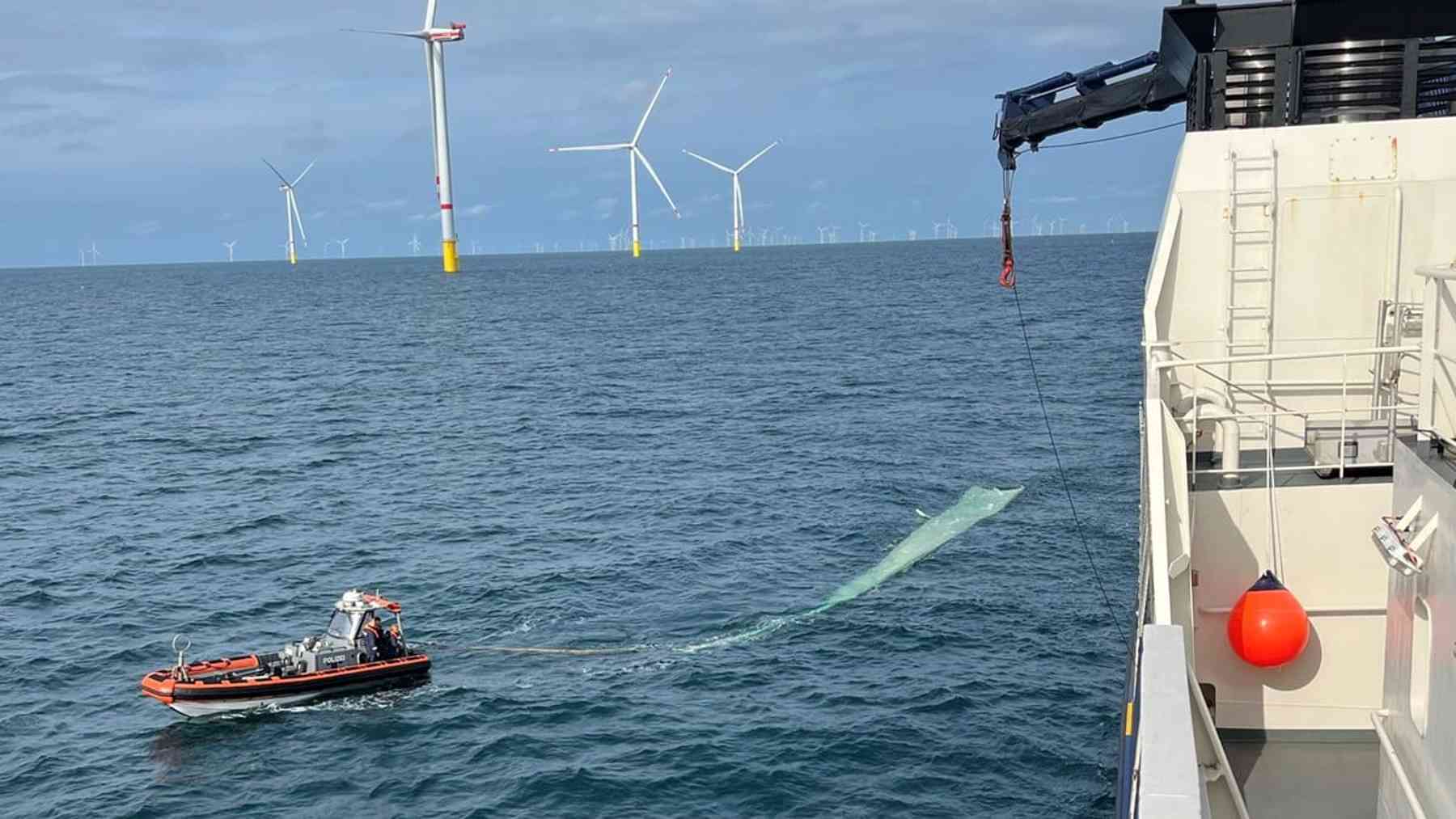
Federal police described the fragment as about 66 feet long and 6 feet wide, made of glass fiber reinforced plastic, and a significant risk to shipping precisely because it was drifting just below the water surface and was difficult to detect. A patrol vessel was sent out to secure it and redirect vessel traffic around the position.
That is the strange part. A chunk of material the length of a city bus was essentially invisible to anyone steering a boat through the area at speed.
The same low profile that let it slip past the operator’s own work boats, which tried to recover it and failed, is what turns ordinary flotsam into a real collision risk for anything moving fast across open water.
Cutting the blade into sections took a saw and a stern slipway
Getting a waterlogged, half submerged blade fragment onto a deck is not as simple as tying a rope to it. By the federal police account, the blade was first towed to the patrol vessel by a control boat, then hauled up over the ship’s stern slipway, and sawn into several sections during the operation so the whole length could be brought aboard.
The pieces were later lifted ashore by crane at Cuxhaven.
So the fix for a floating hazard that outsized machinery could not out muscle turned out to be the oldest trick in salvage: cut it down until it is small enough to lift. A single rigid piece of composite material that size will not bend around a slipway.
Out at the turbine itself, something had gone wrong in a spot nobody could fully see from a boat deck either.
64 towers and 192 blades make up the wind farm
The broken piece came from one of the first Vestas V236 machines in commercial service, a 15 megawatt turbine making its offshore debut at this exact wind farm. Each blade on that platform runs about 380 feet, so losing a 66 foot section is a serious structural event rather than cosmetic damage. Sixty-four towers stand at the site, three blades apiece, 192 in all.
The operator says the blade failure was detected on July 22 and that nobody was hurt. Certain activities at the wind farm were paused afterward while the manufacturer ran a root cause investigation, which narrowed to a specific area of the blade without reaching a published conclusion.
Because this is the first large scale deployment of the design, the question was never only about one component. Full output at the site slipped past the original late summer target while that work continued.
A similar blind spot shows up nearly two miles down in Oregon too
Low visibility is not unique to broken turbine blades. Crews chasing underground heat at a drill near an Oregon volcano work almost entirely from instrument readings, because nothing thousands of feet down can be observed directly.
A blade drifting a foot under the surface and a drill bit thousands of feet down share the same basic problem. Position and scale have to be judged from the outside, by people who cannot see the thing they are chasing.
Offshore wind’s deep water cousins face a harder version of this. A tidal platform off Nova Scotia was built so crews could raise its rotors clear of the water for service rather than leave failed parts sitting unseen on the seabed.
So the He Dreiht blade got lucky in one sense. It drifted in a watched stretch of sea, so somebody found it floating rather than lost on the bottom.
Full power is still pending months after the September inauguration
Nobody aboard any vessel near the drifting blade was injured, and the operator announced on August 12 that all 64 turbines had been installed, with technical and electrical commissioning still to follow. The 960 megawatt project was formally inaugurated in September, is already feeding the German grid, and is being brought up to full capacity in stages.
The cause of the original break has not been published in detail. Even so, the episode is a useful reminder of how little margin for error exists once hardware this large sits miles offshore.
A blade that cannot be spotted from a passing boat is a problem measured in feet of freeboard, not megawatts of capacity. As more of these first of their kind machines go up around the world’s coastlines, how quickly crews can find, secure and haul in a failed part may end up mattering just as much as how rarely parts fail in the first place.
Read the whole thing?
Get the week's signal, not the noise
Our sharpest reporting on energy, climate and nature — free, once a week.