
For most of the modern era, the Des Plaines River in Illinois looked like a slow brown pond.
Old concrete dams held it back, turning a river into a chain of stagnant pools.
Then crews started pulling the dams out, one by one.
The river began to remember what it once was.
And downstate, on another Illinois river, something even stranger surfaced.
So what shows up when a river is finally set loose?
A sturgeon no one had seen in living memory
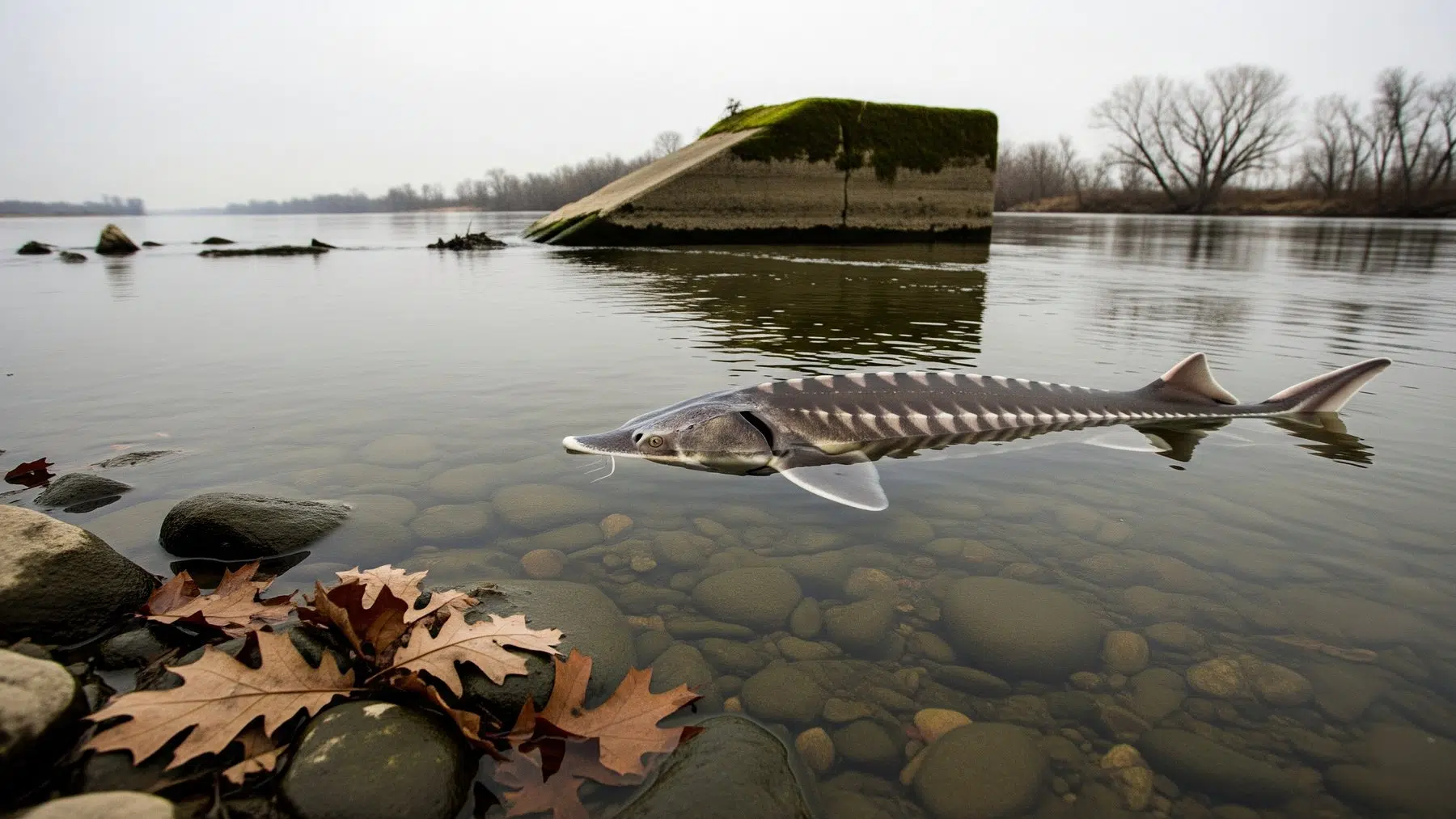
The most striking moment came far to the east, on the Vermilion River near Danville. After the state pulled an old dam out of the water there, biologists from a nearby university kept watching what moved through, and one season later they logged a sturgeon. It was an ancient, armored fish never recorded in that stretch before.
Nobody had put it there.
The fish had simply swum up newly open water the moment the concrete came out, reaching habitat that a dam had walled off for generations. One removal, and a creature out of deep time found its way back.
A sturgeon is not a fish that turns up by accident. Some kinds live for decades and were once native to these waters, so a single one in a place it had vanished from is a sign the whole river is starting to heal.
How concrete cut a river into pieces
A low dam does more damage than it looks. It turns moving water into a slack pond, warms it, starves it of oxygen, and blocks every fish and mussel trying to move upstream. A river stops behaving like a river.
Behind the old Hofmann Dam, the Des Plaines did exactly that.
For decades the water there sat slow and stagnant, more a reservoir than a stream. Pulling the dam out let the current run again, scouring the bed clean and handing the channel back to the fish and mussels that need flow.
Most of these barriers were never big power dams to begin with. They were low mill and diversion dams built long ago, many of them now useless, and some so dangerous that swimmers have drowned in the churning water below them.
Seventeen dams out, 100 miles running free
The Vermilion fish was no fluke. Over about five years, Illinois has pulled roughly 17 dams out of its rivers, and nine of them came off the Des Plaines alone. Those removals opened more than 100 miles of that river to flow freely for the first time in decades.
The response came fast.
In a single year after the work, biologists watched the number of fish species climb by about 6 percent, and one called the effect almost immediate. With the dams gone, fish could suddenly reach spawning grounds that had been sealed off for a century.
The push started with the Hofmann Dam in 2012, the first of a statewide campaign. What began as one project became a model, with agencies and river groups picking off obsolete dams across Illinois year after year, much of it paid for with restoration money.
The mussel that needs a living river
Among all the returning animals, the freshwater mussel may be the most reliant on a river set loose. A grown mussel barely moves, yet its larvae hitch a ride on the gills and fins of passing fish, riding upstream before dropping off to settle, the same hidden linkage behind an offshore wind reef.
Dam out the fish, and the mussels stall too.
When a barrier blocks the host fish, the mussels cannot spread, which is why so many of Illinois’s freshwater mussel species have slid onto threatened lists. Free the fish, and the mussels get their ride upstream back.
Mussels earn their keep once they return. A healthy bed of them filters huge volumes of river water, cleaning it for every other creature, so their comeback ripples out well beyond the mussels themselves.
What remains, and what the river still needs
None of this means the work is done. The state has taken out well over a dozen dams, but many old barriers still stand, and each one keeps its own stretch of river locked in place. The map still has plenty of gaps to close.
The Vermilion shows how much is left to gain.
Not everyone cheered the removals at first. Some anglers worried the deep pools behind the dams held better fishing, though the open river has since drawn back more species than it lost.
Removing two more dams there could open another 175 miles of river, letting fish and mussels reach even farther, the way a fox settles in around some solar panels once a place turns friendly. Groups tracking the rebuilt river say the recovery keeps widening every year.
A sturgeon nosing through a stretch no one alive had ever seen it in is proof of the plainest fix, take out the wall, and the river does the rest, season after season.
Read the whole thing?
Get the week's signal, not the noise
Our sharpest reporting on energy, climate and nature — free, once a week.


