
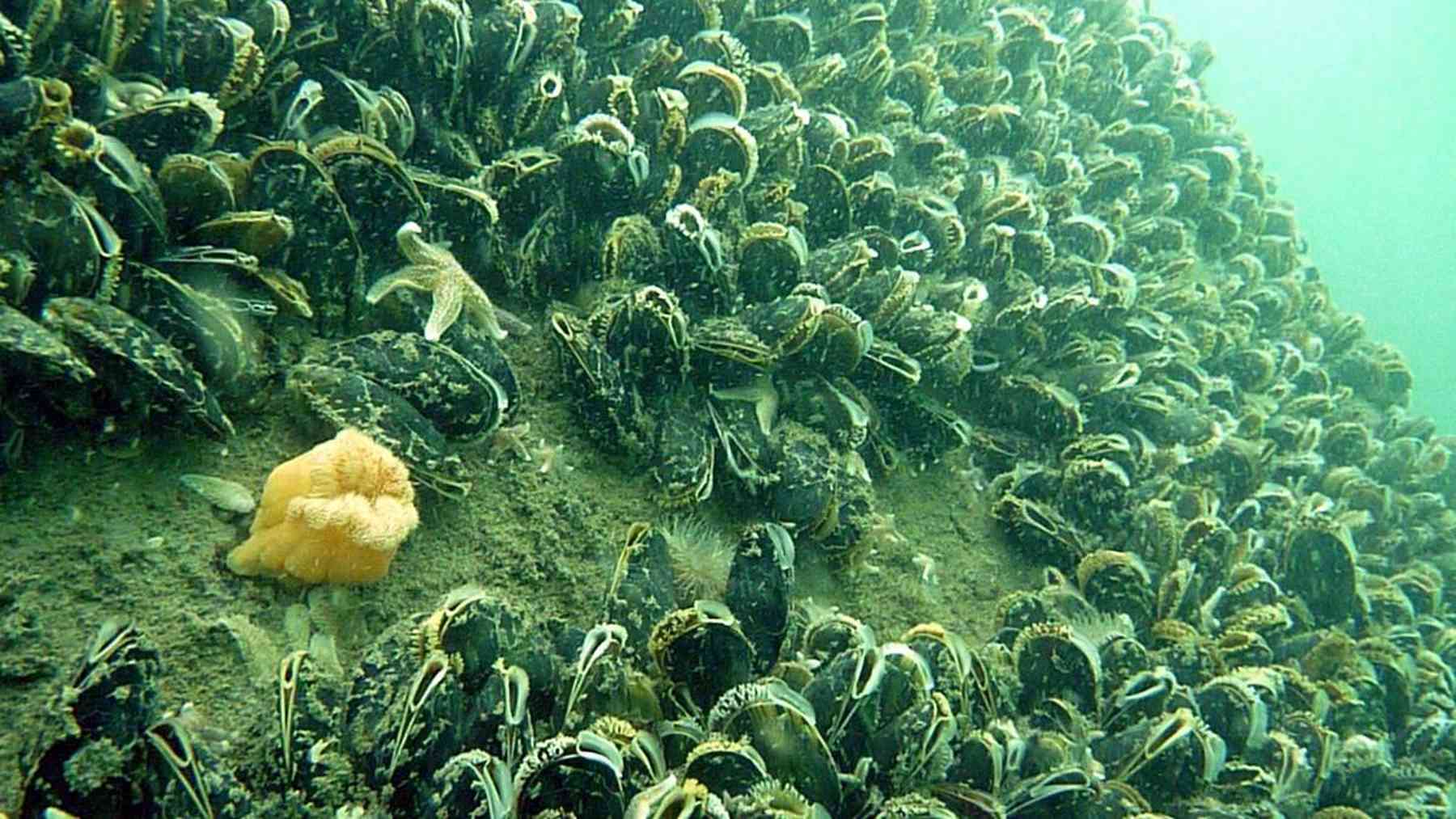
A single steel leg rises out of the North Sea, barely visible below the waves.
Every inch of it below the surface is covered in something alive.
Blue mussels, packed shoulder to shoulder, cling to the steel in a thick living crust.
Every so often, one lets go.
It falls, slow and spinning, down through the water toward the sand.
Researchers who worked their way down one of these towers wanted to know how much was falling, and why.
Why does a wind turbine leg grow its own reef of shellfish?
The mechanism starts with drifting mussel larvae that spend their first weeks in the plankton before they ever touch anything solid. Out in the open southern North Sea there is almost nothing for a young mussel to grab onto, because the seabed there is mostly soft sand and mud for miles in every direction.
A bare steel foundation driven into that sand is, to a larva, the first hard surface it has met in its life. So the larvae settle, and they settle thickly. On turbine foundations in Dutch waters, mussels covered 80 to 100 percent of the structure from the waterline down to about 33 feet, with anemones and hydroids taking over below that.
Once a handful of mussels are in place, their own shells become new habitat for the next wave of arrivals, and the colony builds in layers like a coral reef built from pipes instead of coral.
What makes mussels different is that they do not stay forever. As the animals grow, space on the steel runs out, and crowded individuals lose their grip and drop straight down the leg toward the seabed below.
Picture the scene a few feet under the surface
Divers working around these foundations describe a landscape that looks nothing like the open sand nearby. Near the surface, where light and food are richest, the mussel band is thickest, a crust several inches deep in overlapping shells.
Deeper down, the mussels give way to swarming amphipods and then to anemones that dominate the lower reaches, producing a clear vertical succession from the waterline to the seabed. That pattern turns a single plain cylinder into several distinct neighborhoods stacked on top of each other.
Fish move in too. Divers at one North Sea platform repeatedly recorded hundreds of horse mackerel around the structure, and many pouting near its base.
None of this was designed into the structure. Engineers chose that foundation shape for strength and installation cost, not biology, yet the biology arrived anyway, turning a bare patch of ocean into something closer to a crowded tenement building.
The hard numbers pulled from a real North Sea platform
The best accounting comes from FINO1, a steel jacket research platform standing in about 100 feet of water in the German Bight, roughly 28 miles north of the island of Borkum. Researchers sampled its fouling community by depth zone across several years, 183 samples in all, and published the results in 2013 in the journal Marine Environmental Research.
They calculated that 3.45 million single mussel shells were produced over the study period, and estimated that at least 6,000 pounds of biomass left the structure each year. That weight does not vanish, it lands on the bottom as a growing drift of shell.
The same work put the arithmetic another way. With total mussel biomass production on a foundation running near 11,000 pounds a year, somewhere between roughly 479,000 and 2.97 million bivalve shells sink to the seabed annually from that one structure.
Measured over its footprint, the platform concentrated 35 times more bottom dwelling animal biomass than the same area of surrounding soft sediment.
Why the shell pile does not just keep growing forever
The seabed around these structures is not simply burying itself. Currents scatter the fallen material, scavengers work it over, and extreme waves can occasionally strip a turbine of its mussels wholesale, resetting the whole colony.
Scientists also caution that one studied platform cannot stand in for every foundation type across the region. A jacket with narrow legs behaves differently from a wide monopile, and flow conditions shift around any tower depending on depth, current speed and season. The published totals are informed estimates built from real counts, not a census of every shell in the German Bight.
What thousands of steel legs could add up to
A 2025 analysis pooling hard and soft substrate data from Belgian, Dutch and German wind farms found that secondary production of fouling communities on turbines averaged about 80 times that of soft bottom communities. Roughly 71 percent of it is released to the surrounding sediment, and production on the seafloor stayed elevated out to 500 to 800 feet from a turbine.
Thousands more foundations are planned across the southern North Sea, the same stretch of water where a broken blade drifted below the surface before anyone spotted it, and where several tons of jellyfish once jammed the intake screens of a coastal plant in northern France.
What began as plain engineering has become something closer to an artificial outcrop, feeding crabs, fish and the next generation of mussels drifting in from miles away.
Read the whole thing?
Get the week's signal, not the noise
Our sharpest reporting on energy, climate and nature — free, once a week.


