
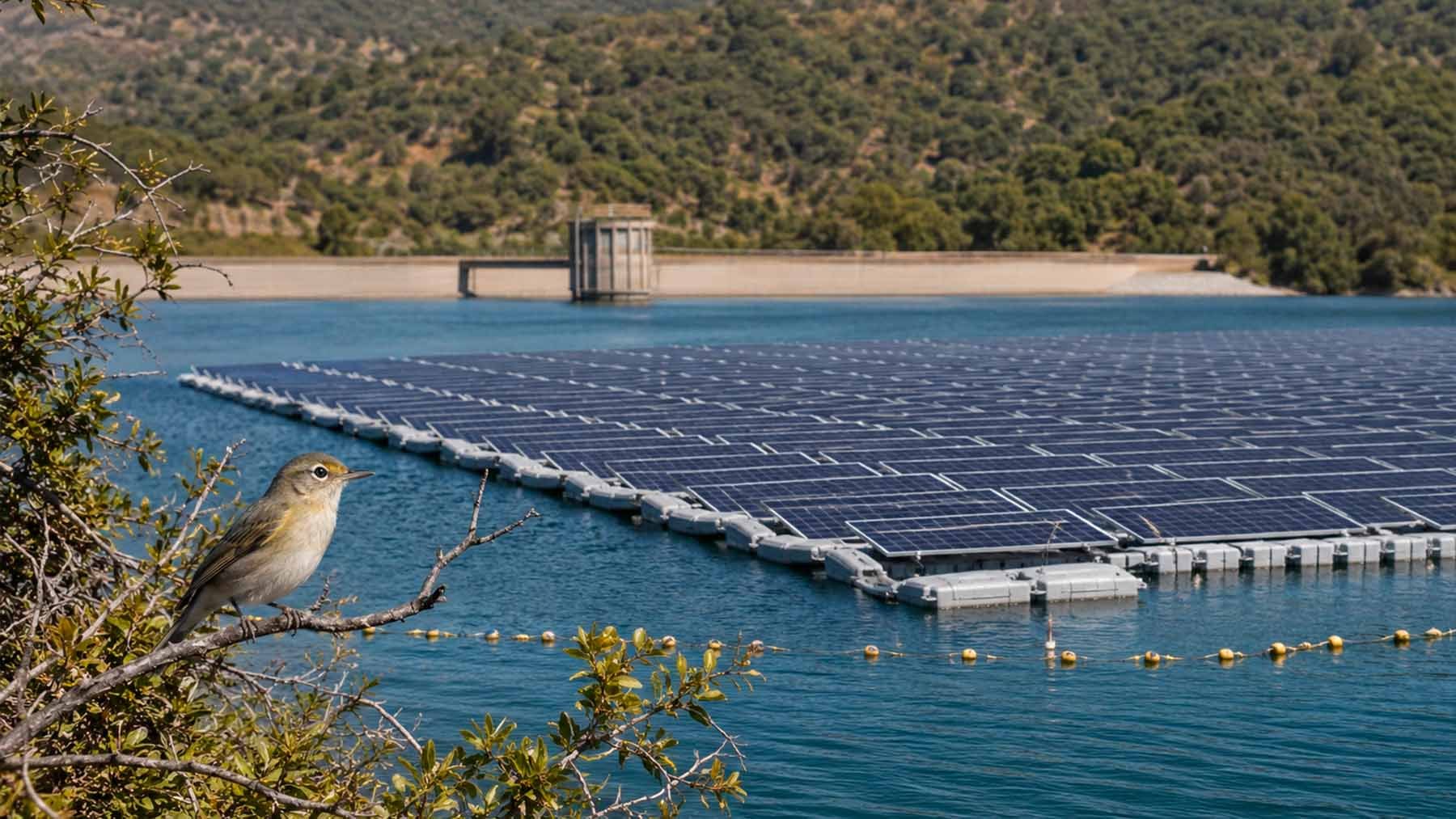
Encino Reservoir has been out of service since 2002, but it sits between Ventura Boulevard and the Santa Monica Mountains.
LADWP is planning a 10-acre floating solar array atop the reservoir and battery storage on the north side.
To proceed, the department needed to determine if endangered songbirds were using the willow stands along the reservoir’s southwestern edge. The target was the Least Bell’s Vireo.
Biologists were sent to make eight trips to the site over three months.
Instead of finding what they were looking for, they created an important addition to the environmental assessment.
Biologists made eight visits to the same reservoir
Biologists surveyed Encino Reservoir on eight occasions from late April through mid-July. These visits followed U.S. Fish and Wildlife Service protocols for the Least Bell’s Vireo, a federally and state-listed endangered species in riparian woodlands.
The surveys require multiple trips during breeding season to confirm absence.
Each visit covered the boat ramp, access road, and proposed ground-mount areas.
The habitat consists largely of Goodding’s willow and red willow.
There is no federally designated critical habitat for the Least Bell’s Vireo at Encino Reservoir. The nearest designated habitat is about 22 miles northwest.
Encino Reservoir was built between 1921 and 1924 and enlarged in the early 1960s before being decommissioned in December 2002.
Since then, the 960-acre property surrounding the reservoir has remained closed to the public.
The project needed more than a bird survey
The plan by the Los Angeles Department of Water and Power includes a 5-MW floating solar array, a 30-kW ground-mount system, and a 5-MW iron-flow battery storage system. The 30-kW ground-mount system was included to give LADWP a direct performance comparison with the floating panels. Additionally, all electrical equipment will tie into an existing 34.5-kV overhead transmission line that currently runs through the property.
This project is expected to generate about 10,280 MWh of electricity per year, enough to power about 2,677 homes.
The California Department of Fish and Wildlife reviewed LADWP’s plans.
Biological surveys at the site in 2022 and 2023 identified yellow warblers and coastal whiptails in the riparian zone. Neither species is federally or state-listed as endangered.
Construction near water and in the Santa Monica Mountains meant LADWP completed a Mitigated Negative Declaration under the California Environmental Quality Act.
LADWP determined that construction impacts would likely include clearing vegetation and impacts on nesting birds and bats. Mitigation measures for each would minimize significant adverse impacts.
What the surveys recorded instead
No Least Bell’s Vireos were seen during any of the eight protocol surveys.
However, biologists noted an abundance of wildlife at the reservoir, documenting 60 species during their surveys.
Of these species, one was classified as an amphibian, three as reptiles, 54 as birds, and four as mammals.
None of these species were identified as being “special status” during the 2025 surveys.
One barrier down, others remained
The lack of detection of Least Bell’s Vireos allowed LADWP to remove one major impediment to proceeding with CEQA analysis.
While this removed one regulatory barrier, it did not negate other biological requirements that must be addressed under CEQA.
On July 14, 2026, LADWP approved its Notice of Determination, allowing them to proceed with construction on-site.
Construction is scheduled to start in July 2026 and conclude by July 2027.
The reservoir still supports wildlife more than two decades after it stopped storing drinking water.
Rather than focusing solely on one endangered species, LADWP will now need to mitigate harm to the 60 species documented during the surveys.
Encino is not the only reservoir where floating solar created unexpected effects on wildlife.
Near London, 23,000 panels were floated on a drinking water reservoir, and the shade changed both the water beneath them and the birds that began using the floats.
Read the whole thing?
Get the week's signal, not the noise
Our sharpest reporting on energy, climate and nature — free, once a week.


