An underwater exploration expedition sponsored by the Ocean Exploration Trust deployed a remotely operated vehicle called Hercules near Jarvis Island. Jarvis Island is a remote U.S. island in the Pacific Remote Islands Marine National Monument.
The expedition aboard E/V Nautilus streamed the dive live and archived the footage for public viewing.
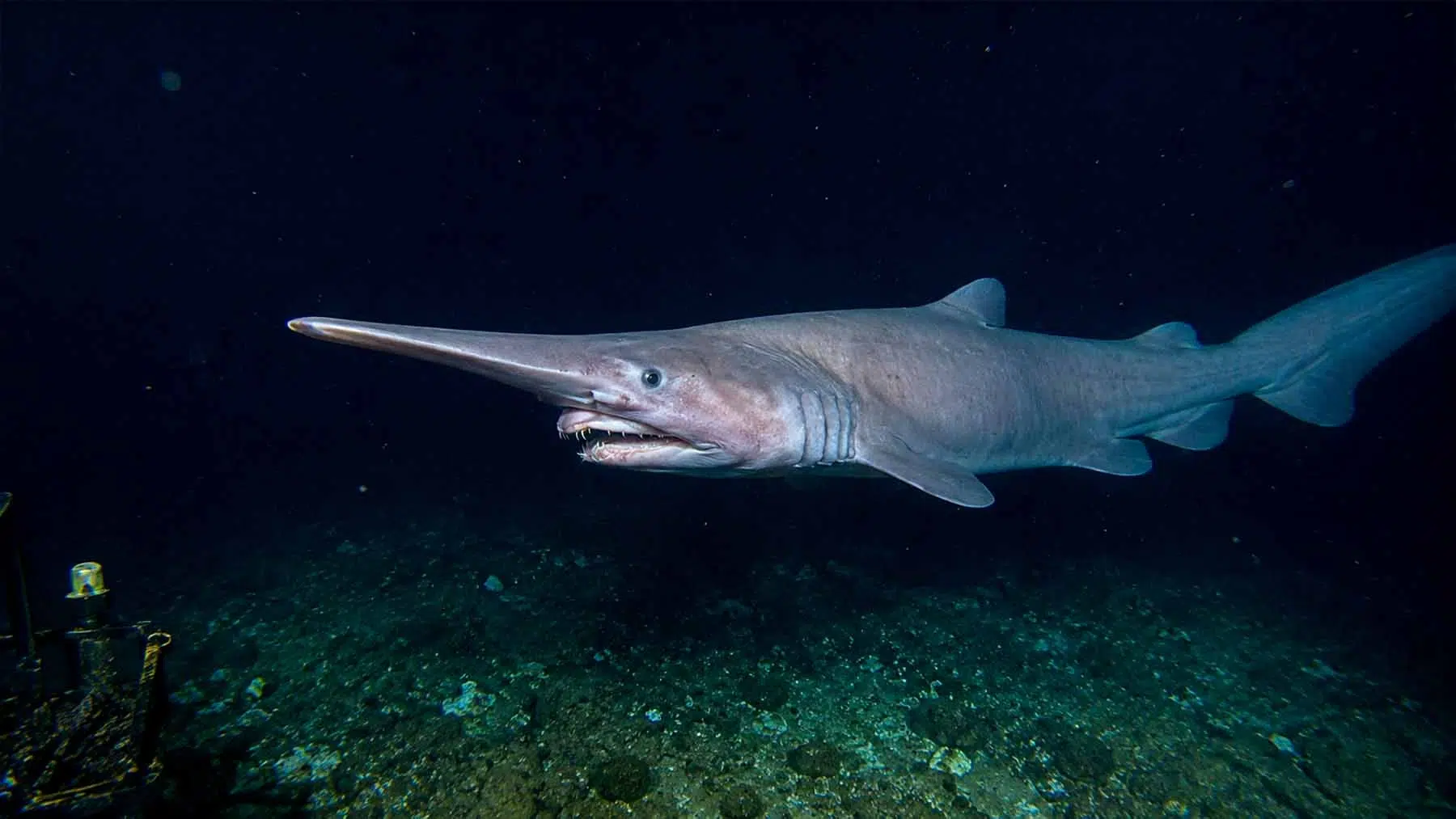
While the camera crew observed a shark swim past, they couldn’t identify it.
The video had been sitting in an archive since 2019 until someone looked at it again in 2025.
The footage sat unnoticed for six years
The 2019 expedition studied deep-sea environments around Jarvis Island, Kingman Reef, and Palmyra Atoll.
A camera system aboard the remotely operated vehicle (ROV) Hercules was used to film the bottom of an unnamed seamount northwest of Jarvis Island. All the footage from the dive was filmed live and archived.
Later, colleagues at the Deep-Sea Animal Research Center were able to annotate previously recorded footage.
In 2025, Aaron Judah, a Ph.D. student in oceanography at the School of Ocean and Earth Science and Technology of the University of Hawai’i, heard colleagues discuss a possible goblin shark sighting from that same 2019 research project. The sighting had come from footage recorded during the expedition.
Judah was surprised.
The species was not previously known to occur in the Central Pacific.
He searched the archived footage from the 2019 dive and confirmed evidence of a goblin shark.
What scientists knew about goblin sharks before this
Goblin sharks are sometimes called “living fossils” because they are the only living representative of their family, a lineage nearly 125 million years old.
School of Ocean and Earth Science and Technology researchers verified the identification.
University of Hawai’i scientists called it the first live observation in a natural habitat.
Prior to these new discoveries, most filmed documentation of a living goblin shark was taken under very different circumstances. Each time, the shark had been caught on a hook and line and hauled to the surface, where divers observed it before it died. There was no prior documentation of footage showing a healthy goblin shark acting naturally in its deep-water home environment.
Historically, goblin sharks had been reported off the coasts of the United States, Australia, and Japan. Additional reports came from limited areas of the Atlantic and Indian Oceans.
However, due to a lack of observation data, there were many unknowns regarding the species’ actual distribution.
What the archived video and a second sighting revealed
The archival footage obtained by University of Hawai’i researchers shows a goblin shark swimming near an unnamed seamount northwest of Jarvis Island. Researchers published their findings related to this initial observation in the Journal of Fish Biology.
The footage showed the shark swimming and behaving naturally at depth.
This represented the first documentation of a living goblin shark found in its natural habitat.
The same team also reported a second observation from the Tonga Trench. A baited camera on a bottom lander captured footage of another goblin shark on the slope of the Tonga Trench.
This second sighting extended the existing depth record for the order Lamniformes. The group includes white sharks, basking sharks, and makos.
Both observations greatly increase our understanding of the geographical extent and depth distribution of this 125-million-year-old species.
These two observations will allow goblin sharks to be included in regional management plans and national biodiversity lists. Some of those countries did not previously know goblin sharks inhabited their waters.
The goblin shark was not the only deep-sea animal to sit in an archive before anyone noticed it.
Off the California coast, researchers used a remote-operated vehicle to film a bumpy pink snailfish about 10,722 feet below the surface, and it took nearly six years to identify the fish.
Read the whole thing?
Get the week's signal, not the noise
Our sharpest reporting on energy, climate and nature — free, once a week.