Blood Falls is a striking feature that looks like it doesn’t belong.
A bright red waterfall flows from the glacial ice in one of the driest areas found in Antarctica.
The red coloration is well understood, but the life present is much less clear.
Whilst the environment appears to be quite isolated now, it is hard to see the link to the ocean. However, the organisms present could give clues to a much older history.
Some of the best clues came from the bacteria itself, with this preserved biological evidence helping reveal the story.
Ancient brine preserved a hidden microbial community
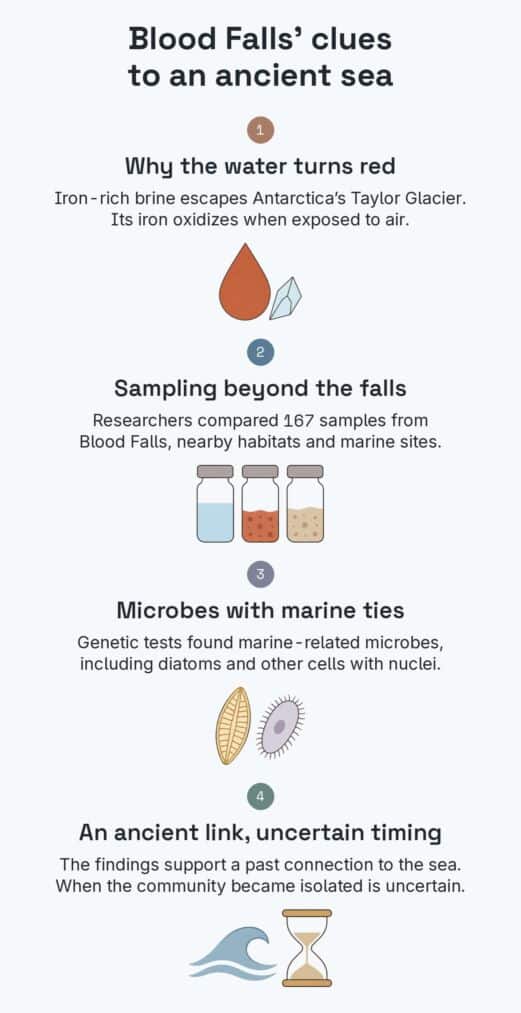
Iron-rich brine flows from the bottom of Taylor Glacier.
When it comes into contact with the air, the striking red falls form.
However, the brine was also transporting communities of microorganisms from the glacial ice.
Bacteria had already been identified here. There were complex organisms present, and the communities they belonged to were key.
The findings suggested the brine had left behind some evidence of a previous marine environment.
Harsh surroundings deepened the environmental mystery further
Blood Falls is located towards the end of the Taylor Glacier, which is found in a region of Antarctica called the McMurdo Dry Valleys.
It is one of the coldest and driest deserts on our planet. The waterfall flows into the area around Lake Bonney.
However, there isn’t much evidence that this area is close to a marine environment. That created confusion between what the biology indicated and what the current landscape suggested.
The environment was also extremely important, as it helped determine whether the signal was meaningful.
Extensive sampling revealed contrasting biological community signals
167 samples were analyzed across a wide range of sources, including water, sediment and aeolian material.
Using genetic analysis, different eukaryote and prokaryote groups were identified.
Results were then compared across the different environments. The red ice, sediment, and mud around the end of the glacier were dominated by microorganisms associated with the marine environment.
Surrounding locations were dominated by freshwater and terrestrial communities.
The results suggest that the brine supported a strong marine affinity, though only those environments sampled can be directly interpreted, as reported in Nature Geoscience.
The biological evidence provided more support, according to findings discussed by Yale University.
Modern samples could not explain the full story
Not all stages can be seen in modern biological samples.
Whilst genetic evidence can provide great clues to relationships, it cannot fully tell the complete ecological story.
As the material comes from aeolian sources, interpreting it can be tricky.
Organisms may not have come from that area. The analysis focused on trends in communities, and there were multiple indicators suggesting the same thing.
Scientists still needed to make sure the signal was long term, which remains difficult to verify.
Past shoreline changes shaped long-term biological survival
Previously, there has been geochemical evidence suggesting that Taylor Valley had a connection to seawater during warmer periods.
The conditions would have been very different. However, this changed due to lowering sea levels.
The advancing glacial ice helped to isolate the water.
A strong environmental filter emerged, meaning only those organisms which could survive the new conditions would remain.
Eventually, the ecosystem adapted to the extreme conditions. The marine signal remained, creating a community which have survived a large environmental change.
Unanswered timing questions continue driving further exploration
One of the main issues is knowing when the isolation happened, and scientists would still like to determine exactly when.
The organisms may hold evidence of this change. As they have survived, they created a rare biological record.
Future work could link together the evolution of the landscape and the adaptation of the microorganisms.
Such work could help explain how life survives through dramatic changes in the environment, and the oldest clues may still be hidden underneath the ice.
Read the whole thing?
Get the week's signal, not the noise
Our sharpest reporting on energy, climate and nature — free, once a week.