

During the winter, there is an issue with debris and ice forming around the intake.
Over several winters, they noticed that certain conditions in the river resulted in fewer issues occurring.
This was a unique engineering problem because the solution required stopping the movement of ice.
A floating structure was eventually used to solve it.
Stable surface conditions changed the entire operating equation
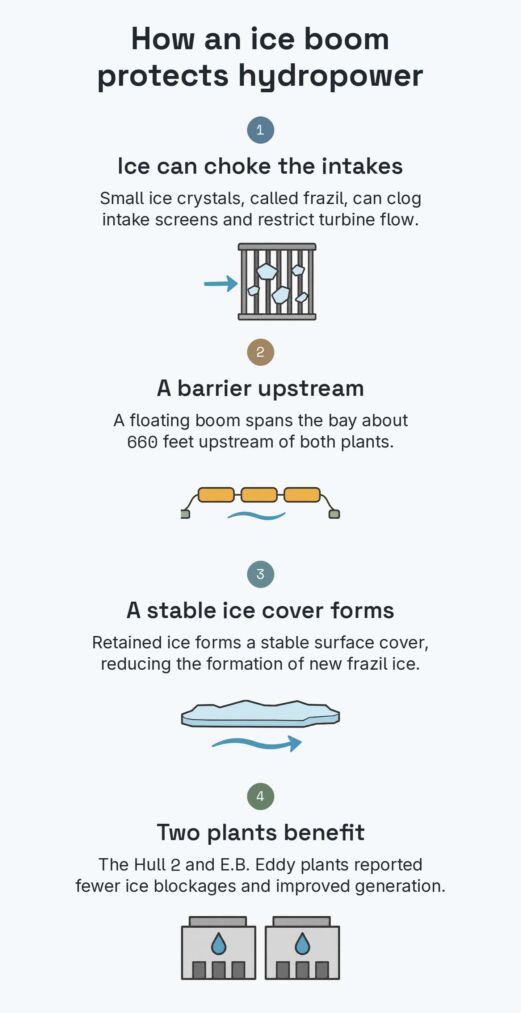
Frazil and slush can build up on trash racks, reducing the amount of water flowing through.
Less water means less electricity can be generated. Having a stable surface results in the debris interacting with the ice.
Much of the debris breaks upon impact and sinks beneath the surface, where movement is affected by underwater currents.
From observation, it was found that having a stable environment resulted in fewer blockages. So, the structure acts as a preventative measure.
One installation protected both generating facilities simultaneously
The project has two separate generation sites. One is run by Hydro-Québec, and the other by E.B. Eddy Forest Products Ltd.
Both sites are situated on the north side of the Arch Dam, and extra water is removed from the river via gates.
By placing the structure across the whole bay, engineers can make sure one installation will affect both sites.
The installation was placed around 200m upstream (approx. 600ft) from the intakes.
By knowing where to place the structure, engineers could ensure it would be effective because a poor location would reduce its impact.
Repeated winter observations justified the overall design
Observation was taken during the winter of 1996/97 and showed regular issues with operations, as described by the International Association for Hydro-Environment Engineering and Research.
Ice would build up around the installation causing issues with production, and these issues would last for up to 10 weeks.
By comparing the before and after, less ice was building up around the sensitive machinery.
The comparison suggests the method was working, as more electricity was being generated during winter, a result also highlighted by Geniglace.
Calculations were done for the design, including the expected loading, pontoon requirement, anchoring resistance and, cable size, all based on local conditions.
Available records could not capture every scenario
It is impossible to know what every winter will be like.
River systems will act differently, and the number of debris will vary.
Depending on the situation, there may be different quantities, movement, and types of debris.
A stable surface may not form every year. Slight changes in the environment may affect this.
Engineers can be confident that calculations can be done for known situations, though there is less information for unknown situations.
Such limitations are common when designing something for a river, as there are rarely records of every situation that could occur.
Incoming river material varies depending on its origin
Depending on where the debris comes from, it will be of a different nature.
Chats Falls will produce debris with large chunks of ice which can be greater than 10cm thickness as it is very cold.
However, in some cases, the debris will be less. Pancake ice, slush, and frazil will occur more frequently.
The quantity of debris is very important, as little will cause less problems with major clogging.
The winter performance depends on many factors, as the structure will perform differently depending on the conditions that are coming in.
Long operating experience still informs future improvements
Decisions will need to be made in the future to ensure the structure will perform reliably throughout varying winters.
The structure has been in use for decades, providing plenty of real-world operating experience.
Now the focus is on improving the design. Since it works well, designers are looking at ways to improve the longevity and reliability.
Decisions will depend on the conditions each winter.
Read the whole thing?
Get the week's signal, not the noise
Our sharpest reporting on energy, climate and nature — free, once a week.


