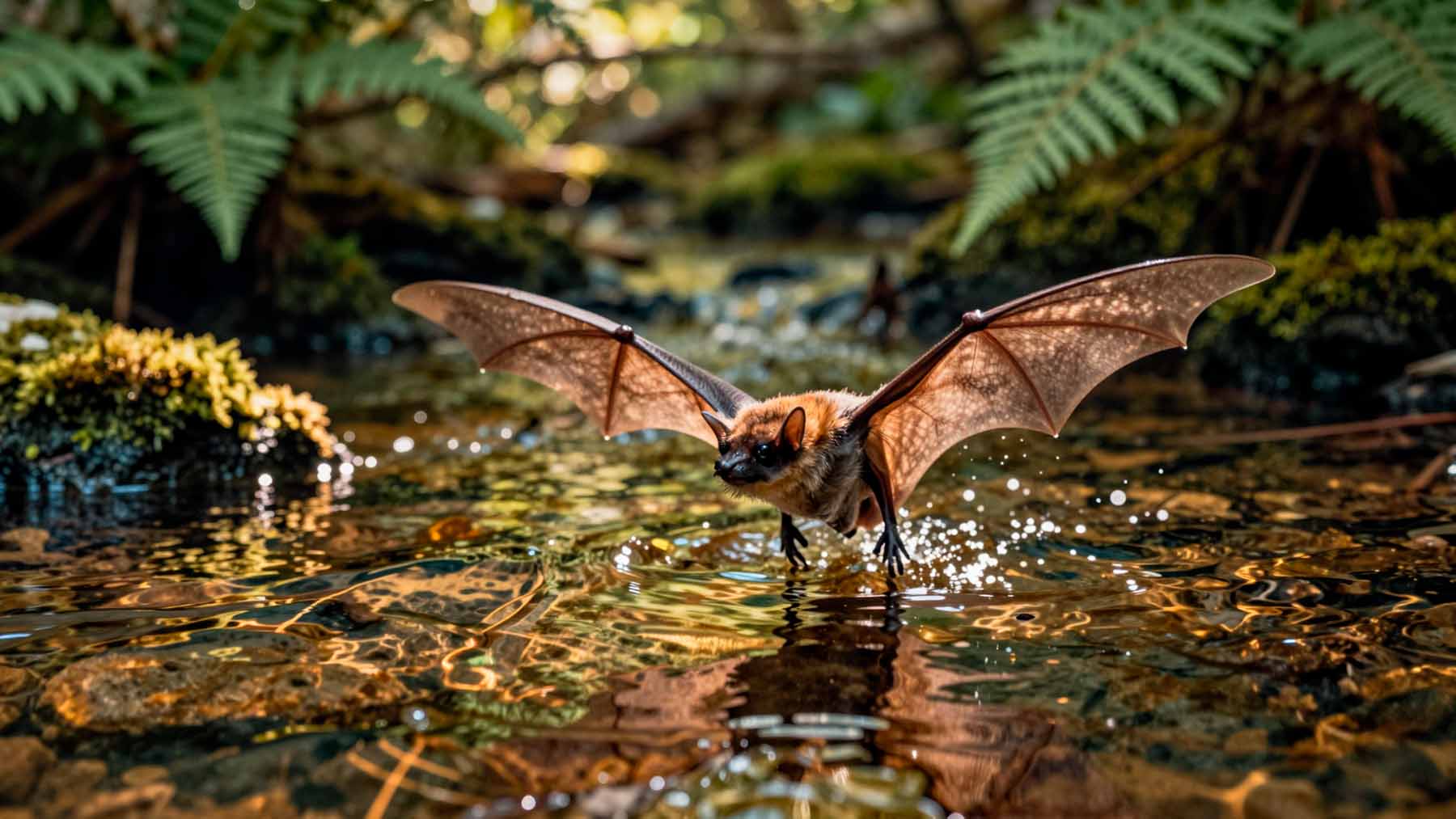
A bat fell into a creek and did something unexpected: it swam. Not flailed, not splashed in panic — it moved through the water with a rhythmic, almost purposeful stroke, crossing to the other side with surprising speed. For a creature whose entire body is engineered for the air, that moment raises an obvious question. How does an animal built around hollow bones and paper-thin wings manage to look so at home in the one environment it was never meant to enter?
A creature of the air meets the water
Bats are, at their core, aerial animals. They spend the overwhelming majority of their lives airborne — hunting insects, navigating obstacles, roosting in high sheltered spots. Even their relationship with water happens from the air. They drink by skimming low over the surface, scooping up liquid mid-flight without ever stopping.
Falling in isn’t part of the plan. For most bat species, it’s a mishap, not a strategy — which is exactly what made an Instagram video posted by @mack2526 so striking. It showed a bat swimming across a small creek, not struggling but moving with clear direction. The kind of footage that makes you look twice.
The butterfly stroke — bat edition
What bats do in water is surprisingly structured. They use a breaststroke or butterfly-like motion, flapping their wings while simultaneously paddling with their hands and feet. Their membranous wings, which double as hands, turn out to be effective paddles when horizontal movement is the goal.
The coordination is what stands out. Wings, hands, and feet work together as a single propulsion system rather than as separate, competing limbs. It looks less like panicked splashing and more like deliberate swimming. Competitive swimmers training the butterfly stroke use a similar simultaneous arm pull — and watching a bat in water, that resemblance is genuinely hard to ignore.
Water’s hidden danger: why wet fur is a serious threat
Here’s the part most people don’t anticipate. The primary danger bats face in water isn’t drowning — it’s their fur. Once soaked, bat fur becomes extremely heavy, and that added weight can make taking flight again very difficult, or even impossible, according to A-Z Animals.
This detail reframes the video entirely. The bat wasn’t just swimming for sport. It was swimming toward the person filming, and that matters, because bats don’t approach humans — they actively avoid us. When a bat breaks that instinct and moves toward a person, it’s a distress signal. The waterlogged fur had likely grounded it, and the human on the bank represented the only available exit from an increasingly dangerous situation. Desperation, not curiosity, explains that approach.
Echolocation: the built-in early warning system
Under normal conditions, bats don’t end up in the water at all. Their echolocation system is partly responsible for that. Bats emit sound pulses and read the returning echoes to build a picture of their surroundings in the dark, and water surfaces are particularly good at reflecting those echoes — meaning bats can detect bodies of water acoustically, without ever seeing them.
That gives them a built-in early warning system. They know where the creek is before they’re anywhere near it. In most situations, that awareness is enough to keep them safely airborne. Echolocation isn’t infallible, though. Unusual conditions, disorientation, or an unexpected obstacle can still send a bat into the water — which is likely how this creek encounter began.
The species that hunts in water on purpose
Not every bat treats water as a hazard. The greater bulldog bat has taken a different evolutionary path entirely. Rather than avoiding water, it hunts there — using echolocation to detect fish activity near the surface, then swooping in to snatch prey with its large, specialized feet. Water isn’t a threat to this species. It’s the hunting ground.
That adaptation is a useful reminder of just how varied bats are. With more than 1,400 known species, the group spans an enormous range of behaviors, diets, and environments. The greater bulldog bat’s fishing strategy sits at one end of a very wide spectrum, far removed from the accidental swimmer crossing a creek in someone’s phone video.
What a swimming bat actually tells us
The bat in that creek video wasn’t demonstrating a hidden talent. It was surviving an accident using whatever tools its body had available — and those tools turned out to be more capable than expected.
That gap between what we assume about an animal and what it can actually do is worth sitting with. Bats are defined, in most people’s minds, by flight. But evolution rarely produces a single-use tool. The same wings that carry a bat through the dark also, when necessary, pull it through the water — a small reminder that the natural world tends to be more resourceful than our categories for it.
Read the whole thing?
Get the week's signal, not the noise
Our sharpest reporting on energy, climate and nature — free, once a week.