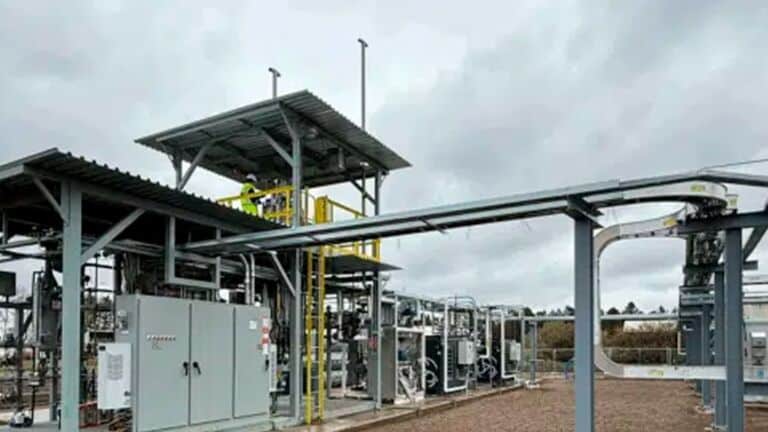
A steel platform stands on three piles in the Cape Cod Canal, just yards from the old railroad bridge.
The water underneath it runs fast enough to knock a diver off balance.
Engineers walk out, lower a small turbine into the current, and wait.
No ship. No barge crane. No offshore crew on standby for weeks.
Just a scaffold, a winch, and a tide that never stops moving.
So how does something this plain stand in for an ocean nobody can afford to test in directly?
Why a canal in Bourne stands in for the open ocean
The trouble with tidal power has never really been the idea. Water moving through a channel can spin a turbine much like wind does, and it does so on a schedule a utility can set a clock to.
The problem is proving a new design survives contact with that water before betting millions of dollars on a full ocean deployment. That is what the Bourne Tidal Test Site in the Cape Cod Canal was built to solve.
The platform stands on three piles in roughly 23 feet of tidal water a few yards from the canal railroad bridge, where flows run better than 3 miles an hour and can push toward 4 knots. A central lifting arm is the whole trick behind the site.
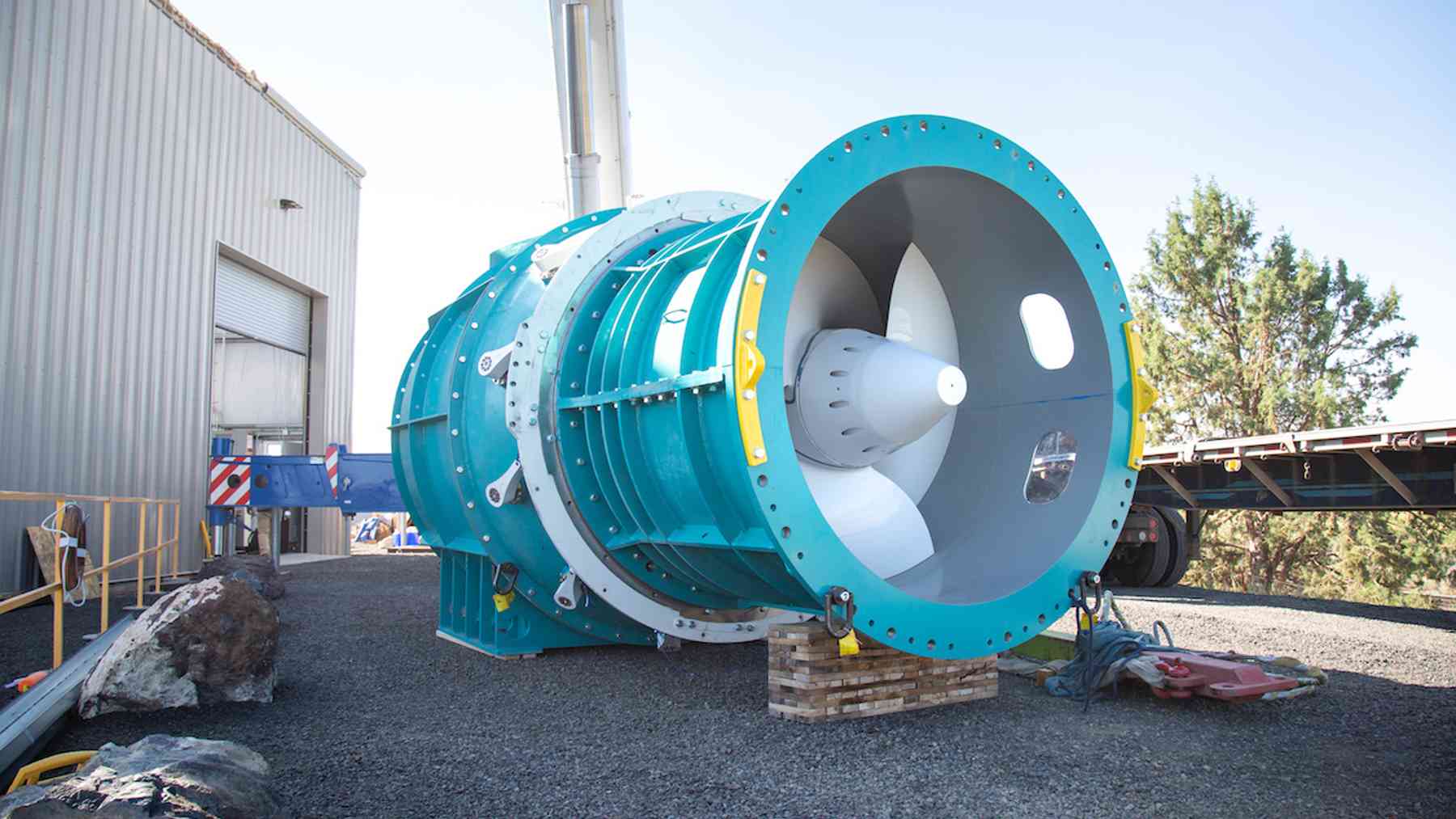
Instead of sending divers down or chartering a heavy lift vessel, crews winch a prototype turbine up out of the canal, inspect it standing on dry grating, and lower it back in the same day. That one mechanical arm is why a day of real seawater testing here can be arranged for a fraction of what an offshore trial costs.
What the scaffold actually looks like up close
Up close the structure reads less like a power plant and more like heavy duty scaffolding dropped into moving water, which is close to the truth. It was built in Middleboro, Massachusetts, by a steel tank fabricator, towed to the canal, and pinned to the bed beside the Army Corps of Engineers field office.
The marine contractor drove 90 foot piles about 45 feet into the seabed, then assembled the work platform and the winch on top. The spot was chosen for current that is both strong and predictable, and for sitting close enough to shore to reach without a boat ride.
The stand can hold turbines up to about 9.8 feet across and rated as high as 100 kilowatts, against the 30 to 40 foot rotors of commercial scale machines. Engineers from a Rhode Island university have parked an acoustic Doppler current profiler nearby to map how the water speeds up and slows down through a tidal cycle.
A platform built from pilings and a winch will never flatter anybody’s budget forecast. It does not need to.
The hardest number to come out of the canal
The people who run the site put its value in blunt terms. A scaled test that would otherwise demand a full offshore campaign can run here for as little as $30,000, against several million at a full scale test centre.
The stand itself was a roughly $300,000 project backed by a Massachusetts state council, and in 2024 it won an eight year federal pilot license that lets test turbines feed power to the grid, the only tidal site in the country holding one.
One recent tenant is an Alaska based company whose modular turbine units are meant to combine into larger arrays without specialized installation equipment. Its founder said the goal is “to make marine energy easier to build, deploy, and maintain in remote areas.”
An earlier tenant was a New Bedford company that supplied the first test turbine deployed here, a conceptual design rather than a finished product. Two further deployments planned for that season were cancelled by pandemic logistics, which says something about how thin the industry’s test calendar still is.
Where the cheap fix still runs into real limits
None of this replaces a true offshore trial. A partial scale rotor bolted to a scaffold in a sheltered canal will never face the storm surge, the hull fouling buildup or the decade long fatigue loading of a device anchored in open water, closer to the long steady duty an inland plant like Mt. Elbert works under for years at a stretch.
What the stand does offer is a rung between a university tank and full scale, the step where expensive prototypes have failed before. Engineers also use the deployments to watch the water around the rotor, with underwater video, an acoustic camera and sensors logging fish behaviour in a busy shipping canal.
That is the real value of a cheap proxy ocean, a point reinforced by sites elsewhere where marine life has disrupted far larger installations. It will not tell a developer everything, but it tells them enough to stop guessing.
What a scaffold in a canal is really buying the industry
Tidal power has spent decades promising steady, predictable electricity that does not care whether the wind is blowing or the sun is out. It has spent just as long failing to scale, in part because testing has always been the expensive part.
A platform that turns a canal into a dress rehearsal changes that math in a small but real way. The honest caveat is that scaled up arrays still face permitting, cable routing and the sheer cost of working at sea, none of which a canal can simulate.
But every turbine that survives a season on three piles in Bourne is one fewer unknown riding on a far more expensive bet offshore, and that is a trade worth making.
Read the whole thing?
Get the week's signal, not the noise
Our sharpest reporting on energy, climate and nature — free, once a week.