Two bogs in southeast MA, one in Kingston (Ring Rd) and one in Plymouth (Black Cat), hadn’t been used for years.
They were financially unproductive and remained unused for years.
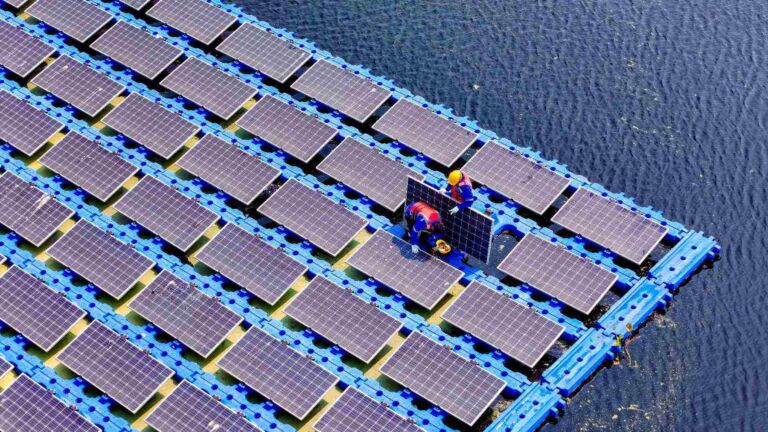
Today, both are being farmed again. And this time, there are rows of solar panels over the bogs.
These are said to be the first “agrivoltaic” cranberry harvests ever.
Years of inactivity left productive bogs idle
Berries grow in very tight profit margins.
If you don’t do routine maintenance, manage the water well, use proper equipment, and hire people to pick your berries, it’s hard to make money.
Eventually, if the numbers aren’t good enough, you stop trying to make money from your bogs.
That is what happened to the Black Cat and Ring Road bogs.
Both became financially non-productive and remained unused for years.
The vines didn’t disappear. But the harvests did.
That left two large parcels of land which had great agricultural potential, but no practical route to get there.
Protecting a working wetland required a different approach
There is generally no issue when building most solar farms.
Not here. Both of the cranberry bogs are functioning wetlands.
Building around the wetlands required construction techniques, and Distributed Energy Infrastructure had to ensure the berry crop and future harvesting conditions weren’t damaged during the process.
The objective wasn’t to replace berry farming.
Instead, the goal was to see if solar power generation and berry farming could occur at the same site.
When harvest time came, we saw berries continuing to come out from under the structures above us.
The harvest showed that berry farming could continue on a working wetland site.
The harvest was only part of the equation
It was not all about the harvest. Keeping these properties generating income was important too.
In addition to selling their berries, the owners can lease the property where their new solar arrays are located.
The project created multiple revenue streams, including berry sales, agricultural management income, and lease payments to landowners.
This development has restored economic activity on bogs that had been idle for years.
Agricultural management returned, along with the sale of the berries.
Berry and energy production can coexist instead of competing with one another.
Operating at two distinct levels of scale
While both locations demonstrate the same basic concept, they are of vastly different sizes.
The Black Cat Agrivoltaics Project produces 1 MW of electrical energy.
Alongside it is a battery-based energy storage system sized at 500 KVA and having 2,700 KWH of installed energy.
In contrast, the Ring Road Agrivoltaics Project is much bigger.
Its photovoltaic array generates 4.4 MW of electricity and is paired with a 13.5 MWH battery-based energy storage system.
The combination of cranberry production, solar energy generation and battery energy storage demonstrates how multiple land uses can occupy the same site.
The first harvest showed what these sites can become
Attention now shifts beyond the first harvest, and toward whether this model can work elsewhere.
Both of the Massachusetts sites made it as Finalists for the North America Agrivoltaics Awards.
Also, one of the farmers behind these bogs, and a member of the team that developed this project, is a co-founder of the Solar & Farming Association.
This organization focuses on creating a better understanding of agrivoltaics for all.
These bogs began as a means to take abandoned land back into production.
Now they represent working examples of cranberry production, solar panels, and battery systems occupying the same space.
With the first harvest complete, these sites now combine crop production, solar generation and battery storage.
For the first time, the concept has moved from planning and construction into a completed agrivoltaic harvest.
Read the whole thing?
Get the week's signal, not the noise
Our sharpest reporting on energy, climate and nature — free, once a week.