Binghamton University New York materials scientists fabricated an experimental paper-based wallpaper that generates steady electrical power from ambient indoor humidity.
Traditional smart-home sensors require frequent battery replacements or direct electrical wiring, creating maintenance headaches across large commercial buildings.
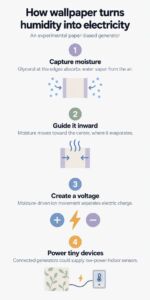
By engineered moisture-transport architecture combining glycerol, polyvinylpyrrolidone (PVP), and wax-treated cellulose paper, researchers created a moisture-electric generator that converts indoor humidity gradients into usable electrical current.
This sustainable power harvesting method could eventually eliminate disposable batteries inside low-power indoor monitoring devices.
Printing bacterial spores onto porous cellulose wallpaper substrates
Binghamton University engineers designed a moisture-electric paper matrix using glycerol, polyvinylpyrrolidone (PVP), and asymmetric wax treatment on cellulose paper.
Cellulose paper sheets provide a lightweight, porous substrate that absorbs microscopic water vapor molecules from indoor air efficiently.
Researchers fabricated the experimental paper device by combining distinct functional zones for absorption, transport, and evaporation, though scalable industrial roll-to-roll production has not yet been demonstrated.
Hydrophilic hygroscopic layers expand local ionic movement as they absorb ambient humidity, generating a continuous ion-concentration gradient across the underlying substrate.
Controlling polymer and wax distribution ensures uniform ionic separation and steady potential difference across the entire breadth of the wallpaper strip.
The asymmetric wetting gradient drives directional water flow and mobile ion migration, converting indoor humidity into continuous electrical potential.
Converting ambient moisture gradients into steady electrical voltage
Asymmetric water absorption triggers ion dissociation and charge separation across specialized conductive carbon electrodes integrated into the paper matrix.
Interlocking carbon pathways collect the electrical charges established by the humidity-driven ion-concentration gradient.
Moisture fluctuations inside typical office rooms provide enough chemical potential energy to drive continuous electron flow.
Under laboratory testing conditions at 80% relative humidity, the experimental paper generator achieved an output of approximately 0.34 V and 2.2, maintaining stable electrical performance across a 90-minute evaluation period.
Rather than relying on integrated micro-supercapacitors, power delivery depends on continuous ambient moisture transport to drive ongoing micro-power generation.
Power generation relies exclusively on ambient moisture, eliminating any need for external chemical fuels or mechanical motors.
Powering low-energy indoor sensors without using lithium batteries
Powering low-energy indoor sensors without using lithium batteries
Wireless environmental sensors monitor indoor air quality, room temperature, and occupancy levels across modern commercial office buildings.
Standard lithium coin-cell batteries power these compact devices, but frequent replacements create significant chemical waste over time.
Humidity-powered wallpaper supplies continuous trickle currents directly to low-voltage sensor microchips without battery intervention.
It comes down to sensors, according to Binghamton University.
Generating local power eliminates wiring expenses, allowing facility managers to place sensors anywhere on interior walls.
Sustained micro-power output supports intermittent data transmissions without draining internal energy storage reserves prematurely.
Overcoming power output limits and fluctuating indoor humidity
Ambient relative humidity levels drop significantly during dry winter months or inside air-conditioned commercial environments.
Low moisture conditions reduce ambient ion dissociation rates, causing electrical power generation to decline sharply.
Engineers acknowledge that current prototype power densities remain far too low to drive high-energy wireless radios.
Scaling power output requires stacking multiple paper generators together, increasing manufacturing complexity and wall thickness.
Material degradation from long-term humidity exposure poses a persistent threat to polymer matrix stability over years of operation.
Laboratory testing confirms short-term power generation performance over 90 minutes, but long-duration stability across extended day-night humidity cycles and multi-year field durability remain unproven.
Evaluating commercial manufacturing hurdles for smart building materials
Commercial building materials must withstand physical abrasion, routine cleaning, and accidental impacts during everyday office use.
Exposed polymer and hygroscopic layers risk losing performance if protective topcoats alter moisture absorption and evaporation efficiency too drastically.
Material costs for specialized functional polymer solutions remain higher than conventional wallpaper pastes used in residential construction markets.
Making the multi-zone paper design fully printable and transitioning to industrial roll-to-roll manufacturing remains a key future goal for large-scale production.
Transitioning from hand-assembled laboratory bench prototypes to automated, continuous green building production lines represents the next major commercial milestone.
All the study details can be found here: Yuan, G., Gao, Y., & Choi, S. (2026). Moist‐Electric Wallpaper With Engineered Unidirectional Moisture Transport for Indoor Energy Harvesting and Humidity Management. Advanced Energy Materials, e71603.
Read the whole thing?
Get the week's signal, not the noise
Our sharpest reporting on energy, climate and nature — free, once a week.