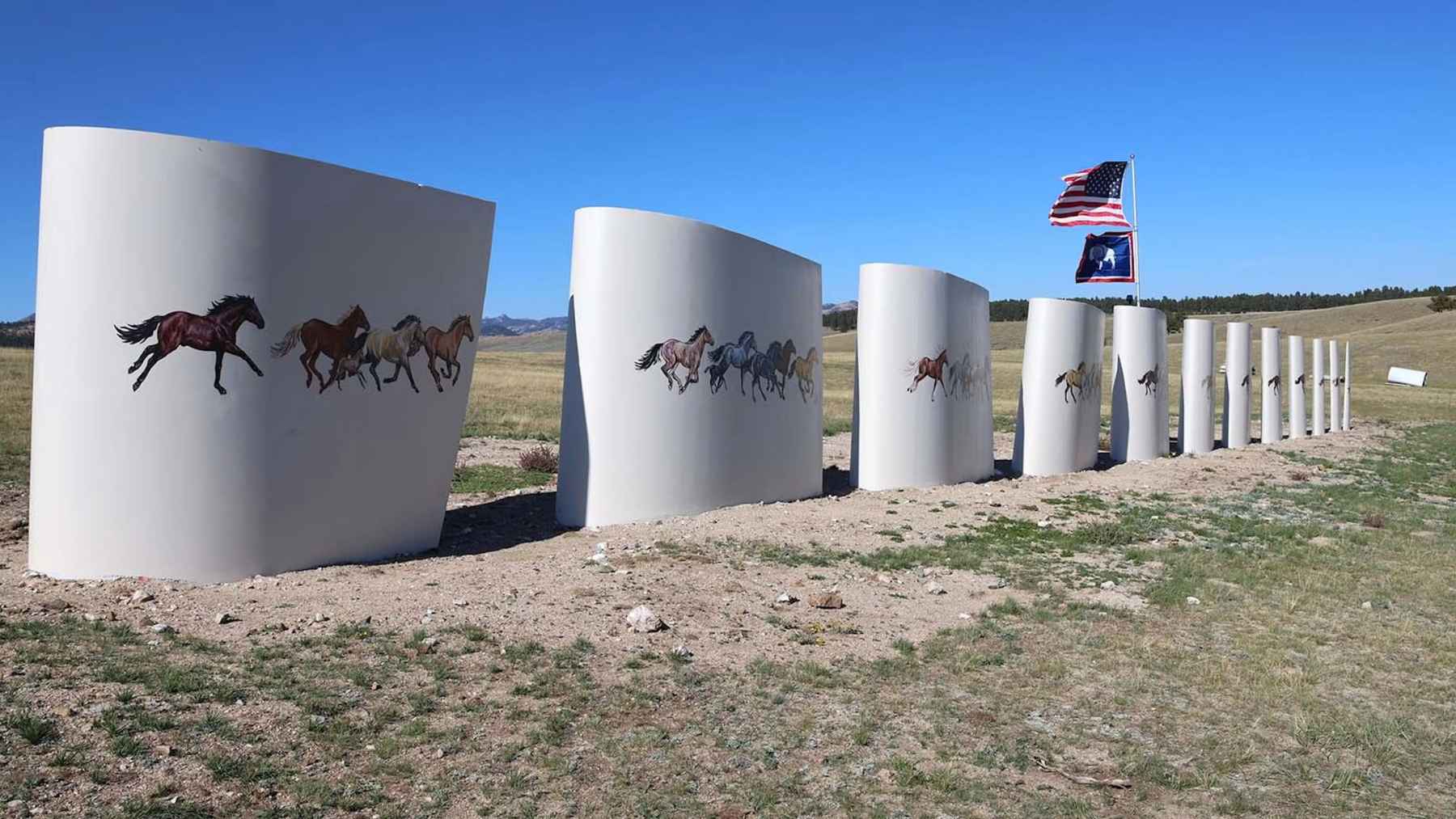
There is a line of painted panels standing in the grass outside a village in eastern Wyoming.
Each one is a slice of a wind turbine blade, cut across the chord, stood on end and planted.
Twelve of them, from a single blade, donated by the company that built it.
Together they run about 120 feet, and they carry a herd of forty galloping horses painted end to end.
It was dedicated in October to about fifty people, with a congressman present and a pastor protesting on the shoulder.
It is also, officially, a test.
Why 50 percent open beats a solid wall
A snow fence does not stop snow. That is the first thing to get straight, and almost everyone gets it wrong.
Blowing snow moves because wind carries it. Drop the wind speed below the threshold that holds those grains in the air and they fall out, in a drift, downwind of whatever slowed the air.
So the job of the structure is to bleed speed out of the wind without blocking it, which means the fence has to be deliberately leaky.
The long standing design guidance puts the best porosity at 40 to 50 percent of the surface area left open, and states plainly that solid fences do not collect snow efficiently.
A solid wall throws the air up and over, so the snow piles tight against it or skips the zone entirely.
Porosity is the whole trick.
12 segments, 40 mustangs, one donated blade
The installation sits on private ranch land at the edge of Esterbrook, alongside a state highway, in open country.
A sculptor spent years on the idea. An engineer at the blade maker did the cutting and offered him possible layouts for the spacing.
The number twelve is not an engineering choice. It stands for the twelve steps of a recovery program, and a recovery ranch sits two miles down the same corridor.
The panels went into the ground in July and were painted in July, with help from people in the area.
A fiberglass section does not rot, does not need paint to survive, and will not be eaten by weather the way a wooden slat is. That is the real argument for the material.
Everything else is decoration.
35 times the height, or it drifts on the road
The numbers behind working fences are well established, because one state has measured them since the seventies.
A drift grows downwind to roughly 30 to 35 times the height of the fence, which is why the guidance sets a minimum setback of 35 times the height from the road shoulder. A 6 foot fence needs 210 feet of room.
Height beats everything else. Adding 6 inches to a 4 foot fence raises its storage by about 30 percent, and a 6 foot fence holds more than twice what a 4 foot fence holds.
There is also a gap under the fence, equal to roughly 10 percent of its height, so the structure does not bury itself in its own drift.
The payoff is not small. Storing snow behind fences has been costed at about three cents a ton against three dollars a ton to move it mechanically, and one fenced stretch of interstate saw 70 percent fewer crashes caused by poor visibility.
The state keeps about 450 miles of it.
The gap nobody has published
Here is the problem sitting in plain sight.
A blade segment is solid. It has no porosity of its own, so every bit of the 40 to 50 percent has to come from the spacing between the twelve pieces, in the way that a wrong description or a late flaw turns into a finished verdict.
That spacing has not been published. The 120 feet is the run, not the rise, and the segments are not one height at all. They step down from a root section taller than a person to tip sections barely knee high.
That matters more than it looks. Drift length, setback and storage all scale on height, so a row of twelve different heights is really twelve fences with twelve different answers. The root piece does nearly all the work.
Without a height there is no setback to check against the 35 times rule, and it stands on ranch land rather than a highway right of way, so it is not placed to protect a road.
The state transportation office said there has never been money for a test project, so nothing here is instrumented, and the design guide it would be measured against is decades old.
Nobody is taking readings.
One winter will settle most of it
There is a contradiction in the project’s own account worth noting.
The blade maker’s engineer says he has been recycling these for five years and that nothing goes to landfill. The man who installed the panels founded his company after seeing photographs of blades lying in a landfill at Casper.
Both statements appear in the dedication report, and both are probably true of different years.
Not everyone wants it there. A local pastor stood through the ceremony calling it a scam and saying its only effect is to spoil the view.
The sculpture has stood since July, and no snow season has run against it yet.
A working snow fence leaves a drift.
That is measurable.
Read the whole thing?
Get the week's signal, not the noise
Our sharpest reporting on energy, climate and nature — free, once a week.