

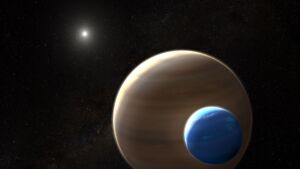
Somewhere in a star system 80 light-years away, an object at least as massive as Jupiter is quietly orbiting a brown dwarf — which is itself orbiting a star. Astronomers studying this arrangement in the CD-35 2722 system aren’t quite sure what to call it.
It might be the first moon ever detected beyond our Solar System. It’s also, by some measures, massive enough to be a planet. And that contradiction is exactly the problem.
A star system that breaks the rules
CD-35 2722 sits about 80 light-years from Earth. Its central star carries roughly half the mass of our Sun. What orbits that star, though, is where things get genuinely strange.
Circling the star is a brown dwarf — too massive to be a planet, yet too small to ignite the hydrogen fusion that powers true stars. Brown dwarfs already occupy an uncomfortable middle ground in the cosmic hierarchy, belonging fully to neither category.
Then comes the third body. Something at least as massive as Jupiter orbits that brown dwarf, creating a layered arrangement that lead author Kevin Hoy, an ESO student based in Chile, describes simply as “super weird.” In our Solar System, planets orbit the Sun and moons orbit planets. This system doesn’t follow that script at all.
The object that refuses to be classified
Here’s the core tension: the suspected object has at least as much mass as Jupiter. Under some definitions, that alone qualifies it as a planet — yet it orbits a brown dwarf, not a star, which makes it a satellite by the logic of its position.
Hoy put it plainly: “The exosatellite is clearly massive enough to be a planet, but it does not orbit a star, though it orbits an object that orbits a star. Being the third wheel in this system makes us want to call it a moon, even if it is nothing like the small, rocky moons we have in our system.”
Alice Zurlo, director of the Millennium Nucleus of Young Exoplanets and their Moons (YEMS) and a collaborator on the study, framed the broader problem. “We have a clear delineation between the planets and the Sun in the Solar System, so defining things like moons is simple. In the CD-35 2722 system, where we are blurring the lines between stars, planets, and moons, the whole thing becomes more complicated to describe.” Compounding the difficulty: no universally accepted definition of an exomoon currently exists among astronomers.
How the team spotted it
To study the system, Hoy, Zurlo, and their colleagues used the CRIRES+ instrument on ESO’s Very Large Telescope in Chile, applying the radial velocity technique — the same approach that led to the first exoplanet ever found around a Sun-like star.
The method tracks tiny shifts in an object’s motion. When two bodies orbit each other, their mutual gravity pulls both around a shared center of mass, and even a smaller companion leaves a detectable wobble in its larger partner’s movement. By carefully measuring subtle changes in the brown dwarf’s motion, the team identified what they describe as strong evidence of a massive orbiting companion. Zurlo called it “the first plausible detection of an exosatellite.” That word — plausible — matters. No confirmed discovery is being claimed here.
A long search with very few candidates
To appreciate how significant this signal is, consider the broader search. Astronomers have confirmed more than 6,000 exoplanets to date. Confirmed exomoons? Zero.
Earlier in 2026, a team led by Quentin Kral reported possible signs of a satellite in the HD 206893 system, using ESO’s Very Large Telescope Interferometer. That candidate generated real interest but fell short of a definitive detection. The CD-35 2722 signal is now considered the most plausible exosatellite detection on record — though “most plausible” still isn’t “confirmed,” and further observations will be needed before anyone can call it definitive.
What comes next — and why it matters
The telescope most likely to resolve that uncertainty hasn’t opened yet. ESO’s Extremely Large Telescope, currently under construction with a 127-foot-primary mirror, will give astronomers the sensitivity to detect smaller, fainter exomoons that current instruments simply can’t reach.
The broader stakes extend well beyond this single system. Understanding how objects like this form — and whether they’re rare or surprisingly common — could reshape what we know about how planetary systems evolve. A Jupiter-mass satellite orbiting a brown dwarf wasn’t part of anyone’s standard model.
What this finding quietly suggests is that the categories we use to describe the cosmos — star, planet, moon — may be more parochial than universal. They were built from one Solar System. As astronomers find more systems that refuse to fit familiar labels, the question worth sitting with isn’t just what to call this object. It’s whether our definitions were ever broad enough to begin with.
Read the whole thing?
Get the week's signal, not the noise
Our sharpest reporting on energy, climate and nature — free, once a week.


