
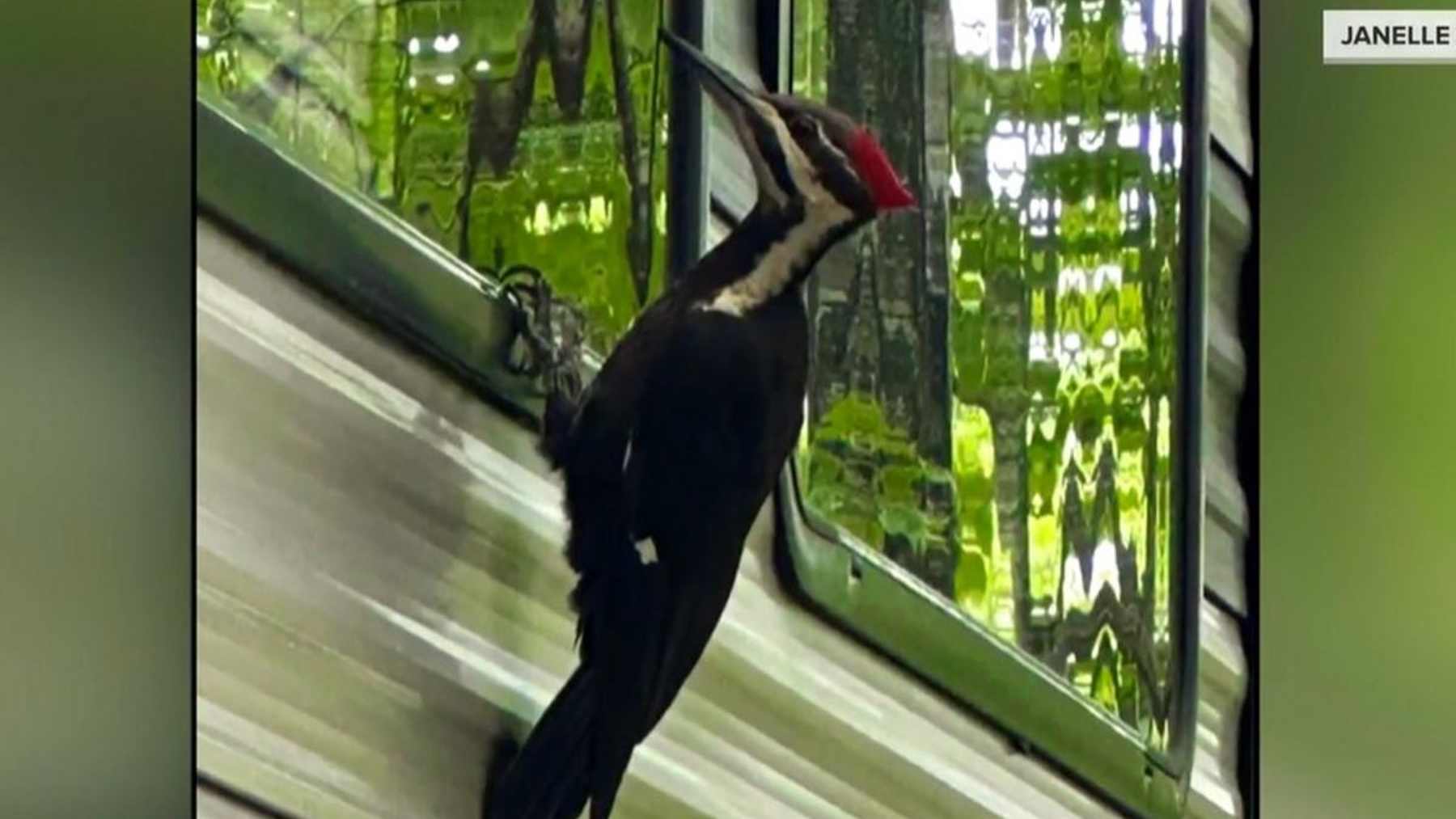
The tapping started on the windshield wipers of a parked RV in a quiet seaside neighborhood.
A resident watched a crow sized bird lean into its own reflection and go still.
Then it struck.
Within weeks, driveways up and down the hill held cracked mirrors and splintered glass.
Neighbors suspected a kid pushing mirrors down before anyone caught the culprit on camera.
What they found was one bird, one reflection and a breeding season.
One bird mistook its reflection for a rival male
The vandal turned out to be a pileated woodpecker, the largest woodpecker found in North America today, working a wooded residential pocket of Rockport, Massachusetts called Squam Hill. The director of bird conservation at Mass Audubon told The Boston Globe it was likely a single male bird establishing territory, at the point in the year when testosterone peaks.
A Brown University researcher who studies bird behavior described pileated woodpeckers as ferocious and genuinely strong animals, and said a blow from one is “the biomechanical equivalent of a hammer.” That force evolved to open rotten wood in search of carpenter ants, not to meet painted steel and tempered glass.
The same expert made the key point about the glass as a surface: the bird does not read it as one. It sees a same sized male holding ground on its hill, and nothing in its instincts offers the alternative that the rival is its own face. Most birds only peck at windows, he noted; a pileated carries a bill big enough to break them.
25 vehicles hit on one wooded hill
Counts of the damage differ depending on who did the tallying. The homeowner who photographed the bird on her RV wipers said at least 25 vehicles had been hit, while a reporter canvassing the street arrived at roughly 20 broken mirrors plus a windshield, and wire coverage settled on more than two dozen mirrors and at least one shattered side window.
One neighbor said the woodpecker landed on his pickup window while he was sitting inside, leaving what he called a “nice big crack” in the glass.
The Facebook post that cracked the case came from the same resident who spotted the bird on her RV, describing the culprit as “18 to 24 inches tall, wearing black and white with a red hat.” So the fixes turned improvised fast. Families folded in side mirrors when their cars were parked or wrapped them in trash bags and towels, a defense better suited to a hailstorm than to one bird working a few driveways at a time. Visitors who parked on the street were warned by neighbors to fold their mirrors in.
A town with a 200 year history of repelling invaders
Rockport is an old fishing village with a long memory for repelling trouble, and that history gave the story its wry local framing. A historical marker at the site of the town’s Old Stone Fort records that during the War of 1812, with their ammunition gone and the fort’s small garrison captured, townsmen hurled rocks at the raiders using their stockings as slings.
This time nobody was looking to repel anything. One resident told reporters that “everybody’s having a good laugh about it,” and said nobody wanted the bird harmed. That tolerance matters, because pileated woodpeckers are federally protected under the Migratory Bird Treaty Act, which bars killing, capturing or possessing them without a federal permit. The remaining options were patience and some creative mirror camouflage until the behavior eased on its own.
Lengthening spring days trigger the aggression
What switches this behavior on is daylight itself. As days lengthen through late winter into spring, rising light exposure drives the hormonal changes behind courtship and territorial aggression in North American birds, pileated woodpeckers included. It is a strange thread connecting a dented pickup truck to shifting daylight, though the birds themselves are following local light levels, not the calendar.
Zoo Miami’s communications director told NBC News that peak mating season explains it, with territorial males reading reflective surfaces as competition. A senior avian biologist at New Hampshire Audubon called this particular case “definitely weird,” noting that many birds square up to reflections but woodpeckers usually chase a rival rather than hammer it.
Readers curious about how animals and household structures collide elsewhere can look at a case where a Pennsylvania father worked out his own fix for birds hitting windows, or at the failures documented after a trench collapse near a Potomac house.
Attacks should fade by early summer
Mating season for pileated woodpeckers runs into early summer, and the hormonal surge behind the attacks fades with it. That gives the neighborhood a rough end point, even if nobody could name the week it would arrive.
Rockport’s cars, and its sense of humor, were left to recover before another spring brought the same bird, or one just like him, back to the same stretch of driveways. Replacing a side mirror is cheap next to a windshield, which is why the bags went on first.
For now, the mirror wraps stay on, and the neighborhood keeps its running joke about the resident with the red hat.
Read the whole thing?
Get the week's signal, not the noise
Our sharpest reporting on energy, climate and nature — free, once a week.


