Wind power companies in Scotland modified the design of the Beinn an Tuirc wind farm project to ensure protection of the golden eagle territory around the Kintyre Peninsula.
There are numerous conflicts with environmental organizations against large-scale wind farms because of the risk of bird or bat collisions and habitat fragmentation within remote highland areas.
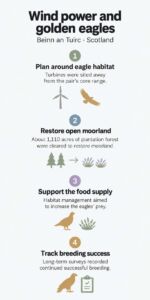
Working closely with ornithologists, engineers moved some of the wind towers and cut down 1,112 acres of commercial forests.
The measures helped restore the natural moorland environment.
Moving wind farms to protect raptor territories
Stringent environmental assessments done prior to the development process revealed that traditional siting of wind turbines would result in significant impacts on the hunting grounds of the golden eagles.
Experts mapped out flight and nesting routes to identify key areas in the rugged landscapes of Argyll and Bute.
Planners modified their master plan and shifted commercial wind turbines from the mountain ridges that the raptors prefer.
Moving the industrial devices sufficiently far away from the eagle’s main feeding grounds reduced the risk of collisions with the spinning turbine blades.
There is no need for renewable energy power stations to compromise on conservation for the sake of generating clean energy if proper planning is done with wildlife protection in mind.
Destruction of dense forests for the revival of the moorland ecosystem
Decades of non-native conifer farming greatly affected the native birds of prey hunting grounds.
Restoration ecology specialists cut down almost hundreds of acres of trees from the hills and valleys.
Without the dense forests, it became easier for native vegetation to grow back in the area.
Clear land is important for eagles to find their prey.
The restoration of native vegetation and the return of various animal species has made the land wild once more.
Using the right land management methods to attract native wildlife
Grazing and heather burning were employed by conservation managers to ensure diversity in the restored moorland.
There is an abundance of mountain hares and red grouse in the Moorlands, which operate in a tight ecosystem, and these are prey bases for the birds.
Eagle habitat manipulation has been proven effective, as this technique moved the birds away from the power sites to other feeding grounds.
Land management is an important practice when there is a need to consider two factors: energy production and wildlife conservation.
Recording the number of breeding pairs and chick survival rates
After the construction of the wind farm, local golden eagle reproductive rates started being monitored by survey teams.
Field surveys have shown that the mating eagles were able to raise healthy eaglets in their respective habitats.
The high breeding rate indicates that wind farms can be well planned around conservation, ScottishPower reports.
Moreover, some observations can give practical information about the reaction of large birds to the operation of renewable energy power stations.
This practical information will facilitate the setting of environmental standards for upland wind farms in Scotland.
Developing sustainable blueprints for future renewable energy ventures
The combination of zero-carbon objectives with strict biodiversity conservation is an important task for modern green infrastructure.
The example of habitat recovery at Beinn an Tuirc can be used to guide the process of compensation of ecological damage in mountainous regions, according to Natural Research.
Mass conservation promises have become an important prerequisite for approval of wind farm projects by industry regulators.
The implementation of proactive habitat recovery alongside standard engineering practices will ensure that clean energy is produced without damaging the land’s natural heritage.
Cooperation between business and conservation is turning out to be a reliable option.
Read the whole thing?
Get the week's signal, not the noise
Our sharpest reporting on energy, climate and nature — free, once a week.