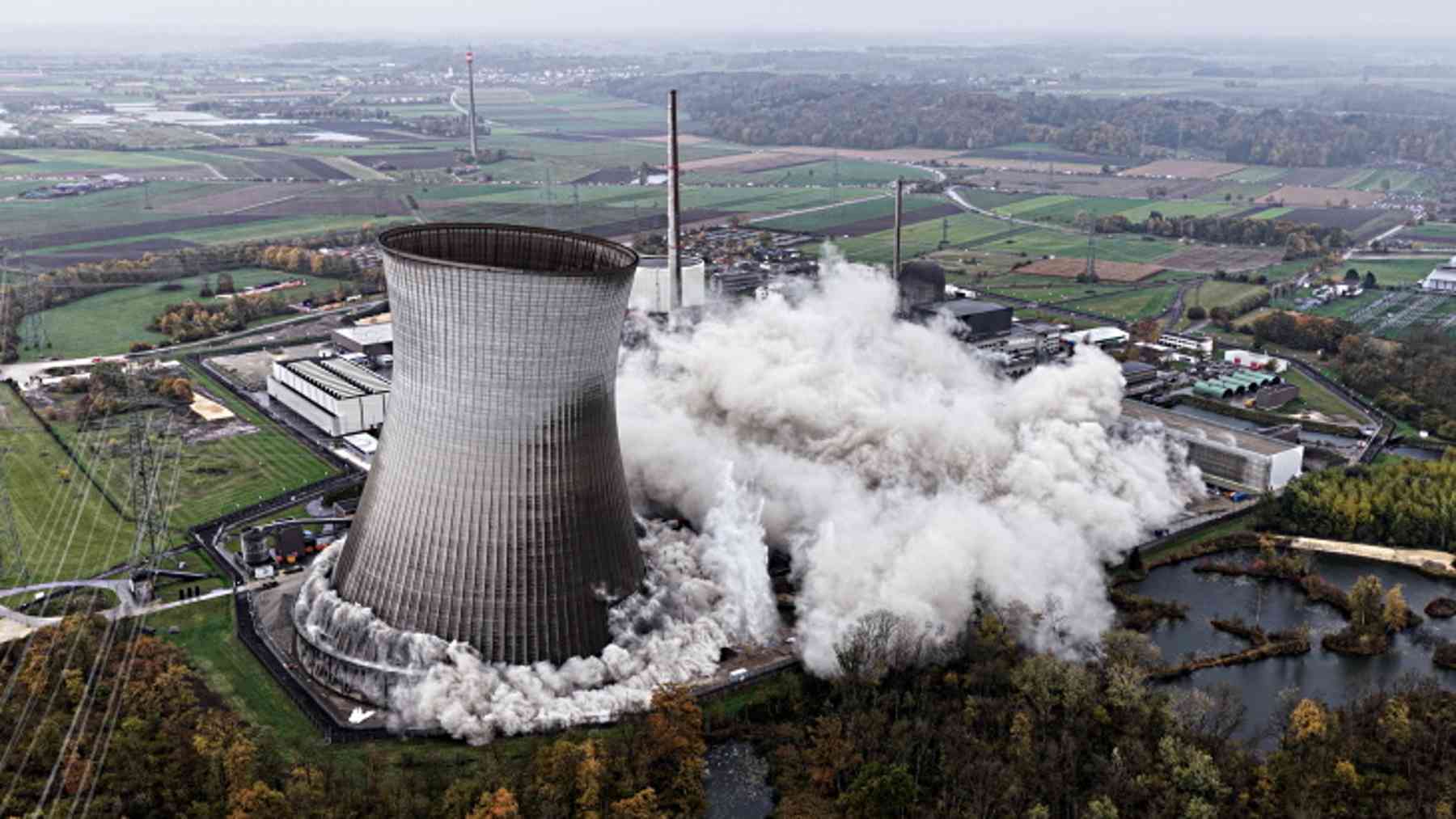
At noon on a Saturday, a dust cloud rolled out across the fields of the Danube valley.
Two towers that had stood over that valley for four decades were simply not there anymore.
The crowd that gathered watched from well behind a safety cordon.
What fell was 525 feet of hollow concrete each, built to cool steam that had not run through a turbine in years.
The bigger story was not the fall itself.
So what actually brought down two structures that size in well under a minute?
Explosives packed into 1,800 boreholes let gravity pull the shells down
The two cooling towers at the former Gundremmingen plant in Bavaria did not topple from a single blast. Crews drilled about 1,800 boreholes into the curved concrete shells and loaded them with roughly 1,300 pounds of explosives, spread so that the base would fail evenly rather than crack on one side and throw the structure sideways.
Vertical and fall slots were cut into the shells in advance to steer the direction of the collapse, according to the operator’s account of the blast. A specialist German blasting firm fired the charges in one sequence.
Coverage of the demolition reported that the first detonation was set off to move birds and other wildlife away from the base. The second and third charges followed roughly fifteen seconds apart, and from the first bang to the shell hitting the ground took about 45 seconds.
What makes that kind of control possible is the shape of the thing. A record breaking natural draft cooling tower is a thin concrete skin that carries its own weight largely through its curvature, so taking out enough of the base leaves the shell unable to support itself and it comes down into its own footprint.
No contamination ever touched these towers in four decades of service
Even though they stood inside a nuclear site, the two towers never came into contact with radioactivity while the plant was running, the operator says. Their job was to shed heat from the circuit that condensed steam after it left the turbines, the same function cooling towers perform at coal and gas plants.
That detail decided how the rubble could be handled. Because the concrete carried no contamination, radiation protection rules did not govern the demolition at all.
So the debris can go into ordinary construction recycling rather than the slow, closely tracked route used for material from inside the reactor buildings.
62,000 tons of rubble is headed for recycled gravel
Once the dust settled, the materials job began. The demolition left roughly 62,000 tons of broken concrete and twisted rebar, about 56,000 metric tons by the operator’s count. The company describes it as record grade concrete and says it is to be processed into recycled gravel, a building material with a ready market in roadworks and site construction.
The steel reinforcement is separated out of the crushed concrete and sold on as scrap, following much the same logic as other retired energy hardware, including a broken turbine blade whose metal and composite parts have to be parted before either is worth anything.
Heiko Ringel, the site manager for the operator, described the demolition as another milestone in the dismantling of the plant for him and his team. Around 30,000 people came to watch, some from organized viewing points, a few from pub patios that advertised the blast as the afternoon’s entertainment.
A battery project ten times larger breaks ground four days later
Four days after the towers fell, the operator broke ground on what it calls Germany’s largest battery storage project to date, rated at 400 megawatts with 700 megawatt hours of capacity and costing around 230 million euros. More than 200 containers holding roughly 850,000 lithium iron phosphate cells will go onto ground already wired into the high voltage grid.
Fast inverters on the site will be able to take in or release power within milliseconds. It is a strange kind of continuity, with the same patch of farmland that once made electricity by boiling water now expected to store it, much like other aging energy hardware being rebuilt rather than simply scrapped.
None of the reactor buildings have come down. Those structures did hold radioactive material during operation and face a far slower, closely monitored dismantling, with reports on the site putting full completion many years out, well into the next decade. The spent fuel stays on site in casks longer still, until a national repository exists to take it.
A flat gap where the skyline stood for forty years
For now there is a flat spread of graded rubble, and a gap in the skyline where two towers stood for four decades. A crushing and hauling operation will turn the region’s most recognizable landmark into gravel under somebody’s road.
Other energy sites across Europe are being rebuilt around similar tradeoffs between old concrete and new uses, much as a German solar park has reshaped its own ground for a different purpose entirely.
Read the whole thing?
Get the week's signal, not the noise
Our sharpest reporting on energy, climate and nature — free, once a week.