Black holes have always had one direction: inward. They grow, they merge, they consume — but they don’t divide. That assumption has held firm across decades of physics.
Now a theoretical study published in Physical Review D suggests the rule may have a crack in it. Under extraordinarily extreme conditions, a single black hole might actually split into two — a class of behavior that’s never been observed and that most physicists had no reason to expect was even possible.
A rule physicists thought was unbreakable
Black holes are governed by thermodynamics — the branch of physics that describes how energy behaves and how physical systems change. Central to that framework is entropy: a measure of how many microscopic arrangements a system can have while still looking the same from the outside. Think of it as a count of hidden possibilities. The higher the entropy, the more ways a system can be configured internally.
Black holes carry entropy, and that property sets hard limits on what can happen to them. For a non-spinning black hole, splitting into two smaller ones would reduce the total entropy of the system. Physics strongly resists that outcome — a drop in entropy makes a process thermodynamically unfavorable, effectively forbidden under normal conditions. This restriction has long served as a near-absolute barrier against black hole fragmentation, and most physicists had little reason to question it.
Where rapid rotation changes the math
The new study, led by researchers at the University of Southern Denmark and collaborators in France and Italy, found that extreme spin could crack that barrier open — slightly. Their calculations show that a black hole rotating fast enough might create a narrow thermodynamic window in which splitting no longer reduces total entropy.
Passing that thermodynamic test is only the first hurdle, though. Even if a split became energetically permissible, the two resulting black holes would need to move apart quickly enough to avoid falling straight back together. When the team folded that separation requirement into their analysis, the window nearly closed again. The exception: black holes spinning close to their theoretical maximum rate.
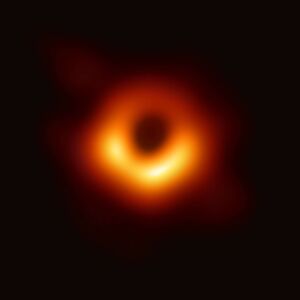
The study’s title — “When Black Holes Admit Pair-of-Pants Topologies” — captures what such a split would look like geometrically. A black hole’s boundary, called the event horizon, would trace a shape through spacetime resembling a pair of trousers: one structure at the top dividing into two distinct legs. Unusual image, but it reflects a precise mathematical description of how the horizon’s topology would change during a split.
Extra dimensions and more exotic possibilities
The researchers didn’t stop at standard four-dimensional spacetime. They also explored theoretical scenarios in which space contains extra dimensions beyond the three we experience in everyday life — and in some of those models, black-hole-like objects can become unstable and begin to fragment on their own, behavior that has no direct equivalent in conventional physics.
In certain higher-dimensional cases, splitting could become not just permitted but thermodynamically favorable. That’s especially true when one of the two resulting objects is far smaller than the other. A very unequal split can, under some conditions, actually increase total entropy rather than decrease it — which flips the usual expectation entirely.
One important caveat applies here. Thermodynamic favorability doesn’t guarantee a process actually happens. Researchers still need to determine whether such a fragmentation can physically occur and what specific conditions would need to be in place. The math opens a door; it doesn’t confirm anything walks through it.
Could a telescope ever catch a black hole splitting?
No confirmed observation of a black hole split exists. The researchers believe the idea is now testable enough to be worth pursuing, though. Their leading candidates are small primordial black holes — hypothetical objects formed in the early universe — rather than the large astrophysical black holes detected through gravitational waves or X-ray emissions. Smaller objects, they suggest, may be more prone to this kind of fragmentation.
Detection would likely be indirect. Gamma-ray telescopes like NASA’s Fermi-LAT could potentially pick up signals from tiny black hole fragments produced during mergers, offering a way to search for evidence without directly witnessing a split.
The probability of any of this occurring remains genuinely uncertain. “It depends on how gravity behaves beyond Einstein’s theory,” co-author Francesco Sannino noted, “and we are working to quantify this.” That open question — how gravity operates at its most extreme — is exactly what the team plans to tackle next.
If future observations turn up anomalous gamma-ray signals consistent with fragmenting black holes, it would force a significant rethinking of what these objects can do. For now, the finding is theoretical. But it gives astronomers a clearer target to look for — and a reason to look.
Read the whole thing?
Get the week's signal, not the noise
Our sharpest reporting on energy, climate and nature — free, once a week.