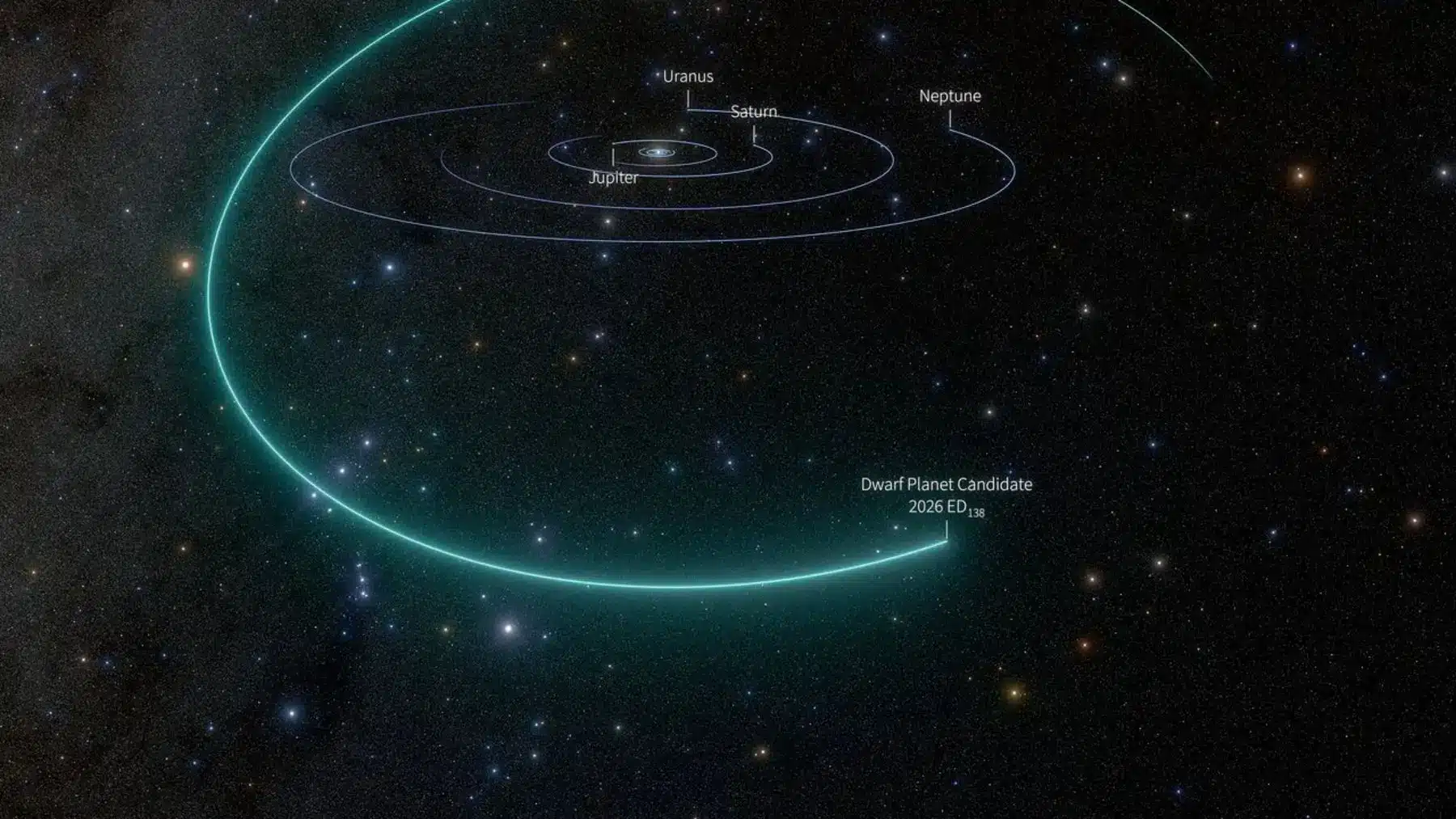
The outer Solar System is vast, dark, and deceptively crowded. Objects lurking billions of miles from the Sun can go undetected for decades, hidden not by darkness alone but by the sheer density of background stars masking their slow movement through space.
On the evening of October 13, astronomer Matthew Holman was running data from the Vera C. Rubin Observatory through a search algorithm when something caught his attention: a faint point of light, unusually bright for its distance, drifting through the sky some 46 astronomical units from the Sun — farther out than Pluto.
What he was looking at may be one of the largest worlds ever found in this remote corner of our Solar System.
A signal in the dark
Holman was running Rubin data through a search algorithm he co-developed with fellow Center for Astrophysics researcher Kevin Napier. The code sifts through billions of detections of moving objects and identifies which ones correspond to the same body — a needle-in-a-haystack problem at astronomical scale.
ED138 stood out immediately. Its brightness relative to its distance suggested something unusually large. “My first reaction was one of excited disbelief,” Holman said. “Objects like this are very rare, so I immediately started checking whether I or the code had done something wrong.”
To rule out errors, the team searched deeper into Rubin’s data. Mario Jurić, Rubin Solar System Lead Scientist at the University of Washington, turned up 20 additional observations — bringing the total to 30 sightings across 20 separate nights, with Rubin’s Simonyi Survey Telescope tracking it from March 4 to July 11, 2026.
What we know about 2026 ED138
ED138 currently sits about 46 astronomical units from the Sun, farther out than Pluto, which orbits at an average of 40 au. That distance places it firmly in trans-Neptunian territory, a zone where knowledge of individual objects remains thin, according to NOIRLab.
Based on brightness and estimated surface reflectivity, the team calculates ED138’s diameter falls somewhere between 372 and 932 miles. The lower end alone would make it a significant world. At the upper end, it could rank among the largest trans-Neptunian objects ever discovered.
Its orbit adds another layer of interest. ED138 is tilted roughly 25 degrees off the plane of the Solar System, classifying it as a “hot-classical” TNO — a designation that points to Neptune’s gravity having disturbed it from its original path, leaving behind a clue to the dynamic processes that shaped the outer planets’ neighborhood.
Why it had stayed hidden until now
ED138 sits in a region close to the plane of the Milky Way, a dense backdrop packed with millions of background stars. Against that crowded field, a slowly drifting, faint object is effectively invisible to most telescopes.
Picking out a distant Solar System body from millions of stationary sources requires both exceptional imaging depth and software capable of linking detections across many separate nights. Rubin’s continuous full-sky monitoring, paired with its powerful object-linking algorithms, made the detection possible. The discovery didn’t stop with 2026 data, either. Archival images from the Dark Energy Camera, surfaced through the Asteroid Institute’s ADAM Precovery service, pushed ED138’s known observation history back to 2016 — giving scientists more than a decade of orbital data to work with.
The dwarf planet threshold — and what comes next
Not every trans-Neptunian object earns dwarf planet status. The key requirement is that an object must be massive enough for its own gravity to pull it into a roughly spherical shape.
Icy bodies in ED138’s estimated size range are generally expected to be round, but “expected” isn’t confirmed. Infrared observations are still needed to nail down its exact dimensions and verify its shape before any formal classification can follow. If those observations come back positive, ED138 would join a very short list: the IAU currently recognizes just five dwarf planets — Pluto, Ceres, Eris, Haumea, and Makemake. Follow-up observations are already being organized by scientists worldwide, with imagery available through the Rubin Science Platform.

A preview of what Rubin will find over the next decade
ED138 is striking on its own, but it signals something larger. Before the Legacy Survey of Space and Time formally began in June 2026, the Rubin Solar System team had already submitted observations of more than 380 new TNOs to the IAU Minor Planet Center — and called that haul “the tip of the iceberg.”
Rubin’s precovery capability dramatically compresses the time needed to determine accurate orbits. What once took years of patient follow-up can now happen in days. The LSST will scan the entire Southern Hemisphere sky repeatedly for ten years, covering regions that earlier surveys skipped or couldn’t see clearly. “Any others hiding in the places earlier surveys skipped are now within reach,” Holman said. ED138 may be the first major world Rubin pulls from the dark — but almost certainly not the last.
Read the whole thing?
Get the week's signal, not the noise
Our sharpest reporting on energy, climate and nature — free, once a week.