In a black-and-white image captured 122 million miles from Earth, a single pixel of light appeared where scientists had only ever seen one — Dimorphos, a 495-foot asteroid, pulling into view as a distinct object for the first time.
Four years ago, NASA deliberately drove a spacecraft into that rock at 3.7 miles per second. The impact worked — better, in fact, than anyone predicted. Now Europe’s Hera spacecraft is closing in to examine the damage, and what it finds may be harder to explain than the collision itself.
A single pixel that changed everything
On the evening of October 18, Hera’s Asteroid Framing Camera did something no instrument had done before: it resolved Dimorphos and Didymos as two separate objects. Until that moment, the entire system had appeared as a single dot of light, indistinguishable from countless other specks in the sky.
Mission scientist Michael Kueppers put it plainly: “Even though Dimorphos is made up of only around one pixel in this initial image, it is clearly well separated from its parent body.” One pixel. That’s all it took to mark a milestone.
The image was captured from roughly 795 miles away, with the asteroid pair sitting about 122 million miles from Earth. Sharper views are coming — the team expects to release the first detailed images of Dimorphos on November 25 as the spacecraft continues closing the gap.
What NASA’s DART mission actually did — and what it didn’t explain
On September 26, 2022, NASA’s DART spacecraft slammed into Dimorphos at approximately 3.79 miles per second, hurling debris as far as 6,200 miles into space. It worked. Dimorphos’s orbital period around Didymos shortened by roughly 33 minutes.
That sounds like a clean success. The deflection, though, was far larger than computer simulations had predicted, and no one fully understands why.
Scientists still can’t say whether DART carved out a distinct crater or reshaped the asteroid more broadly. Precise measurements of Dimorphos’s composition, internal structure, and mass remain elusive — the very variables that likely drove the outsized result. The experiment proved the concept. The mechanics are another matter entirely.
Slowing down to take a closer look
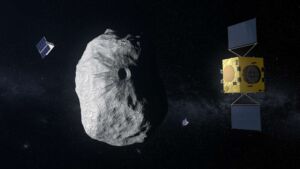
Getting close to a small, fast-moving asteroid isn’t a casual maneuver. In early October, Hera fired its thrusters twice — with a week between burns — to reduce its approach velocity to just 65 feet per second relative to the asteroids. That careful deceleration put the mission in position to actually study what it came to find.
Mission manager Ian Carnelli described the moment directly: “For the very first time we are seeing through Hera’s own eyes the very double asteroid system that the mission was designed and built for.”
Dimorphos is about 495 feet across, roughly the size of the Great Pyramid of Giza. Didymos, the larger body, spans approximately 2,559 feet. Dimorphos orbits its companion at a separation of just 0.7 miles, drifting at around 7 inches per second — a slow, quiet loop around a much bigger rock.
A crash-site investigation like no other
Hera isn’t just flying past for a quick look. Over the coming months, the spacecraft will conduct what ESA describes as a detailed “crash site investigation,” deploying a suite of scientific instruments to examine both asteroids and the space around them.
Two CubeSat satellites — each roughly the size of a shoebox — will be released to gather close-range observations the main spacecraft can’t collect on its own. These small probes can get nearer to the surface and return data from angles Hera itself won’t reach. Landing operations on the asteroid’s surface are also expected, giving scientists an unprecedented look at what a high-speed kinetic impact actually does to a small rocky body — from the inside out.
Why the answer matters for Earth’s future
Kinetic impact is currently the most viable method for deflecting an asteroid on a collision course with Earth. But “viable” and “reliable” aren’t the same thing, and the gap between those two words is exactly what Hera is trying to close.
If the deflection effect depends on variables like internal structure or surface composition, future missions will need to account for those factors before committing to a target. A strategy that works on one asteroid might underperform — or overperform — on another. That’s not a theoretical concern. It’s an engineering problem with real consequences.
Hera’s findings will directly shape how space agencies design future deflection missions. Dimorphos holds a unique distinction: it’s the first object in the Solar System whose orbit was measurably shifted by human action. Science now needs to fully understand how that happened — because the next time, the stakes may not be experimental.
Read the whole thing?
Get the week's signal, not the noise
Our sharpest reporting on energy, climate and nature — free, once a week.