A crane swings a pale concrete block over a narrow span laid across a working quarry floor.
Dust hangs in the air as the block settles into place next to a dozen others already stacked along the deck.
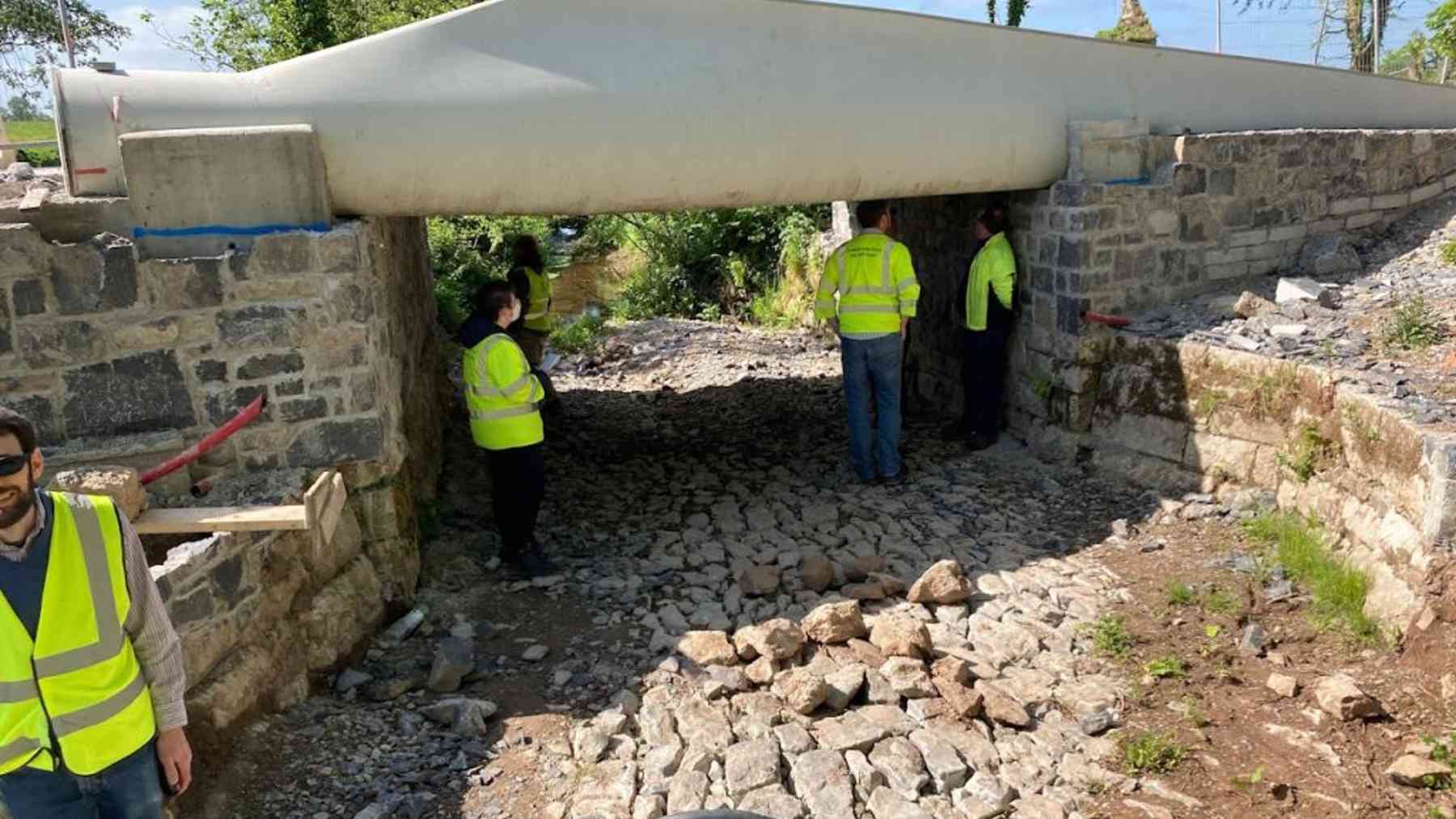
Underneath, two long curved white beams stretch from bank to bank, their surfaces scuffed and weathered.
They look nothing like steel or timber.
Someone keeps adding blocks, waiting for a crack that never comes.
What exactly are those beams hiding that lets them take this kind of punishment?
The fiberglass shell carries far more than its skin suggests
A wind turbine blade is built to flex constantly in strong gusts without snapping, which means its fiberglass skin is layered and reinforced in ways that never show from the outside. That same built in flexibility is what makes blades so hard to recycle through ordinary shredders, since the toughness that keeps them aloft also keeps them stubbornly intact once they come down.
It is also what lets a cut section behave like a strong, lightweight structural beam once it is turned on its side and set into a bridge frame. The internal layering that once resisted wind gusts resists bending loads just as well on the ground.
Researchers with the Re-Wind network, a group working across Ireland, Northern Ireland and the United States, built a short pedestrian bridge using two blade girders as its main supports. Then they brought in a crane and started stacking concrete blocks on the deck.
That turned a discarded piece of machinery into a measured engineering question.
Thirty-three tons of concrete moved the deck about a third of an inch
The span was loaded with 34 concrete blocks, lowered one at a time onto a deck about 23 feet long. At full load, which the team recorded as 33 metric tons or roughly 73,000 pounds, the middle of the bridge had sagged only nine millimeters, about a third of an inch, and the structure held.
That was not the expected ending. The bridge had been built in a quarry precisely so it could be destroyed, and the designers were worried that the steel bolts fixed through the blades would tear once real weight went on. Nothing tore.
Kenny McDonald, a technical manager at Queen’s University Belfast, which led the testing, put it plainly: “We kept loading these concrete blocks and we could not get the bridge to fail.” A colleague on the project compared the load the span absorbed to parking a 30 ton digger on a footbridge.
Millions of tons of blades are waiting for a second use like this one
The scale behind this one small bridge is enormous. Most of a wind turbine by weight, including the steel tower, the gearbox and generator assembly and the concrete base, already has established recycling routes, which leaves the composite blades as the stubborn exception. The Queen’s team estimates that around 8.6 million metric tons of blades, close to 9.5 million US tons, will be decommissioned worldwide by 2042.
Re-Wind has pushed the idea beyond footbridges, publishing designs that reuse blade sections as transmission poles, sound barriers, shelters and seawalls. The group treats the shape of a blade as raw architecture rather than waste, matching the curve and taper of a given blade to the job it can do.
None of that solves the full volume problem alone, but each project chips away at a material stream with nowhere established to go.
Old utility poles already gave birds a second home nearby
The bird connection here is not a stretch, because a very similar swap has already happened with other retired infrastructure. Decommissioned power poles from a Michigan transmission company went into two osprey nesting platforms along the Huron River in Ann Arbor, giving fish eating raptors a sturdy perch assembled from parts nobody wanted anymore.
That precedent matters for blade reuse too. A retired highway sign gantry follows the same pattern, with structures built for one job becoming load bearing parts of another long after their first service life ends. The same logic turns up in a square cut from a different retired blade, soaked in solvents to pull its glass fibers back out whole. The Re-Wind team’s own load test results are what first confirmed the structure could take this kind of punishment.
If blade sections can carry people across a stream, there is little reason they could not eventually carry a nest platform, a trail marker or a barn roof beam in rural America.
The idea still has real limits before it reaches your local park
Even with a strong test result, nobody is claiming every blade can become a bridge. Figuring out what to do with used blades remains a weak point in the rollout of wind power, and two experimental footbridges do not absorb the volume of blades now reaching retirement age.
Cutting, hauling and certifying blade sections for construction also costs money and engineering time that a landfill trench does not require. That cost is the same barrier facing other recovery methods built around blade material.
Even so, a beam that refused to break under 33 tons is a hopeful data point. The next bridge, or the next osprey platform built from scrap, may simply need a bigger number written into the plan.
Read the whole thing?
Get the week's signal, not the noise
Our sharpest reporting on energy, climate and nature — free, once a week.