Astronomers have spent decades cataloging the Milky Way’s neighborhood — and they’re still missing most of it. Perched on a mountaintop in the Chilean Andes, the newly operational Vera C. Rubin Observatory has barely begun its work. Yet in its very first sweep of the sky, covering a sliver of what it will eventually survey, the telescope surfaced something no one had seen before.
Two objects that had no business being missing
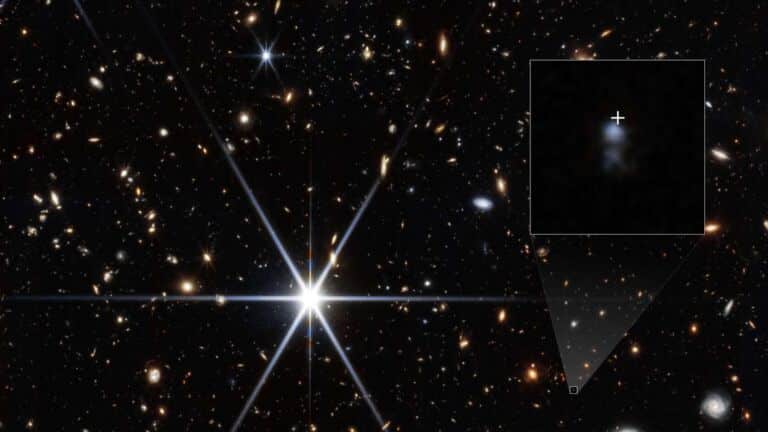
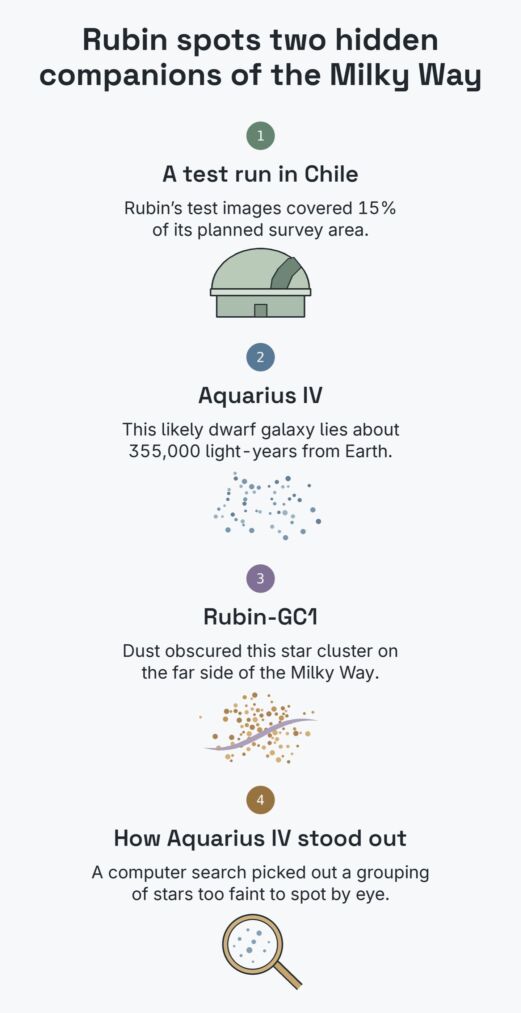
The first discovery is Aquarius IV — a tiny, ultra-faint dwarf galaxy sitting roughly 355,000 light-years from Earth, on the distant outskirts of the Milky Way. Extraordinarily dim, it contains so few stars that it had simply blended into the background of the night sky for all of recorded astronomical history.
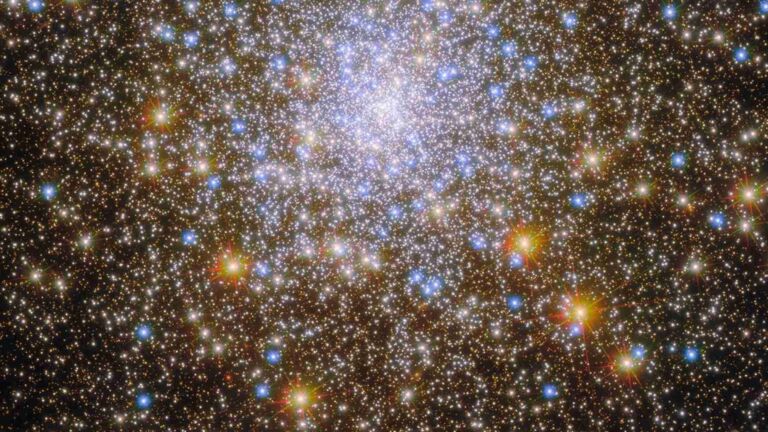
The second find is Rubin-GC1, a star cluster on the opposite side of the galaxy. Its obscurity had a specific culprit: thick clouds of cosmic dust that blocked the line of sight for previous surveys.
Both objects were identified using preview data collected before the observatory’s official launch — observations gathered between April 2025 and January 2026. The Aquarius IV discovery was published in Research Notes of the American Astronomical Society, while the Rubin-GC1 study was accepted by The Astrophysical Journal Letters.
A telescope built to see what others couldn’t
Rubin isn’t a conventional observatory. At its core is the 8.4-meter Simonyi Survey Telescope, paired with the largest digital camera ever built — a 3.2-gigapixel instrument capable of capturing enormous swaths of sky in extraordinary detail. That combination puts it in a category of its own.
In June 2026, the observatory formally began its 10-year Legacy Survey of Space and Time, known as LSST. The project will repeatedly photograph large portions of the Southern Hemisphere sky, building a sweeping, time-lapse record of the universe. One of its central goals is mapping the Milky Way’s halo — the vast, roughly spherical region surrounding the galaxy’s main disk, holding scattered stars, gas, dark matter, and faint satellite objects that carry ancient clues about the galaxy’s past.
The observatory is jointly funded by the National Science Foundation and the U.S. Department of Energy’s Office of Science.
Why the Milky Way’s satellites keep hiding from us
Satellite galaxies are smaller companions — dwarf galaxies and star clusters — that orbit larger galaxies like the Milky Way. They’re not rare in theory. Astronomers have confirmed roughly 65 of them around our galaxy, but estimates suggest hundreds more remain undetected.
The reason they’re so hard to find comes down to sheer faintness. These objects contain so few stars that they barely register against the noise of the background sky, and distinguishing a real satellite from a random scatter requires both sensitivity and patience. Rubin-GC1 added another layer of difficulty: dense dust lanes along the galactic plane absorbed and scattered light, effectively hiding the cluster from earlier surveys. Finding it required a telescope capable of pushing through that interference.
What faint galaxies can tell us about dark matter
Ultra-faint galaxies like Aquarius IV aren’t just curiosities — they’re scientific tools. Despite containing only a small fraction of the stars found in larger galaxies, dark matter dominates their total mass, making them some of the cleanest laboratories available for studying how dark matter actually behaves.
Researchers can test theoretical models by examining the motions and properties of these objects, probing how dark matter shapes galaxy formation at the smallest scales.
The satellites also function as records of the Milky Way’s own history, preserving information about how the galaxy accumulated matter and interacted with smaller systems over billions of years. William Cerny, lead author of the Aquarius IV study and a graduate student at Yale, framed the stakes clearly: “These new satellites will give us new opportunities to test models of galaxy formation, trace the assembly history of the Milky Way, and investigate the nature of dark matter.”
Hundreds more discoveries may be on the horizon
Two galaxies from 7% of the sky. That ratio is what makes astronomers cautious about predicting exactly what comes next — and quietly optimistic.
The preview observations that yielded Aquarius IV and Rubin-GC1 covered only a sliver of what the full LSST will eventually map. As the survey expands over the next decade, the number of detectable satellites could grow substantially. Marla Geha, professor of astronomy and physics at Yale and co-author on both studies, put it directly: “Continued discoveries will allow us to complete the census of satellite galaxies around the Milky Way, which is a key to understanding how the faintest galaxies form.”
The research drew on a wide international collaboration spanning institutions across the United States, Spain, Sweden, and Canada. That collective effort will only deepen as Rubin collects more data — and as the list of hidden companions grows longer.
Read the whole thing?
Get the week's signal, not the noise
Our sharpest reporting on energy, climate and nature — free, once a week.