When the James Webb Space Telescope began peering into the earliest chapters of cosmic history, astronomers expected to find galaxies still taking shape — dim, messy, and faint. Instead, Webb delivered something far harder to explain: strikingly bright, blue-tinted objects blazing with starlight in a universe less than a billion years old. They were too luminous, too orderly, and too “clean” to fit the standard models. Something about their past wasn’t adding up.
Webb’s dazzling puzzle: galaxies that shouldn’t exist
The James Webb Space Telescope wasn’t supposed to find galaxies like these. In the first few hundred million years after the Big Bang, the universe should have been a rough, chaotic place — hardly ideal for producing brilliant, well-organized star-forming systems. Yet Webb’s observations revealed exactly that: bright, blue galaxies radiating with an intensity that existing formation models simply couldn’t account for.
What made these objects especially puzzling was their apparent lack of dust. Dust is a natural byproduct of star formation, and early, rapidly star-forming galaxies should be wrapped in it. These galaxies looked almost pristine — “clean” in a way that contradicted what theorists expected, with no satisfying explanation for how such systems could appear so polished so early in cosmic time.
The mismatch was too large to ignore, pushing theorists to ask whether Webb might be catching these galaxies mid-story — at a bright, visible moment following an earlier, hidden chapter.
The ‘no blue without red’ principle
That hidden chapter is the central idea behind new research by Ferrara and colleagues, published in The Open Journal of Astrophysics. Their framework, titled “No Blue without Red,” proposes that every bright blue galaxy Webb has detected was preceded by a dust-shrouded “red” phase — one that optical and near-infrared instruments would have largely missed.
The sequence works like this: a young galaxy ignites a furious burst of star formation, but that activity is buried beneath thick clouds of dust produced by the first dying stars. During this red phase, the galaxy is faint or invisible in blue and ultraviolet light — it’s there, just hidden. Stellar winds and supernova explosions eventually carve through the dust, blowing it away, and only then does the galaxy emerge as the luminous blue object Webb can detect.
The title captures this elegantly: the brilliant blue phase doesn’t arise in isolation but is the product of a violent, obscured beginning.
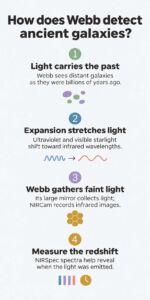
How dust shapes — and hides — the earliest star factories
The dust itself accumulates rapidly. In super-early galaxies, the primary source is core-collapse supernovae — the explosive deaths of the first massive stars — which seed surrounding gas with dust grains at a pace that can quickly build a thick, obscuring cocoon around the galaxy’s star-forming regions.
That cocoon absorbs ultraviolet light from young stars and re-emits it at infrared wavelengths, making dust-shrouded early galaxies effectively invisible to optical telescopes. Instruments like ALMA, designed to observe at millimeter and submillimeter wavelengths where that re-emitted energy peaks, are better positioned to catch them.
The red phase is short relative to the galaxy’s overall evolution — but brevity doesn’t diminish its importance. According to the model, this phase sets the conditions for everything that follows.
What the new model predicts — and what it explains
One of the framework’s strengths is that it doesn’t just explain the anomaly; it makes testable predictions. The model successfully reproduces the observed luminosity functions of super-early galaxies that Webb has catalogued, matching the number of bright objects seen at different luminosities.
It also explains why some early galaxies appear over-luminous relative to their inferred stellar mass. If caught mid-burst, just after dust clearance, their light output would temporarily exceed what you’d expect from their mass alone. Beyond that, the model predicts specific ratios of red-to-blue galaxy populations at high redshift — measurable targets for future surveys — and constrains how quickly early galaxies cycle between active star-formation bursts and quieter periods.
Finding the ‘missing’ red galaxies: the road ahead
The most direct test of this theory is finding the red galaxies it predicts. A population of heavily dust-obscured systems at very high redshift should exist; the model requires them. The challenge is that they’re designed, by nature, to be hard to see.
ALMA is currently the best tool for the job, capable of detecting the infrared glow that leaks through even thick dust shrouds. Webb’s own MIRI instrument, which operates at longer wavelengths than its other cameras, could also reveal heavily reddened candidates in future deep-field surveys.
If that hidden population is confirmed, the implications extend well beyond any individual galaxy. Current reconstructions of the universe’s early star-formation history would be missing a significant chapter — one written in dust and infrared light, invisible to the instruments that first revealed the blue galaxies blazing above it. Astronomers would need to revise not just their models, but their entire picture of how the first cosmic structures came to be.
Read the whole thing?
Get the week's signal, not the noise
Our sharpest reporting on energy, climate and nature — free, once a week.