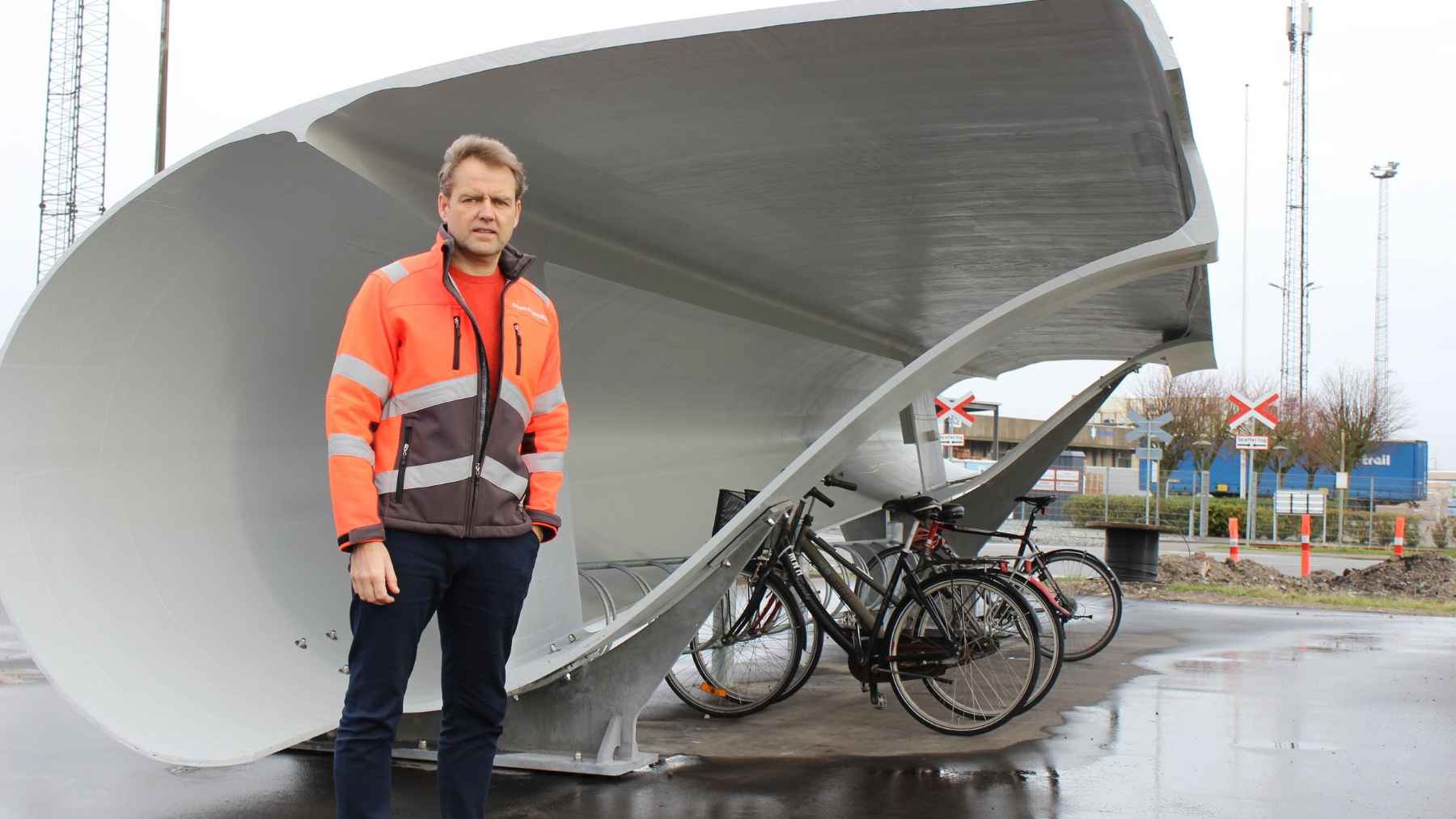
A sawn edge at head height, white and an inch thick, with a second wall down the middle of the hollow.
Bicycles underneath. Rain leaving the curve without pooling anywhere.
The thing over them tapers, thick at one end and thin at the other, wrong for a building and right for something built to spin.
It went up in 2019 and had come through its first winter by February 2020.
Nothing melted it down. Nothing can.
That is where this starts.
Eighty five percent of a turbine, and then the blade
Take a turbine apart and most of it is ordinary scrap. The tower is steel, the hub cast iron, the generator copper and magnet.
That is why the industry puts 85 to 90 percent of a turbine’s mass in the recyclable column.
The blade falls outside it, and the reason is chemistry rather than size. It is glass fiber in a cured thermoset resin, which does not soften when heated. It chars.
So the routes are shredding, burning and grinding. Each ends with a material worth less than what went in.
What survives all of that is the shape. A cut section is a hollow beam with an internal web down the center, built to hold loads no bicycle shelter will ever see.
Heat breaks the resin. It leaves the geometry.
Twenty two tons, minus the root end
The port sits next to one of the world’s largest blade factories, and that is where the blade came from.
A whole one of that size weighs about 22 tons. The port did not get a whole one.
The root end had already been committed to a test in Germany. What was left was the middle piece, which has the most usable length and the least taper.
Nobody handed over drawings. Blade makers do not release construction data, so the engineer had no load paths and no idea where the internal walls ran.
He built a model at home over a weekend out of cardboard and wood, then cut it apart until the proportions held.
A local smithy made the bearings it rests on and the tie downs that hold it against coastal wind. A diamond drilling firm cut away the rest.
No drawings came with it. The model was cardboard.
Nearly 5 tons of coal, from one model
The comparison everyone reaches for is the cement kiln, and it has real numbers.
An American blade program published them in December 2020. Shredded blade enters a kiln as fuel and raw material, standing in for coal, sand and clay.
Nearly 90 percent of the blade is reused by weight. More than 65 percent of that weight substitutes for raw materials, and about 28 percent supplies energy for the reaction inside the kiln.
A commissioned analysis put the result at a 27 percent net cut in carbon dioxide from cement production, with 13 percent less water.
The headline figure is per blade. One 7 ton blade, roughly 120 feet long, lets a kiln avoid nearly 5 tons of coal, 2.7 tons of silica and 1.9 tons of limestone.
Twenty eight percent supplies the heat. Sixty five percent replaces the rock.
Two tons burned, five tons credited
Now run the arithmetic on the fuel line, because that is where the figure turns interesting.
Twenty eight percent of a 7 ton blade is about 2 tons of material. The same blade is credited with avoiding nearly 5 tons of coal.
The published summaries do not show how those two numbers meet. The gap may rest on energy equivalence, on process assumptions, or on both.
That does not make the route false. The kiln line exists, it runs, and it takes blades today.
It does make the comparison softer than it reads, because a bicycle shelter and a kiln are not being measured on one scale.
A retired blade can also carry highway signs, as one Houston project showed.
Chemists have pulled fiber and resin building blocks back out of a solvent bath as well.
Two tons go in. Five tons come off the ledger.
Five blades in Rotterdam, one bridge in Cork
The shape route has a thin record, and it is worth stating accurately.
A Rotterdam playground was built from five retired blades across about 12,900 square feet, finished more than fifteen years ago.
Ireland has one blade bridge, not several. It opened in March 2024 near Midleton in County Cork and uses two 46 foot sections.
An Ohio maker sells benches, planters and picnic tables cut from blade sections for 3,500 to 9,500 dollars, putting a price where a disposal fee used to sit.
Against that, Europe retires somewhere near 22,000 to 28,000 short tons of blade a year, heading toward 60,000 by 2030, and the industry’s own landfill ban started in January 2026.
The Danish build is on record at a trade site.
The kiln percentages and the coal figure come from the recycler.
The chemistry stayed unsolved, and the shape kept working through seven winters.
Read the whole thing?
Get the week's signal, not the noise
Our sharpest reporting on energy, climate and nature — free, once a week.