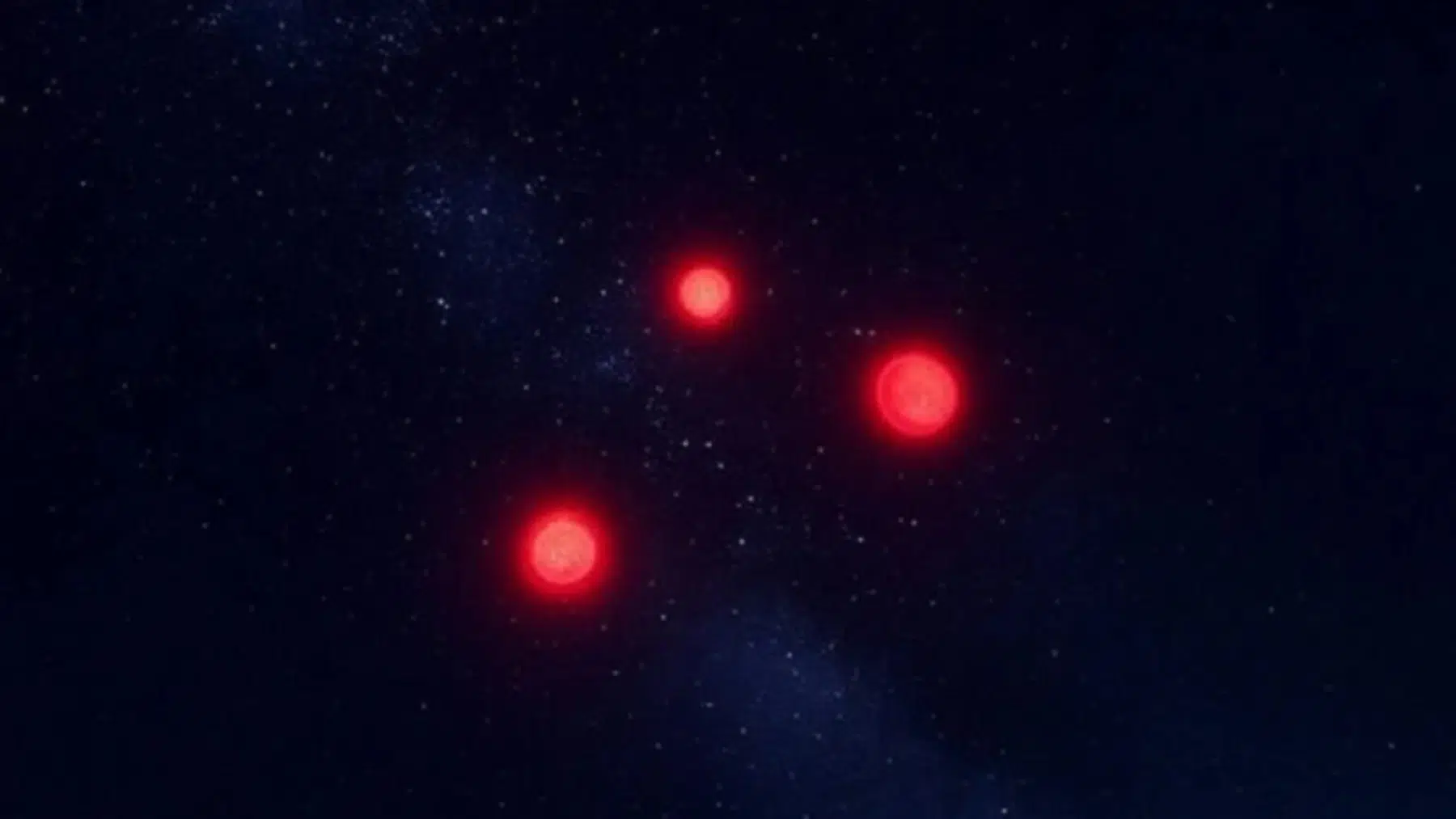
NASA’s James Webb Space Telescope has spotted three ‘red monsters’ that are challenging our understanding of physics. The JWST is one of the most advanced instruments ever built to explore the cosmos, delivering new discoveries from space on a regular basis. Currently, it orbits more than 1.5 million kilometers from Earth, well beyond our planet’s atmosphere, at the Sun-Earth L2 Lagrange point. NASA relies on cutting-edge technology to study the universe, and that’s exactly what helped reveal these surprising findings.
NASA spots ancient cosmic giants: older than the Milky Way
NASA doesn’t just monitor Earth-based observatories like the Vera C. Rubin Observatory; it can also send updates remotely to spacecraft operating far from Earth. One of the most intriguing discoveries from the James Webb Space Telescope in the early universe are objects scientists have nicknamed “little red dots”.
True to the name, these points are tiny — far smaller than our Milky Way — and emit a noticeable reddish glow. But the real puzzle for NASA astronomers is their unusual light patterns, which don’t match current explanations or experiences. This is something new, and astronomers are looking for more like these.
The dots formed soon after the Big Bang: over 13 billion years ago
NASA recently identified three massive galaxies from the universe’s earliest days using JWST — and they are unlike anything researchers predicted. Called the “red monsters,” these galaxies are enormous. Each one contains about 100 billion times the mass of our Sun, similar in size to the Milky Way, yet they formed when the universe was less than a billion years old.
This timing confuses scientists. Stars weren’t expected to form this quickly, and galaxies shouldn’t have grown so fast. Yet here they are, appearing far ahead of schedule and defying conventional rules. Even more striking is how efficiently these galaxies turned gas into stars. Usually, only about 20% of a galaxy’s gas becomes stars. But the red monsters? They converted up to 80% of their gas into bright, young stars, almost as if the universe pressed fast-forward.
How astronomers “look back in time” to find the three ancient galaxies
Researchers used JWST’s Near Infrared Camera (NIRCam) to detect the glow of these distant giants. The red color isn’t just aesthetic — it reflects how their light has stretched while traveling nearly 13 billion years across space. Now astronomers want a deeper look. Plans are in motion to observe them again with JWST and the ALMA telescope in Chile, hoping to understand how these galaxies formed so quickly.
Whatever the results, they’re likely to challenge textbooks. As one scientist put it, some galaxies didn’t just appear early — they matured fast. The international team behind this discovery includes over 30 astronomers from countries such as the U.S., Switzerland, Denmark, the U.K., France, the Netherlands, Japan, Australia, and Spain.
NASA can operate multiple telescopes at once: more power to search the cosmos
Using two powerful telescopes simultaneously has proven useful for exploring the universe. Previously, JWST and the Chandra X-ray Observatory detected signals timed at precise intervals toward Earth — leaving scientists puzzled about what could be sending repeating signals every 44 minutes. This wasn’t a common move, but after the success of this particular discovery, the space agency will be using multiple telescopes to search the cosmos and capture readings that one alone can’t handle.
Launched in December 2021, the James Webb remains the most powerful space telescope humanity has ever built, though the Vera C. Rubin Observatory in Chile’s Atacama Desert could soon expand our survey of the cosmos. Either way, JWST is expected to operate for decades, continuing to broaden our view of the universe. New tools will be created in the meantime, with JWST remaining one of the most remarkable observatories still active today.
Read the whole thing?
Get the week's signal, not the noise
Our sharpest reporting on energy, climate and nature — free, once a week.