For decades, the fix for a wind turbine standing in moving water has been the same blunt answer.
Dump rock around its feet.
Tons of quarried stone, piled high enough to keep the current from digging a pit at the base.
It works, mostly.
But a flat pile of broken rock is a poor home for almost anything that needs a crevice to hide in.
Off the Sussex coast last autumn, engineers tried something smaller and stranger instead.
Hollow shapes do a job loose rock cannot
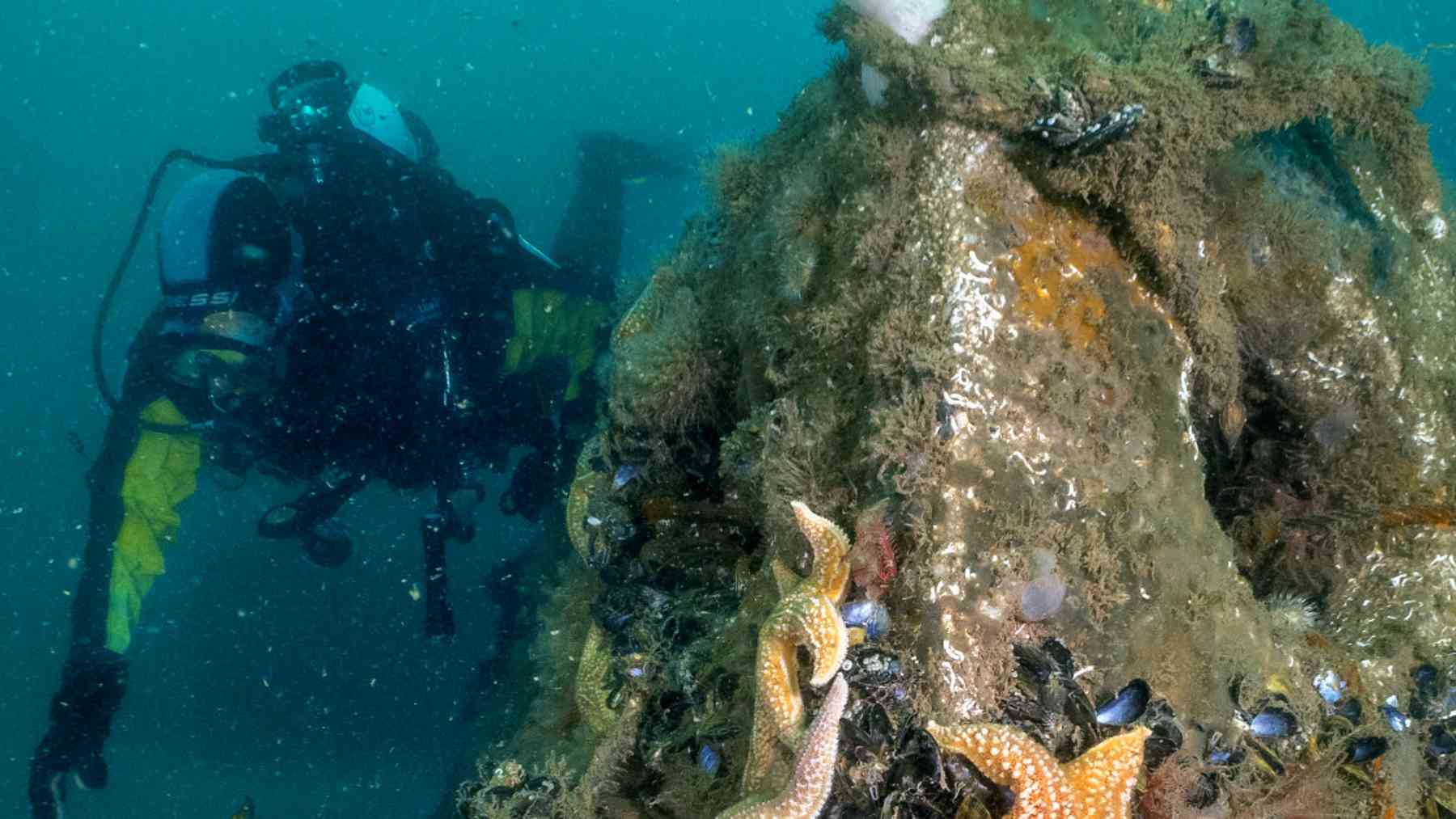
The replacement material is a record breaking concrete block called a Reef cube, cast with open voids so water and animals can pass through rather than only over it. Around one turbine at the Rampion offshore wind farm, crews lowered roughly 75,000 of these cubes, ranging from about 6 to 14 inches across, to do the same structural job as loose rock while leaving far more surface for life to grab onto.
Standard scour protection is layers of rock placed on the seabed around the base of a foundation, and the cubes are offered as an alternative meant to give equally effective protection from erosion while adding biodiversity. The cube design, by contrast with a random stone pile, is engineered on purpose, with rough textured faces and crevices. The blocks come in two sizes and are built to attract species such as seabass, brown crab and starfish.
So the cubes are not decoration bolted onto an engineering solution. They are the engineering solution, just shaped differently than the rock that came before them.
Six named storms later, the seabed holds its shape
Picture a turbine leg rising out of the English Channel, its base ringed by what from a boat would look like gravel but up close is a field of chunky, holed concrete blocks stacked loosely across the seabed. That is turbine J04 at Rampion, which sits between 13 and 20 kilometers, roughly 8 to 12 miles, off the Sussex coast.
Then came winter. The Reef cube scour protection system withstood six named storms in its first winter, with survey data confirming the full scale installation maintained its designed profile and continued protecting the turbine foundation from seabed scour.
That is the blunt engineering test a new material has to pass before anyone cares what moves into it. The bathymetric record, essentially sonar maps of the seafloor shape, shows a cube field that has not slumped or washed thin. The blocks stayed roughly where they were dropped.
One turbine base gained about 6 acres of extra surface
The hard numbers behind the swap matter as much as the storms. Tom Birbeck, CEO of ARC marine, called the project a “landmark moment” for the technology, saying the patented shape and optimised texture give the cubes “over 100% more volume of habitat spaces than standard rock protection and 38% more surface area.”
At that single turbine, the cubes provide a habitat surface area of about 270,000 square feet, or roughly 6 acres of textured surface where a plain pile of rock would otherwise sit. That scale is why the project is described as a full scale deployment rather than a lab trial.
The cubes went in during October 2025, installed by RWE with ARC marine in what the Rampion owner calls a “global first.” J04 was picked because it showed a developing scour pit of six to ten feet of seabed already gone.
Five more years of surveys will test the claim
None of this proves the cubes beat rock for good. One winter of storms is a start, not a verdict. The real ecological payoff, more fish, more shellfish, a denser food web clinging to the turbine’s feet, takes years to show up in survey data rather than months.
That is why the next phase matters more than the first. Ecological and geophysical surveys are planned between 2026 and 2030 to assess the cubes’ performance and to study how marine life interacts with the structures over time, monitoring built to answer whether this becomes a stable artificial reef.
Offshore foundations elsewhere have already shown that even plain steel and rock can turn bare seabed into something closer to a reef, the kind of accidental habitat that appears wherever a hard surface meets open water. It is the same unplanned growth found on a tidal rotor pulled from New York’s East River. The Rampion pilot asks a sharper question, whether shaping that hard surface on purpose changes how much life actually moves in, the same logic now being tested with wildlife corridors built into solar sites on land.
What a crab finds when the rock gets smarter
So far the signal is modest but real. A new shape held its ground through a hard winter, and the habitat math on paper looks better than rock can manage. Whether that translates into more crabs, more starfish and more fish fry is still an open question, because the ecological surveys that would show it have not reported yet.
The monitoring data due over the next few years should start to answer it honestly.
What is already clear is smaller and more durable than any single survey number. A block built with a hole through it did a job rock has done for decades, and did it while leaving room for something to live inside the answer.
Read the whole thing?
Get the week's signal, not the noise
Our sharpest reporting on energy, climate and nature — free, once a week.