The sonar trace on a French Navy support ship matched nothing on the charts.
It was early March, and the crew was not hunting for history.
They were surveying the seabed off Ramatuelle, near Saint-Tropez.
Then the shape on the display refused to resolve into anything familiar.
A camera went down first, then a robot.
What came back would turn out to be the deepest wreck ever documented in French waters.
A routine seabed sweep turned up a ship nobody expected
The find came out of a military mission, not a search for shipwrecks. Officials said the wreck was discovered unexpectedly during an exploratory mission conducted as part of the ministerial strategy for mastering the seabed. The survey was run by the Navy’s expert center for human diving and underwater intervention, CEPHISMER, working off the coast of Ramatuelle near Saint-Tropez.
Sonar flagged something unusually large more than 8,400 feet down, far below the reach of divers and most crewed submersibles. So the team went back with a camera, then with a remotely operated vehicle built for the pressure at that depth.
The deputy maritime prefect described it simply: “The sonar detected something quite big, so we went back with the device’s camera.”
The images showed a hull about 98 feet long and 23 feet wide, indicating a large vessel. That alone made it notable. What sat beside the wreck, undisturbed in the dark, is the detail that would not stop traveling once the photographs went public.
A cargo of 200 jugs sat untouched beside a modern can
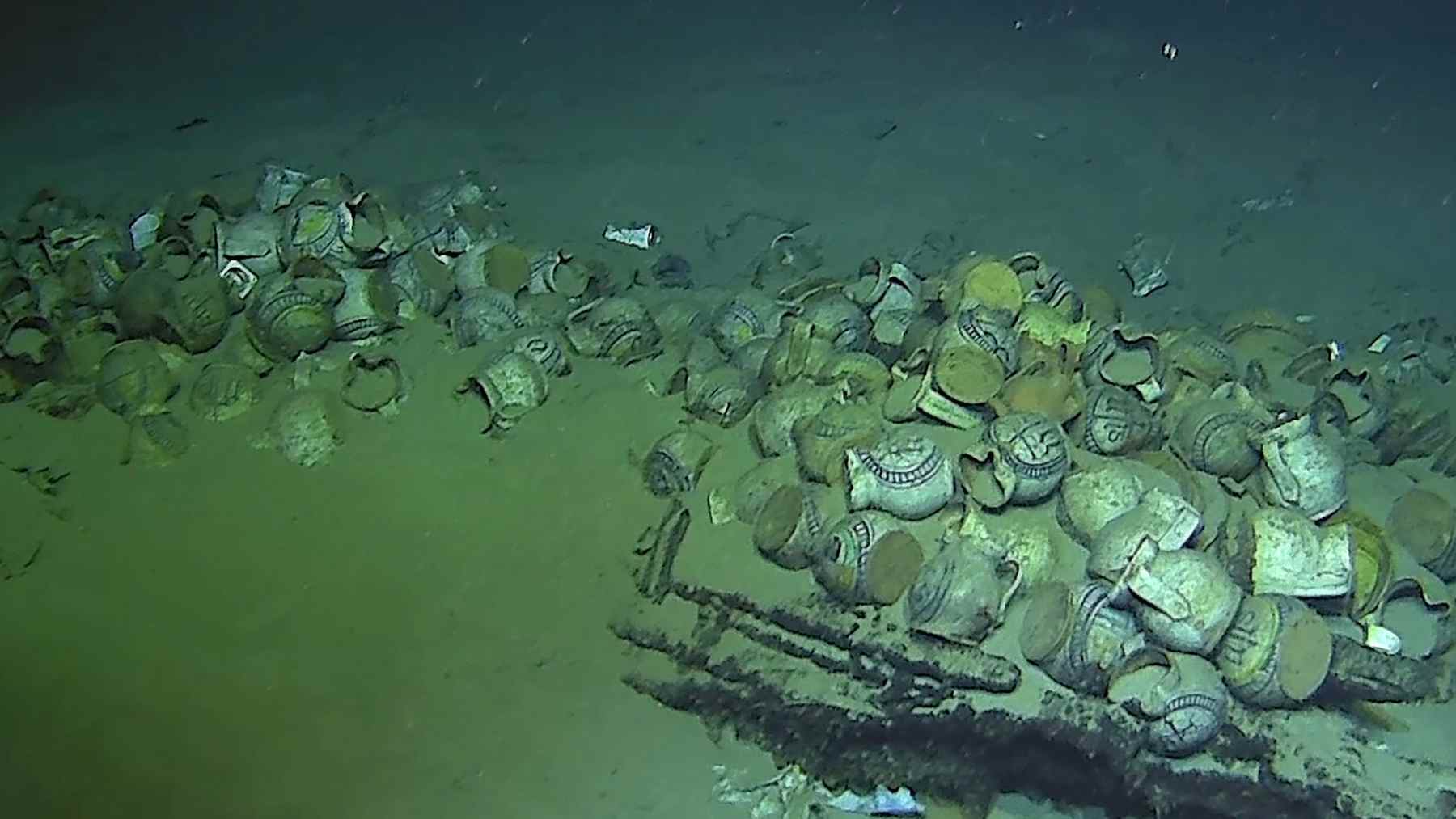
Archaeologists who reviewed the footage catalogued the cargo first. Roughly 200 polychrome faience pitchers were visible, with many more apparently trapped under sediment, their globular shapes, pinched spouts and ribbon handles typical of sixteenth century Ligurian production and decorated with the Christ monogram “IHS” and vegetal and geometric motifs. Also present were an anchor, six iron cannons, about a hundred stacked yellow plates and two overturned cauldrons.
The site was named Camarat 4 under the naming convention of France’s underwater archaeology department, marking the fourth maritime cultural asset inventoried in that sector, near the nearby cape. Archaeologists believe the ship was sailing from northern Italy loaded with ceramics and metal bars before it sank.
Threaded through those centuries old artifacts, the cameras picked out something that should not have been there at all. Alongside the plates, cauldrons, anchor and cannons, the team also recorded modern waste, including a soda can and an empty yogurt pot. The site is scattered with modern macro litter, plastic bottles, cans and fishing nets, mixed among the archaeological remains. One released photograph shows a can lying beside an anchor that has sat on the Mediterranean floor for five centuries.
A record that had stood since a submarine was found off Toulon
Before this find, the deepest sunken vessel French authorities had located lay about 1.4 miles under sea level off the southern city of Toulon, found in 2019: the submarine La Minerve, lost decades earlier. Camarat 4 lies several hundred feet deeper, at 8,422 feet, and officials call it the deepest wreck ever recorded in waters under French jurisdiction.
That measurement matters because the depth sits at the edge of what archaeological equipment can reach. France’s underwater archaeology department operates three ROVs capable of documenting a site in detail, and the deepest of them can work only to about 8,200 feet, short of the wreck by a stretch, which is why the return visit needed borrowed hardware.
Darkness and pressure kept the hull intact for 500 years
Depth has done the preserving here. Officials say the wreck has remained untouched by recovery efforts and, at that depth, has been protected from degradation, including plundering. A marine archaeologist on the team called the wreck “frozen in time,” its depth keeping it almost perfectly intact.
The same conditions that keep the wreck beyond the reach of looters also hold the modern trash in place. There is no salvage crew to clear it.
No current is strong enough to sweep it away either. The can may well outlast the pottery sitting next to it, a strange kind of permanence shared between a merchant ship and a piece of litter.
A three day return dive followed the first sonar hit
Researchers have gone back. From April 6 to 8 the following year, during the seabed operation Calliope 26.1, Navy teams and archaeologists returned to the site off Ramatuelle with a commercial remotely operated vehicle able to work down to about 13,100 feet, deployed from the support vessel Jason. Four objects were brought up.
One of the recovered ceramic jugs was examined in the Marseille laboratory, where the archaeologist leading the operation described it as among the most deeply recovered objects from a French wreck. The wreck itself stays where it is, which the Navy says follows UNESCO conservation guidance.
A similar reliance on remote sensors and careful signal reading, the kind used to trace a hidden network of faults far beneath the surface, is what let the team document the wreck without ever going down themselves. None of the recovered items answer the biggest open question, which is how and why the ship went down.
That piece of the story may never surface, well over a mile beneath the waves. What the mission has already shown is smaller but just as striking.
Even seafloor this far from anyone is not untouched, and a cheap can can end up part of the record beside a cannon. A routine mission surveying the seabed rewrote a record book instead. The details of the discovery are set out in the naval prefecture’s statement, with the earlier record reported by AFP.
Read the whole thing?
Get the week's signal, not the noise
Our sharpest reporting on energy, climate and nature — free, once a week.